




A parallel beam of light strikes a piece of transparent glass having a cross section as shown in the figure below. Correct shape of the emergent wavefront will be(figures are schematic and not drawn to scale)
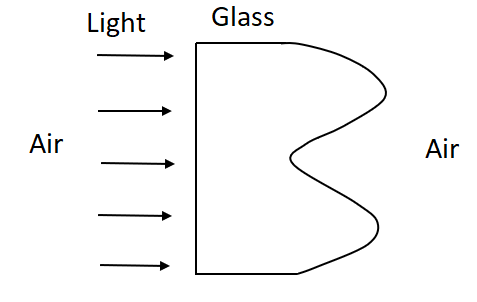
A. 
B. 
C. 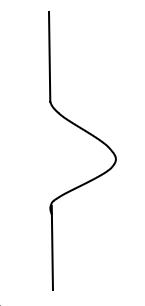
D. 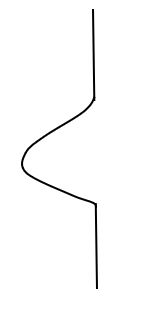
Answer
 Verified
249.3k+ views
Hint: Here we use the concept of Huygens principle. According to the theory of wavefront waves move in such a way that direction of propagation is perpendicular to the wavefront. In every point on a wavefront is the source of spherical wavelets which spread out in the forward direction with the speed of light. The sum of these spherical wavelets can form the wavefront.
Complete step by step solution:
As we know that the rays of light will travel more in air than glass medium. If the glass medium is greater than the wavefront will be slack. Hence the shape of the emergent wavefront will be the figure given as,

Hence option A is the correct answer.
Note: According to Huygens principle the light is the form of wave that propagates through space like ripples form in the water or sound in air. Therefore, the light spread out like a wave in all the directions from a source. The locus of points that travel some distance in a fixed time interval is known as a wavefront. Hence from a point source of light, the locus of points is a sphere that light has travelled during a fixed time period. The concepts of diffraction of light, interference of light, etc all are proved by Huygens principle.
Complete step by step solution:
As we know that the rays of light will travel more in air than glass medium. If the glass medium is greater than the wavefront will be slack. Hence the shape of the emergent wavefront will be the figure given as,
Hence option A is the correct answer.
Note: According to Huygens principle the light is the form of wave that propagates through space like ripples form in the water or sound in air. Therefore, the light spread out like a wave in all the directions from a source. The locus of points that travel some distance in a fixed time interval is known as a wavefront. Hence from a point source of light, the locus of points is a sphere that light has travelled during a fixed time period. The concepts of diffraction of light, interference of light, etc all are proved by Huygens principle.
Recently Updated Pages
JEE Isolation, Preparation and Properties of Non-metals Important Concepts and Tips for Exam Preparation

Isoelectronic Definition in Chemistry: Meaning, Examples & Trends
Ionisation Energy and Ionisation Potential Explained
Iodoform Reactions - Important Concepts and Tips for JEE
Introduction to Dimensions: Understanding the Basics
Instantaneous Velocity Explained: Formula, Examples & Graphs
Trending doubts
JEE Main 2026: Exam Dates, Session 2 Updates, City Slip, Admit Card & Latest News
Hybridisation in Chemistry – Concept, Types & Applications
JEE Main 2026 Application Login: Direct Link, Registration, Form Fill, and Steps
Understanding the Electric Field of a Uniformly Charged Ring
Derivation of Equation of Trajectory Explained for Students
JEE Main Marking Scheme 2026- Paper-Wise Marks Distribution and Negative Marking Details
Other Pages
CBSE Class 12 Physics Question Paper 2026: Download SET-wise PDF with Answer Key & Analysis
JEE Advanced Marks vs Ranks 2025: Understanding Category-wise Qualifying Marks and Previous Year Cut-offs
JEE Advanced 2026 - Exam Date (Released), Syllabus, Registration, Eligibility, Preparation, and More
JEE Advanced Weightage 2025 Chapter-Wise for Physics, Maths and Chemistry
Understanding the Angle of Deviation in a Prism
Understanding Centrifugal Force in Physics