




A man places a rectangular glass slab of thickness $9cm$ on a newspaper. On the top of glass slab he placed a glass beaker of negligible wall thickness containing water up to a height of $6cm$ . if refractive index of glass is $1.5$ and refractive index of water is $\left( {\dfrac{4}{3}} \right)$ , what is the apparent depth of the newspaper?
Answer
 Verified
263.7k+ views
Hint: We can solve this question in two parts first we take lower medium after refraction the image formed will work as an object for upper medium then we take upper medium and find the apparent depth due to this medium that will be the final apparent depth.
Complete step by step solution:
In diagram the arrangement shown
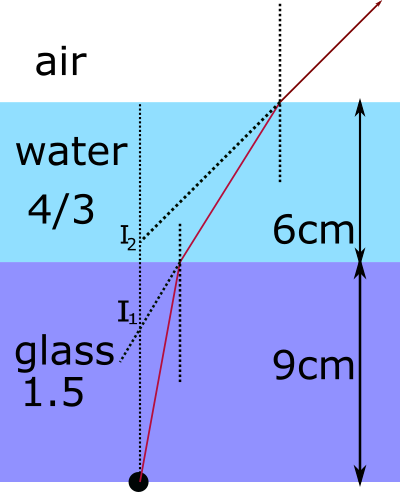
Step 1
First we take refraction from glass slab when see from water then apparent depth from upper end of glass slab can be calculated as
We know the apparent depth given by $AD = \dfrac{d}{{_r{n_d}}}$
Where $_r{n_d}$ is the refractive index of denser medium with respect to rare medium
$ \Rightarrow A{D_1} = \dfrac{9}{{_w{n_g}}}$
We know
$_w{n_g} = \dfrac{{_a{n_g}}}{{_a{n_w}}}$
So refractive index of glass with respect to water
$_w{n_g} = \dfrac{{\dfrac{3}{2}}}{{\dfrac{4}{3}}}$
$_w{n_g} = \dfrac{9}{8}$
So apparent depth
$ \Rightarrow A{D_1} = \dfrac{9}{{\dfrac{9}{8}}}$
$A{D_1} = 8cm$
Image formed at $8cm$ below upper end of glass slab this work as image for water
Step 2
Now we take refraction from water air surface
For this the real depth = height of water + AD1
Real depth = $\left( {6 + 8} \right) = 14cm$
Apply formula for apparent depth
$ \Rightarrow A{D_2} = \dfrac{{14}}{{_a{n_w}}}$
$ \Rightarrow A{D_1} = \dfrac{{14}}{{\dfrac{4}{3}}}$
Solving this
$ \Rightarrow A{D_2} = \dfrac{{21}}{2}cm$ from upper end of water surface
So the apparent depth due to system of both medium is $\left( {\dfrac{{21}}{2}} \right)cm$ when see from air
So the apparent depth of newspaper is $\left( {\dfrac{{21}}{2}} \right)cm.$
Note: By this method we can solve these types of questions we can also solve this question by another method:
We have direct formula for apparent depth if refractive index of medium ${n_1},{n_2}$ with respect to air and depth of medium is ${d_1},{d_2}$ then
$ \Rightarrow AD = \dfrac{{{d_1}}}{{{n_1}}} + \dfrac{{{d_2}}}{{{n_2}}}$
$ \Rightarrow AD = \dfrac{9}{{\dfrac{3}{2}}} + \dfrac{6}{{\dfrac{4}{3}}}$
Solving this
$
\Rightarrow AD = 6 + \dfrac{9}{2} \\
AD = \dfrac{{21}}{2}cm \\ $
Complete step by step solution:
In diagram the arrangement shown
Step 1
First we take refraction from glass slab when see from water then apparent depth from upper end of glass slab can be calculated as
We know the apparent depth given by $AD = \dfrac{d}{{_r{n_d}}}$
Where $_r{n_d}$ is the refractive index of denser medium with respect to rare medium
$ \Rightarrow A{D_1} = \dfrac{9}{{_w{n_g}}}$
We know
$_w{n_g} = \dfrac{{_a{n_g}}}{{_a{n_w}}}$
So refractive index of glass with respect to water
$_w{n_g} = \dfrac{{\dfrac{3}{2}}}{{\dfrac{4}{3}}}$
$_w{n_g} = \dfrac{9}{8}$
So apparent depth
$ \Rightarrow A{D_1} = \dfrac{9}{{\dfrac{9}{8}}}$
$A{D_1} = 8cm$
Image formed at $8cm$ below upper end of glass slab this work as image for water
Step 2
Now we take refraction from water air surface
For this the real depth = height of water + AD1
Real depth = $\left( {6 + 8} \right) = 14cm$
Apply formula for apparent depth
$ \Rightarrow A{D_2} = \dfrac{{14}}{{_a{n_w}}}$
$ \Rightarrow A{D_1} = \dfrac{{14}}{{\dfrac{4}{3}}}$
Solving this
$ \Rightarrow A{D_2} = \dfrac{{21}}{2}cm$ from upper end of water surface
So the apparent depth due to system of both medium is $\left( {\dfrac{{21}}{2}} \right)cm$ when see from air
So the apparent depth of newspaper is $\left( {\dfrac{{21}}{2}} \right)cm.$
Note: By this method we can solve these types of questions we can also solve this question by another method:
We have direct formula for apparent depth if refractive index of medium ${n_1},{n_2}$ with respect to air and depth of medium is ${d_1},{d_2}$ then
$ \Rightarrow AD = \dfrac{{{d_1}}}{{{n_1}}} + \dfrac{{{d_2}}}{{{n_2}}}$
$ \Rightarrow AD = \dfrac{9}{{\dfrac{3}{2}}} + \dfrac{6}{{\dfrac{4}{3}}}$
Solving this
$
\Rightarrow AD = 6 + \dfrac{9}{2} \\
AD = \dfrac{{21}}{2}cm \\ $
Recently Updated Pages
JEE Main 2025-26 Experimental Skills Mock Test – Free Practice

JEE Main 2025-26 Electronic Devices Mock Test: Free Practice Online
JEE Main 2025-26 Mock Tests: Free Practice Papers & Solutions
JEE Main 2025-26: Magnetic Effects of Current & Magnetism Mock Test
JEE Main 2025-26 Atoms and Nuclei Mock Test – Free Practice Online
JEE Main Mock Test 2025-26: Experimental Skills Chapter Online Practice
Trending doubts
JEE Main 2026: Exam Dates, Session 2 Updates, City Slip, Admit Card & Latest News
JEE Main Participating Colleges 2026 - A Complete List of Top Colleges
Kinematics Mock Test for JEE Main 2025-26: Comprehensive Practice
Kinematics Mock Test for JEE Main 2025-26: Practice & Ace the Exam
Hybridisation in Chemistry – Concept, Types & Applications
Understanding the Electric Field of a Uniformly Charged Ring
Other Pages
CBSE Class 12 Physics Question Paper 2026: Download SET-wise PDF with Answer Key & Analysis
JEE Advanced 2026 Notification Out with Exam Date, Registration (Extended), Syllabus and More
JEE Advanced Percentile vs Marks 2026: JEE Main Cutoff, AIR & IIT Admission Guide
JEE Advanced Weightage Chapter Wise 2026 for Physics, Chemistry, and Mathematics
JEE Advanced Marks vs Rank 2025 - Predict Your IIT Rank Based on Score
Derivation of Equation of Trajectory Explained for Students