




A loop made of straight edges has six corners at A (0, 0, 0), B (L, 0, 0), C(L, L, 0), D (0, L, 0), E (0, L, L) And F (0, 0, L). A magnetic field $\overrightarrow B = B_0 (\widehat{i}+ \widehat{k})T$ is present in the region. The flux passing through the loop ABCDEFA (in the order ) is:
A) \[{B_0}{L^2}Wb\]
B) \[2{B_0}{L^2}Wb\]
C) \[\sqrt 2 {B_0}{L^2}Wb\]
D) \[4{B_0}{L^2}Wb\]
Answer
 Verified
276.6k+ views
Hint: The number of magnetic field lines passing through the given closed surface is called Magnetic flux. It is denoted by $\phi $ and the unit is Weber. The magnetic flux indicates the strength of magnetic lines that are produced by a magnet.
Complete step by step solution:
Let say L=1 the diagram will be like:
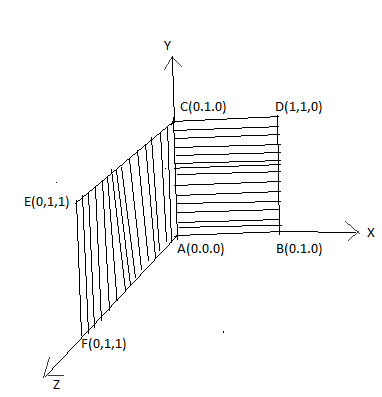
Given six corners are A (0, 0, 0), B (L, 0, 0), c (L, L, 0), D (0, L, 0), E (0, L, L) and F (0, 0, L).
Magnetic field, \[\overrightarrow B = {B_0}\left( {\widehat i + \widehat k} \right)T\]
Magnetic flux =?
The area vector of ABCD $ = {L^2}\widehat k$
The area vector of DEFA $ = {L^2}\widehat i$
Thus total area vector, \[\overrightarrow A = {L^2}\left( {\widehat i + \widehat k} \right)\]
We know that magnetic flux is given by the formula, $\phi = \overrightarrow B .\overrightarrow A $
Substituting the values of \[\overrightarrow B\] and \[\overrightarrow A \], we get,
\[\phi = {B_0}\left( {\widehat i + \widehat k} \right).{L^2}\left( {\widehat i + \widehat k} \right)\]
\[ \Rightarrow \phi = {B_0}{L^2}\left( {1 + 1} \right) = 2{B_0}{L^2}Wb\]
Thus the total magnetic flux, \[\phi = 2{B_0}{L^2}Wb\]
Hence the correct option is B.
Note: 1. The magnetic flux in the open surface is not zero and through a closed surface is zero always. It always forms a closed loop. The magnetic flux depends on the area and the magnetic strength of the magnet.
2. Magnetic flux starts from the north pole and ends at the south pole and they will never intersect each other. The lines of forces that are parallel to each other and in the same direction will repel each other.
3. The region around a magnet where the moving charge experiences a force is called a magnetic field. It depends on the magnet.
4. A closed path in a circuit is called a loop. It is used for executing a set of statements repeatedly, till a particular condition is satisfied.
Complete step by step solution:
Let say L=1 the diagram will be like:
Given six corners are A (0, 0, 0), B (L, 0, 0), c (L, L, 0), D (0, L, 0), E (0, L, L) and F (0, 0, L).
Magnetic field, \[\overrightarrow B = {B_0}\left( {\widehat i + \widehat k} \right)T\]
Magnetic flux =?
The area vector of ABCD $ = {L^2}\widehat k$
The area vector of DEFA $ = {L^2}\widehat i$
Thus total area vector, \[\overrightarrow A = {L^2}\left( {\widehat i + \widehat k} \right)\]
We know that magnetic flux is given by the formula, $\phi = \overrightarrow B .\overrightarrow A $
Substituting the values of \[\overrightarrow B\] and \[\overrightarrow A \], we get,
\[\phi = {B_0}\left( {\widehat i + \widehat k} \right).{L^2}\left( {\widehat i + \widehat k} \right)\]
\[ \Rightarrow \phi = {B_0}{L^2}\left( {1 + 1} \right) = 2{B_0}{L^2}Wb\]
Thus the total magnetic flux, \[\phi = 2{B_0}{L^2}Wb\]
Hence the correct option is B.
Note: 1. The magnetic flux in the open surface is not zero and through a closed surface is zero always. It always forms a closed loop. The magnetic flux depends on the area and the magnetic strength of the magnet.
2. Magnetic flux starts from the north pole and ends at the south pole and they will never intersect each other. The lines of forces that are parallel to each other and in the same direction will repel each other.
3. The region around a magnet where the moving charge experiences a force is called a magnetic field. It depends on the magnet.
4. A closed path in a circuit is called a loop. It is used for executing a set of statements repeatedly, till a particular condition is satisfied.
Recently Updated Pages
With which part the mRNA should be bound to initiate class 12 biology JEE_Main

Which one of the following is an example of a biofertiliser class 12 biology JEE_Main
A straight line goes through the points pq and rs -class-11-mathematics-JEE_Main
Which of the following protein destroys the antigen class 12 biology JEE_Main
Which of the following scientists discovered the Pasteurization class 11 biology JEE_Main
Explain the experiment of Julius von Sachs class 11 biology JEE_Main
Trending doubts
JEE Main 2026: Exam Dates, Session 2 Updates, City Slip, Admit Card & Latest News
Understanding the Electric Field of a Uniformly Charged Ring
Derivation of Equation of Trajectory Explained for Students
How to Convert a Galvanometer into an Ammeter or Voltmeter
Understanding Uniform Acceleration in Physics
Understanding Combined Translation and Rotational Motion
Other Pages
CBSE Class 12 Physics Question Paper 2026: Download SET-wise PDF with Answer Key & Analysis
JEE Advanced 2026 Notification Out with Exam Date, Registration (Extended), Syllabus and More
JEE Advanced Percentile vs Marks 2026: JEE Main Cutoff, AIR & IIT Admission Guide
JEE Advanced Weightage Chapter Wise 2026 for Physics, Chemistry, and Mathematics
Class 12 Physics Formulas: Complete Chapter-wise PDF Guide
Understanding Instantaneous Velocity