




A liquid if filled into a semi elliptical cross section with a semi major axis and b as a semi minor axis. The ratio of surface tension forces on the curved part and the plane part of tube in vertical position will be:
A) $\dfrac{{\pi \left( {a + b} \right)}}{{4b}}$
B) $\dfrac{{2\pi A}}{b}$
C) $\dfrac{{\pi A}}{{4b}}$
D) $\dfrac{{\pi \left( {a - b} \right)}}{{4b}}$
Answer
 Verified
246k+ views
Hint: The surface or curved tension force f is equal to the product of the tension along it and the perimeter of that part. We will find both the forces along the curved and flat surface and then their ratio will be our solution.
Complete step by step answer:
Step 1:
We are given:
A liquid if filled into a semi elliptical cross section with a as semi major axis and b as semi minor axis.
And we need to find the ratio of surface tension forces on the curved part and the plane part of tube in vertical position.
Now, coming to the solution:
To clearly understand the language of question and way to solution let us consider a diagram below;
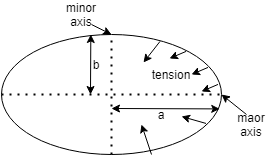
We have an elliptical tube having a as a semi major axis and b as a semi minor axis of it.
In semi-elliptical we can have two cases: either along semi major axis or along semi minor axis
Let us take along the minor axis as shown in the figure.
Step 2:
In figure the arrows on the semi minor axis are depicting the surface tension force.
Then force on the minor axis will be${f_M}$ =the product of tension and length of the minor axis
This implies${f_M}$ =T × 2b
Force on the curved part will be ${f_C}$ =the product of tension and half the perimeter of semi ellipse which is $\dfrac{{\pi \left( {a + b} \right)}}{2}$
This implies ${f_C}$ =T × $\dfrac{{\pi \left( {a + b} \right)}}{2}$
Now, the ratio of surface tension forces on the curved part and the plane part of tube in vertical position will be $\dfrac{{{f_C}}}{{{f_M}}}$ =$\dfrac{{\pi \left( {a + b} \right)}}{2} \times \dfrac{1}{{2b}}$
On further solving this will ultimately equal to $\dfrac{{{f_C}}}{{{f_M}}}$ =$\dfrac{{\pi \left( {a + b} \right)}}{{4b}}$
This means the ratio of surface tension forces on the curved part and the plane part of tube in vertical position will be$\dfrac{{\pi \left( {a + b} \right)}}{{4b}}$
Hence option A is correct.
Note: Every time while doing such a question it is important to make diagrams wherever it is possible because diagrams give us a clear vision of finding the solution like in this question we have found out the ration by taking the minor axis and the curve along it.
Complete step by step answer:
Step 1:
We are given:
A liquid if filled into a semi elliptical cross section with a as semi major axis and b as semi minor axis.
And we need to find the ratio of surface tension forces on the curved part and the plane part of tube in vertical position.
Now, coming to the solution:
To clearly understand the language of question and way to solution let us consider a diagram below;
We have an elliptical tube having a as a semi major axis and b as a semi minor axis of it.
In semi-elliptical we can have two cases: either along semi major axis or along semi minor axis
Let us take along the minor axis as shown in the figure.
Step 2:
In figure the arrows on the semi minor axis are depicting the surface tension force.
Then force on the minor axis will be${f_M}$ =the product of tension and length of the minor axis
This implies${f_M}$ =T × 2b
Force on the curved part will be ${f_C}$ =the product of tension and half the perimeter of semi ellipse which is $\dfrac{{\pi \left( {a + b} \right)}}{2}$
This implies ${f_C}$ =T × $\dfrac{{\pi \left( {a + b} \right)}}{2}$
Now, the ratio of surface tension forces on the curved part and the plane part of tube in vertical position will be $\dfrac{{{f_C}}}{{{f_M}}}$ =$\dfrac{{\pi \left( {a + b} \right)}}{2} \times \dfrac{1}{{2b}}$
On further solving this will ultimately equal to $\dfrac{{{f_C}}}{{{f_M}}}$ =$\dfrac{{\pi \left( {a + b} \right)}}{{4b}}$
This means the ratio of surface tension forces on the curved part and the plane part of tube in vertical position will be$\dfrac{{\pi \left( {a + b} \right)}}{{4b}}$
Hence option A is correct.
Note: Every time while doing such a question it is important to make diagrams wherever it is possible because diagrams give us a clear vision of finding the solution like in this question we have found out the ration by taking the minor axis and the curve along it.
Recently Updated Pages
JEE Main 2026 Exam Events - Dates Announced, Application Form, Admit Card, Result

JEE Main 2026 Session 2 City Intimation Slip Out Now: Here's Your Direct Download Link
Internet data is broken up as A Length packets B Variable class 12 physics JEE_Main
A plastic hemisphere has a radius of curvature of 8 class 12 physics JEE_Main
Which of the following contains the highest percentage class 12 chemistry JEE_Main
Find the value of undersetx to 0lim dfracleft sin 2x class 12 maths JEE_Main
Trending doubts
JEE Main 2026: Exam Dates, Session 2 Updates, City Slip, Admit Card & Latest News
Hybridisation in Chemistry – Concept, Types & Applications
Understanding the Electric Field of a Uniformly Charged Ring
Derivation of Equation of Trajectory Explained for Students
Understanding Collisions: Types and Examples for Students
Ideal and Non-Ideal Solutions Explained for Class 12 Chemistry
Other Pages
JEE Advanced Marks vs Ranks 2025: Understanding Category-wise Qualifying Marks and Previous Year Cut-offs
CBSE Notes Class 11 Physics Chapter 1 - Units And Measurements - 2025-26
JEE Advanced 2026 - Exam Date (Released), Syllabus, Registration, Eligibility, Preparation, and More
Important Questions For Class 11 Physics Chapter 1 Units and Measurement - 2025-26
NCERT Solutions For Class 11 Physics Chapter 1 Units And Measurements - 2025-26
CBSE Notes Class 11 Physics Chapter 4 - Laws of Motion - 2025-26