




A current of 1A is flowing on the side of an equilateral triangle of side \[4.5\times {{10}^{-2}}m\]. The magnetic field at the centre of the triangle will be:
A) $4\times {{10}^{-5}} {Wb}/m^2$
B) $Zero$
C) $2\times {{10}^{-5}} {Wb}/m^2$
D) $8\times {{10}^{-5}} {Wb}/m^2$
Answer
 Verified
292.8k+ views
Hint: Magnetic field due to current carrying conductor (wire) is, $B=\dfrac{{{\mu }_{0}}i}{4\pi r}\left( \sin {{\phi }_{1}}+\sin {{\phi }_{2}} \right)$.
Where r is the perpendicular distance from the wire of that point,
${{\phi }_{1}}$ and ${{\phi }_{2}}$ are angles.
Complete step by step solution:
When a current flows in a conductor or wire then produces a magnetic field around it. The magnetic field lines shape depend on the shape of the current carrying conductor. If the conductor is in the shape of a cylinder, then the magnetic field lines are circular around the wire (cylinder shape).
The magnetic field due to a finite conducting wire,
$B=\dfrac{{{\mu }_{0}}i}{4\pi r}\left( \sin {{\phi }_{1}}+\sin {{\phi }_{2}} \right)$
Where r is the perpendicular distance from the wire of that point,
${{\phi }_{1}}$ and ${{\phi }_{2}}$ are the angels.
For equilateral triangle
${{\phi }_{1}}={{\phi }_{2}}={{60}^{\circ }}$
$\Rightarrow \tan 30{}^\circ =\dfrac{r}{2.25\times {{10}^{-2}}}$
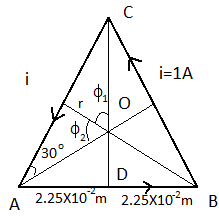
$r=2.25\times {{10}^{-2}}\times \tan 30{}^\circ $
$\Rightarrow r=2.25\times {{10}^{-2}} \times \dfrac{1}{\sqrt{3}}m$
Magnetic field at the centre of the triangle due side AB,
$\Rightarrow$ \[{{B}_{1}}=\dfrac{{{\mu }_{0}}i}{4\pi r}\left( \sin {{\phi }_{1}}+\sin {{\phi }_{2}} \right)\]
Direction of the magnetic field above the plane
Magnetic field is same due to side BC and CA and direction also same,
So resultant magnetic field
$B=3{{B}_{1}}=3\dfrac{{{\mu }_{0}}i}{4\pi r}\left( \sin {{\phi }_{1}}+\sin {{\phi }_{2}} \right)$
$\because {{\phi }_{1}}={{\phi }_{2}}={{60}^{\circ }}$
$\Rightarrow B=3\times \dfrac{{{\mu }_{0}}i}{4\pi r}\left( \sin {{60}^{\circ }}+\sin {{60}^{\circ }} \right)$
$\Rightarrow B=3\times \dfrac{{{\mu }_{0}}i}{4\pi r}\left( \dfrac{\sqrt{3}}{2}+\dfrac{\sqrt{3}}{2} \right)$
$\Rightarrow B=3\times {{10}^{-7}}\times \dfrac{1}{\dfrac{2.25\times {{10}^{-2}}}{\sqrt{3}}}\left( \dfrac{\sqrt{3}+\sqrt{3}}{2} \right)$
$\Rightarrow B=\dfrac{\sqrt{3}\times {{10}^{-7}}\times \sqrt{3}}{2.25\times {{10}^{-2}}}$
$\Rightarrow B=\dfrac{9\times {{10}^{-7}}}{2.25\times {{10}^{-2}}}$
$\Rightarrow B=4\times {{10}^{-5}}$ ${Weber}/{{{\left( meter \right)}^{2}}}$
Note: When we find out the magnetic field at the centre, then maximum times we take the distance from the corner but really. We should take a perpendicular distance from the write to that point.
Where r is the perpendicular distance from the wire of that point,
${{\phi }_{1}}$ and ${{\phi }_{2}}$ are angles.
Complete step by step solution:
When a current flows in a conductor or wire then produces a magnetic field around it. The magnetic field lines shape depend on the shape of the current carrying conductor. If the conductor is in the shape of a cylinder, then the magnetic field lines are circular around the wire (cylinder shape).
The magnetic field due to a finite conducting wire,
$B=\dfrac{{{\mu }_{0}}i}{4\pi r}\left( \sin {{\phi }_{1}}+\sin {{\phi }_{2}} \right)$
Where r is the perpendicular distance from the wire of that point,
${{\phi }_{1}}$ and ${{\phi }_{2}}$ are the angels.
For equilateral triangle
${{\phi }_{1}}={{\phi }_{2}}={{60}^{\circ }}$
$\Rightarrow \tan 30{}^\circ =\dfrac{r}{2.25\times {{10}^{-2}}}$
$r=2.25\times {{10}^{-2}}\times \tan 30{}^\circ $
$\Rightarrow r=2.25\times {{10}^{-2}} \times \dfrac{1}{\sqrt{3}}m$
Magnetic field at the centre of the triangle due side AB,
$\Rightarrow$ \[{{B}_{1}}=\dfrac{{{\mu }_{0}}i}{4\pi r}\left( \sin {{\phi }_{1}}+\sin {{\phi }_{2}} \right)\]
Direction of the magnetic field above the plane
Magnetic field is same due to side BC and CA and direction also same,
So resultant magnetic field
$B=3{{B}_{1}}=3\dfrac{{{\mu }_{0}}i}{4\pi r}\left( \sin {{\phi }_{1}}+\sin {{\phi }_{2}} \right)$
$\because {{\phi }_{1}}={{\phi }_{2}}={{60}^{\circ }}$
$\Rightarrow B=3\times \dfrac{{{\mu }_{0}}i}{4\pi r}\left( \sin {{60}^{\circ }}+\sin {{60}^{\circ }} \right)$
$\Rightarrow B=3\times \dfrac{{{\mu }_{0}}i}{4\pi r}\left( \dfrac{\sqrt{3}}{2}+\dfrac{\sqrt{3}}{2} \right)$
$\Rightarrow B=3\times {{10}^{-7}}\times \dfrac{1}{\dfrac{2.25\times {{10}^{-2}}}{\sqrt{3}}}\left( \dfrac{\sqrt{3}+\sqrt{3}}{2} \right)$
$\Rightarrow B=\dfrac{\sqrt{3}\times {{10}^{-7}}\times \sqrt{3}}{2.25\times {{10}^{-2}}}$
$\Rightarrow B=\dfrac{9\times {{10}^{-7}}}{2.25\times {{10}^{-2}}}$
$\Rightarrow B=4\times {{10}^{-5}}$ ${Weber}/{{{\left( meter \right)}^{2}}}$
Note: When we find out the magnetic field at the centre, then maximum times we take the distance from the corner but really. We should take a perpendicular distance from the write to that point.
Recently Updated Pages
The average and RMS value of voltage for square waves class 12 physics JEE_Main

The force between two short electric dipoles placed class 12 physics JEE_Main
The force of interaction of two dipoles if the two class 12 physics JEE_Main
The value of current through 2Omega resistor is A 10A class 12 physics JEE_MAin
when an object Is placed at a distance of 60 cm from class 12 physics JEE_Main
Formula for number of images formed by two plane mirrors class 12 physics JEE_Main
Trending doubts
JEE Main 2026: Exam Dates, Session 2 Updates, City Slip, Admit Card & Latest News
Understanding the Electric Field of a Uniformly Charged Ring
Understanding Atomic Structure for Beginners
Electron Gain Enthalpy and Electron Affinity Explained
Derivation of Equation of Trajectory Explained for Students
How to Convert a Galvanometer into an Ammeter or Voltmeter
Other Pages
CBSE Class 12 Physics Question Paper 2026: Download SET-wise PDF with Answer Key & Analysis
JEE Advanced Percentile vs Marks 2026: JEE Main Cutoff, AIR & IIT Admission Guide
JEE Advanced 2026 Notification Out with Exam Date, Registration (Extended), Syllabus and More
JEE Advanced Weightage Chapter Wise 2026 for Physics, Chemistry, and Mathematics
What Are Current and Potential Difference in Electricity?
Hybridisation in Chemistry – Concept, Types & Applications