




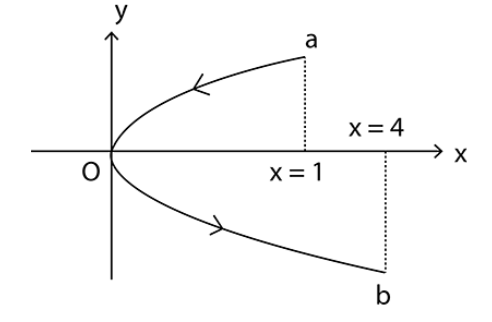
A conducting wire is bent in the form of a parabola ${{\text{y}}^2} = {\text{x}}$ carrying a current ${\text{i}} = 1\;{\text{A}}$ as shown in the figure. This wire is placed in a magnetic field $\overrightarrow {\text{B}} = - 2\widehat {\text{k}}$ \[T\] . The unit vector in the direction of force (on the given portion a to b) is:
(A) $\dfrac{{3i + 4j}}{5}$
(B) $\dfrac{{i + j}}{{\sqrt 2 }}$
(C) $\dfrac{{i + 2j}}{{\sqrt 5 }}$
(D) $\dfrac{{i - 2j}}{{\sqrt 5 }}$
Answer
 Verified
265.8k+ views
Hint: A magnetic field has magnitude as well as direction. It is a vector quantity, therefore, and is denoted by $\vec B$. A current-carrying conductor's magnetic field depends on the current in the conductor and the distance of the point from the conductor. The magnetic field's direction is perpendicular to the wire.
Formula Used: We will use the following formula to find out the required force
$\vec F = i(\vec L \times \vec B)$
Where
$\overrightarrow {\text{F}} $ is the force vector
${\text{i}}$ is the current across the conducting wire
$\overrightarrow {\text{L}} $ is the length of the wire in vector form
$\overrightarrow {\text{B}} $ is the magnetic field represented in vector form
Complete Step-by-Step Solution:
According to the question, the following information is provided to us
The equation of the parabola is ${y^2} = x$
The electrical current flowing in the conducting wire is $i = 1A$
The magnetic field $\vec B = - 2\hat kT$
The coordinates of point $a(1,1)$
The coordinates of point $b(4, - 2)$
Now we need to calculate $\overrightarrow {\text{L}} $
So, we get
$\vec L = (4 - 1)\hat i + ( - 2 - 1)\hat j$
Upon further solving, we get
$\vec L = 3\hat i - 3\hat j$
Now, we know that
$\vec F = i(\vec L \times \vec B)$
Now, we will put the known values in to the above formula to get the force vector
\[\vec F = 1((3\hat i - 3\hat j) \times - 2\hat k)\]
Upon further solving, we get
\[\vec F = 6\hat j + 6\hat i\]
Now, we have to calculate the magnitude of the force vector, that is
$|\overrightarrow {\text{F}} | = |6\widehat {\text{j}} + 6\widehat {\text{i}}| = 6\sqrt 2 $
Now, we have to calculate the unit vector of force, which can be obtained by
$\widehat {\text{F}} = \dfrac{{\overrightarrow {\text{F}} }}{{|\overrightarrow {\text{F}} |}}$
Upon substituting the value of force vector, we get
$\hat F = \dfrac{{6\widehat {\text{j}} + 6\widehat {\text{i}}}}{{6\sqrt 2 }}$
Upon further solving, we get the unit vector of force as
$\therefore \hat F = \dfrac{{\widehat {\text{i}} + \widehat {\text{j}}}}{{\sqrt 2 }}$
Hence, the correct option is (B.)
Note: As vector quantities, the physical quantities for which both magnitude and direction are distinctly defined are known. By putting an arrow over the denotations representing them, vectors are denoted. For example, to define a vehicle's acceleration, its direction must also be specified along with its magnitude. It can be represented as $\vec am/{s^2}$ in vector form. Vectors can be easily represented in three dimensions using the coordinate system.
Formula Used: We will use the following formula to find out the required force
$\vec F = i(\vec L \times \vec B)$
Where
$\overrightarrow {\text{F}} $ is the force vector
${\text{i}}$ is the current across the conducting wire
$\overrightarrow {\text{L}} $ is the length of the wire in vector form
$\overrightarrow {\text{B}} $ is the magnetic field represented in vector form
Complete Step-by-Step Solution:
According to the question, the following information is provided to us
The equation of the parabola is ${y^2} = x$
The electrical current flowing in the conducting wire is $i = 1A$
The magnetic field $\vec B = - 2\hat kT$
The coordinates of point $a(1,1)$
The coordinates of point $b(4, - 2)$
Now we need to calculate $\overrightarrow {\text{L}} $
So, we get
$\vec L = (4 - 1)\hat i + ( - 2 - 1)\hat j$
Upon further solving, we get
$\vec L = 3\hat i - 3\hat j$
Now, we know that
$\vec F = i(\vec L \times \vec B)$
Now, we will put the known values in to the above formula to get the force vector
\[\vec F = 1((3\hat i - 3\hat j) \times - 2\hat k)\]
Upon further solving, we get
\[\vec F = 6\hat j + 6\hat i\]
Now, we have to calculate the magnitude of the force vector, that is
$|\overrightarrow {\text{F}} | = |6\widehat {\text{j}} + 6\widehat {\text{i}}| = 6\sqrt 2 $
Now, we have to calculate the unit vector of force, which can be obtained by
$\widehat {\text{F}} = \dfrac{{\overrightarrow {\text{F}} }}{{|\overrightarrow {\text{F}} |}}$
Upon substituting the value of force vector, we get
$\hat F = \dfrac{{6\widehat {\text{j}} + 6\widehat {\text{i}}}}{{6\sqrt 2 }}$
Upon further solving, we get the unit vector of force as
$\therefore \hat F = \dfrac{{\widehat {\text{i}} + \widehat {\text{j}}}}{{\sqrt 2 }}$
Hence, the correct option is (B.)
Note: As vector quantities, the physical quantities for which both magnitude and direction are distinctly defined are known. By putting an arrow over the denotations representing them, vectors are denoted. For example, to define a vehicle's acceleration, its direction must also be specified along with its magnitude. It can be represented as $\vec am/{s^2}$ in vector form. Vectors can be easily represented in three dimensions using the coordinate system.
Recently Updated Pages
JEE Main 2025-26 Experimental Skills Mock Test – Free Practice

JEE Main 2025-26 Electronic Devices Mock Test: Free Practice Online
JEE Main 2025-26 Mock Tests: Free Practice Papers & Solutions
JEE Main 2025-26: Magnetic Effects of Current & Magnetism Mock Test
JEE Main 2025-26 Atoms and Nuclei Mock Test – Free Practice Online
JEE Main Mock Test 2025-26: Experimental Skills Chapter Online Practice
Trending doubts
JEE Main 2026: Exam Dates, Session 2 Updates, City Slip, Admit Card & Latest News
JEE Main Participating Colleges 2026 - A Complete List of Top Colleges
Kinematics Mock Test for JEE Main 2025-26: Practice & Ace the Exam
Kinematics Mock Test for JEE Main 2025-26: Comprehensive Practice
Hybridisation in Chemistry – Concept, Types & Applications
Understanding the Electric Field of a Uniformly Charged Ring
Other Pages
CBSE Class 12 Physics Question Paper 2026: Download SET-wise PDF with Answer Key & Analysis
JEE Advanced 2026 Notification Out with Exam Date, Registration (Extended), Syllabus and More
JEE Advanced Percentile vs Marks 2026: JEE Main Cutoff, AIR & IIT Admission Guide
JEE Advanced Marks vs Rank 2025 - Predict Your IIT Rank Based on Score
JEE Advanced Weightage Chapter Wise 2026 for Physics, Chemistry, and Mathematics
Derivation of Equation of Trajectory Explained for Students