




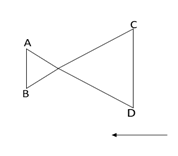
A conducting wire frame is placed in a magnetic field which is directed into the plane of the paper (figure). The magnetic field is increasing at a constant rate. The directions of induced currents in wires AB and CD are:
$\left( A \right)$ B to A and D to C
$\left( B \right)$ A to B and C to D
$\left( C \right)$ A to B and D to C
$\left( D \right)$ B to A and C to D
Answer
 Verified
265.2k+ views
Hint: Ampere’s circuital law states the relationship between the magnetic and the electric field. A magnetic field is generated, whenever a current travels through a conductor. Right-Hand Thumb Rule determines the direction of magnetic field lines. Then apply Lenz's law to determine the direction of the induced current in the system.
Complete solution:
A magnetic field is generated, whenever a current travels through a conductor. Right-Hand Thumb Rule determines the direction of magnetic field lines.
Electric fields are caused by stationary charges and magnetic fields are caused by moving electric charges. Stationary charges cause electric fields.
Since a non-relativistic proton beam passes without deviation through a region of space, we can say that force due to magnetic field equals force due to electric field.
The relationship between the magnetic and the electric field is given by Ampere circuit law.
We can say that from the Lenz law that the induced emf induces a current whose magnetic field opposes the change in magnetic flux.
Now let us consider the surface having points A, B, C and D facing upwards in anticlockwise direction when viewing towards the surface.
From Lenz's law we can say that when the flux increases, the induced current will be in the direction CBABC, so it can oppose the increase in flux.
Then the direction of induced current in wires AB and CD is anticlockwise
$B \to A$ and $D \to C$
Then option A is the right option.
Note: A magnetic field is generated, whenever a current travels through a conductor. Right-Hand Thumb Rule determines the direction of magnetic field lines. We can say that from the Lenz law that the induced emf induces a current whose magnetic field opposes the change in magnetic flux.
Complete solution:
A magnetic field is generated, whenever a current travels through a conductor. Right-Hand Thumb Rule determines the direction of magnetic field lines.
Electric fields are caused by stationary charges and magnetic fields are caused by moving electric charges. Stationary charges cause electric fields.
Since a non-relativistic proton beam passes without deviation through a region of space, we can say that force due to magnetic field equals force due to electric field.
The relationship between the magnetic and the electric field is given by Ampere circuit law.
We can say that from the Lenz law that the induced emf induces a current whose magnetic field opposes the change in magnetic flux.
Now let us consider the surface having points A, B, C and D facing upwards in anticlockwise direction when viewing towards the surface.
From Lenz's law we can say that when the flux increases, the induced current will be in the direction CBABC, so it can oppose the increase in flux.
Then the direction of induced current in wires AB and CD is anticlockwise
$B \to A$ and $D \to C$
Then option A is the right option.
Note: A magnetic field is generated, whenever a current travels through a conductor. Right-Hand Thumb Rule determines the direction of magnetic field lines. We can say that from the Lenz law that the induced emf induces a current whose magnetic field opposes the change in magnetic flux.
Recently Updated Pages
JEE Main 2025-26 Experimental Skills Mock Test – Free Practice

JEE Main 2025-26 Electronic Devices Mock Test: Free Practice Online
JEE Main 2025-26 Mock Tests: Free Practice Papers & Solutions
JEE Main 2025-26: Magnetic Effects of Current & Magnetism Mock Test
JEE Main 2025-26 Atoms and Nuclei Mock Test – Free Practice Online
JEE Main Mock Test 2025-26: Experimental Skills Chapter Online Practice
Trending doubts
JEE Main Marking Scheme 2026- Paper-Wise Marks Distribution and Negative Marking Details
Degree of Dissociation: Meaning, Formula, Calculation & Uses
Understanding the Electric Field Due to Infinite Linear Charge and Cylinders
Understanding Displacement and Velocity Time Graphs
Understanding Instantaneous Velocity
Understanding Electric Flux and Area Vector in Physics
Other Pages