




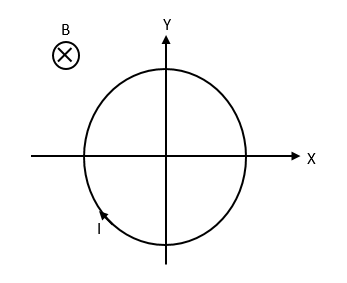
A conducting loop carrying a current is placed in a uniform magnetic field pointing into the plane of the paper as shown in the figure. The loop will have a tendency to:
A) Conduct
B) Expand
C) Move towards +ve x-axis
D) Move towards -ve x-axis
Answer
 Verified
265.5k+ views
Hint: If a current carrying conductor is placed in an external magnetic field then the conductor experiences a force. The direction of the force is given by Fleming's left hand rule. The magnetic field, the direction of the current and the force due to the magnetic field are mutually perpendicular to each other.
Complete solution:
Fleming’s left hand rule states that whenever a current carrying conductor is kept in a magnetic field a force is experienced by the conductor due to the magnetic field. When the forefinger, middle finger and thumb are mutually perpendicular to each other and if the forefinger represents the direction of the magnetic field and the middle finger points the direction of the current in the conductor, then the thumb is pointing the direction of force or motion of the conductor experienced due to the presence of the magnetic field. The question here mentions that the magnetic field is uniform.
The current carrying current loop in magnetic force experiences zero force. Since it experiences zero force there won’t be any translational motion experienced by the current loop. Thus, we can eliminate the options (C) and (D) which state the motion of the current loop in the positive or negative x-axis. Now we use Fleming's left hand rule. The question states the magnetic field pointing perpendicular to the plane of the paper in the inwards direction represented by the forefinger. Also the diagram shows that the current is flowing clockwise which is represented by the middle finger. Then using Fleming's left hand rule we get that the thumb represents the direction of the force which at every point in the loop is directed radially outwards.
As the force at every point directs radially outwards, thus, the loop will have a tendency to expand.
Therefore, option (B) is the correct answer.
Note: Do not confuse between Fleming's left hand rule and Fleming’s right hand rule. Fleming's right hand rule is used to find the direction of the current induced by the conductor due to the force applied in a given magnetic field whereas Fleming’s left hand rule is used to find the direction of the force experienced by the current carrying conductor kept in the magnetic field.
Complete solution:
Fleming’s left hand rule states that whenever a current carrying conductor is kept in a magnetic field a force is experienced by the conductor due to the magnetic field. When the forefinger, middle finger and thumb are mutually perpendicular to each other and if the forefinger represents the direction of the magnetic field and the middle finger points the direction of the current in the conductor, then the thumb is pointing the direction of force or motion of the conductor experienced due to the presence of the magnetic field. The question here mentions that the magnetic field is uniform.
The current carrying current loop in magnetic force experiences zero force. Since it experiences zero force there won’t be any translational motion experienced by the current loop. Thus, we can eliminate the options (C) and (D) which state the motion of the current loop in the positive or negative x-axis. Now we use Fleming's left hand rule. The question states the magnetic field pointing perpendicular to the plane of the paper in the inwards direction represented by the forefinger. Also the diagram shows that the current is flowing clockwise which is represented by the middle finger. Then using Fleming's left hand rule we get that the thumb represents the direction of the force which at every point in the loop is directed radially outwards.
As the force at every point directs radially outwards, thus, the loop will have a tendency to expand.
Therefore, option (B) is the correct answer.
Note: Do not confuse between Fleming's left hand rule and Fleming’s right hand rule. Fleming's right hand rule is used to find the direction of the current induced by the conductor due to the force applied in a given magnetic field whereas Fleming’s left hand rule is used to find the direction of the force experienced by the current carrying conductor kept in the magnetic field.
Recently Updated Pages
JEE Main 2025-26 Experimental Skills Mock Test – Free Practice

JEE Main 2025-26 Electronic Devices Mock Test: Free Practice Online
JEE Main 2025-26 Mock Tests: Free Practice Papers & Solutions
JEE Main 2025-26: Magnetic Effects of Current & Magnetism Mock Test
JEE Main 2025-26 Atoms and Nuclei Mock Test – Free Practice Online
JEE Main Mock Test 2025-26: Experimental Skills Chapter Online Practice
Trending doubts
JEE Main 2026: Exam Dates, Session 2 Updates, City Slip, Admit Card & Latest News
JEE Main Participating Colleges 2026 - A Complete List of Top Colleges
Kinematics Mock Test for JEE Main 2025-26: Practice & Ace the Exam
Kinematics Mock Test for JEE Main 2025-26: Comprehensive Practice
Hybridisation in Chemistry – Concept, Types & Applications
Understanding the Electric Field of a Uniformly Charged Ring
Other Pages
CBSE Class 12 Physics Question Paper 2026: Download SET-wise PDF with Answer Key & Analysis
JEE Advanced 2026 Notification Out with Exam Date, Registration (Extended), Syllabus and More
JEE Advanced Percentile vs Marks 2026: JEE Main Cutoff, AIR & IIT Admission Guide
JEE Advanced Marks vs Rank 2025 - Predict Your IIT Rank Based on Score
JEE Advanced Weightage Chapter Wise 2026 for Physics, Chemistry, and Mathematics
Derivation of Equation of Trajectory Explained for Students