






Why Did the British First Come to India and What Happened After Their Arrival?
The topic When And Why British First Landed On Indian Territory is an important part of Indian History and General Knowledge. It explains how the British established their presence in India and gradually turned from traders into rulers. Understanding this topic helps students preparing for competitive exams such as UPSC, SSC, State PSC, and other government exams. It also provides clarity about the early phase of British rule in India and the beginning of colonial influence.
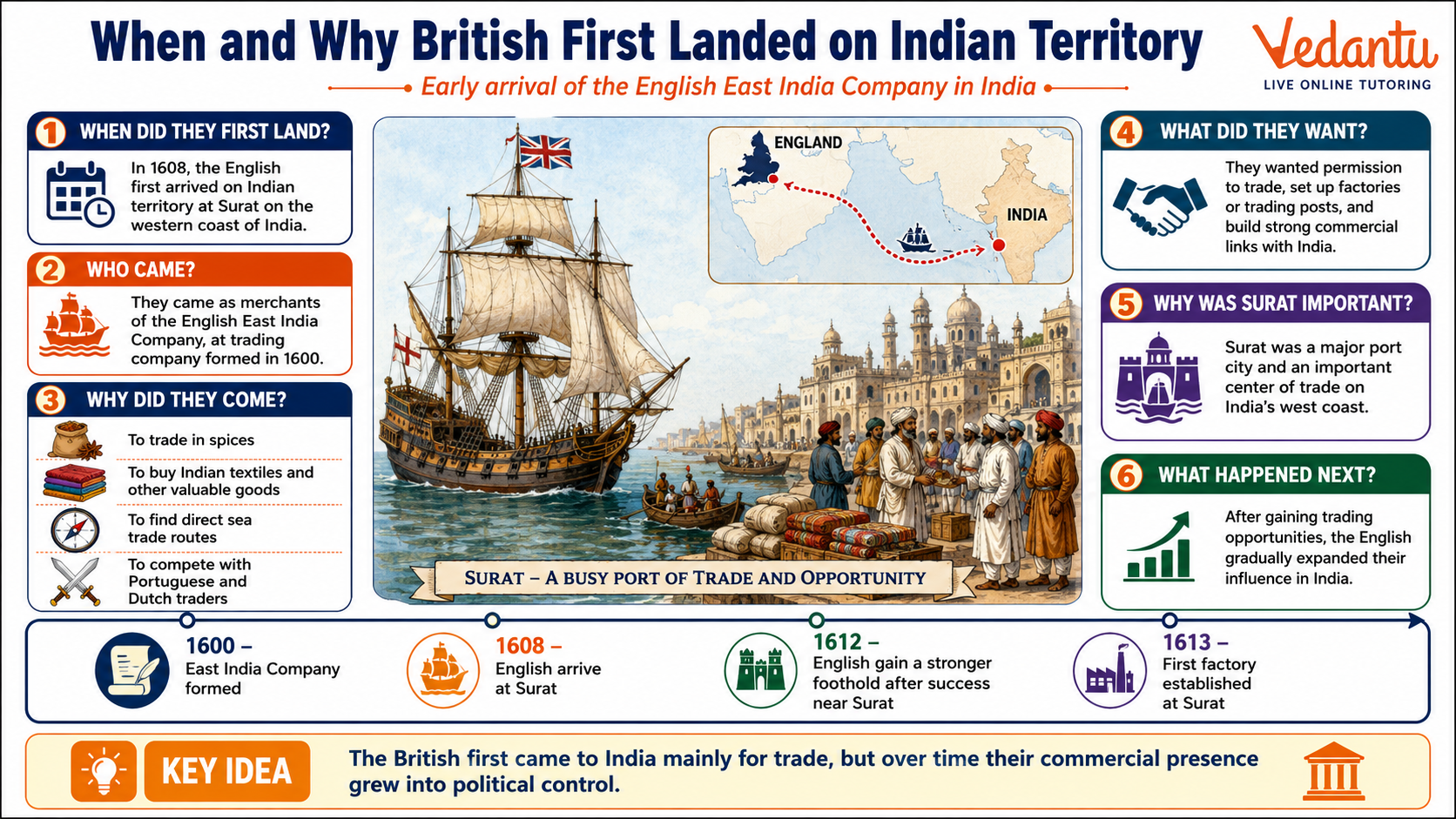
When Did the British First Land in India?
The British first landed in India in the early 17th century. The English East India Company was formed on 31 December 1600 by Queen Elizabeth I. After its formation, the Company sent ships to Asia in search of trade opportunities.
In 1608, Captain William Hawkins arrived at the port of Surat on the western coast of India. This is considered the first official arrival of the British on Indian territory. Later, in 1615, Sir Thomas Roe came to the court of Mughal Emperor Jahangir to secure trading rights for the Company.
Key Events Related to British Arrival in India
| Year | Event | Importance |
|---|---|---|
| 1600 | Formation of East India Company | British received royal charter for trade in the East |
| 1608 | Arrival of Captain William Hawkins at Surat | First English landing in India |
| 1615 | Arrival of Sir Thomas Roe | Obtained trading rights from Mughal Emperor |
These events marked the beginning of British commercial activities in India, which later transformed into political control.
Why Did the British Come to India?
The British came to India mainly for trade and economic profit. During the 16th and 17th centuries, European countries were eager to access the rich resources of Asia. India was famous for its spices, silk, cotton textiles, indigo, and other valuable goods.
Main Reasons for British Arrival
- To trade in spices, silk, cotton, and other luxury goods.
- To compete with Portuguese and Dutch traders in Asia.
- To establish profitable trading posts known as factories.
- To expand their economic and later political influence.
At first, the British had no intention of ruling India. Their primary objective was trade. However, over time, political instability in India and rivalry among Indian rulers gave the British opportunities to interfere in internal matters.
How Did Trade Turn into Political Control?
After securing trading rights from the Mughal Empire, the British gradually strengthened their position by building fortified settlements. Important trading centers were established at Surat, Madras, Bombay, and Calcutta.
The turning point came after the Battle of Plassey in 1757, when the British defeated Siraj ud Daulah, the Nawab of Bengal. This victory gave them political power and control over Bengal’s vast resources. From this point, the British expanded their rule across India.
Major Trading Centers Established by the British
- Surat - First trading factory in western India.
- Madras - Established in 1639.
- Bombay - Acquired in 1668 from the Portuguese.
- Calcutta - Established in 1690.
Significance of British Arrival in India
The arrival of the British had long term consequences for India. It changed the political, economic, and social structure of the country. While they introduced modern education, railways, and administrative systems, their policies also led to economic exploitation and decline of traditional industries.
- Beginning of European colonial rule in India.
- Transformation of India’s economy to serve British interests.
- Foundation for future political movements and freedom struggle.
Quick Revision Points for Exams
- East India Company formed in 1600.
- First British arrival in India - 1608 at Surat.
- Sir Thomas Roe visited Jahangir’s court in 1615.
- Primary aim - Trade and profit.
- Political control began after Battle of Plassey in 1757.
Conclusion
The British first landed in India in 1608 at Surat with the objective of trade. Over time, commercial interests turned into political ambitions, leading to nearly two centuries of British rule in India. Understanding when and why the British came to India helps students grasp the foundation of modern Indian history and the origins of colonial rule. This topic remains highly important for competitive exams and general awareness.
FAQs on When and Why the British First Landed in India: Historical Background and Reasons
1. When and why did the British first land on Indian territory?
The British first landed in India in 1608 for trade and commercial expansion.
• In 1608, Captain William Hawkins arrived at Surat.
• The main aim was to establish trade relations through the British East India Company.
• They sought spices, silk, cotton, indigo, and other profitable goods.
• This marked the beginning of British colonial rule in India and European commercial competition.
2. Who founded the British East India Company?
The British East India Company was founded by English merchants in 1600 under a royal charter.
• Established on 31 December 1600 by Queen Elizabeth I.
• Granted monopoly rights over trade with the East.
• Initially focused on commerce, not political control.
• Later became a powerful force in Indian administration and governance.
3. Why did the British come to India in the 17th century?
The British came to India primarily for trade and economic profit.
• To purchase spices, textiles, silk, and indigo.
• To compete with the Portuguese and Dutch in Asian trade.
• To establish profitable trading factories along the Indian coast.
• Trade later expanded into political and military control.
4. Where did the British first establish their factory in India?
The first British factory in India was established at Surat in 1613.
• Permission was granted by the Mughal Emperor Jahangir.
• Surat became the first major trading center of the East India Company.
• Later factories were set up in Madras, Bombay, and Calcutta.
• These centers became key bases of British expansion.
5. How did the British get permission to trade in India?
The British obtained trading rights through diplomacy with the Mughal Empire.
• Captain William Hawkins visited Emperor Jahangir's court.
• Later, Sir Thomas Roe secured official trade privileges in 1615.
• The Mughals allowed the British to set up factories.
• These agreements strengthened Anglo-Mughal relations.
6. Which European powers came to India before the British?
The Portuguese were the first Europeans to reach India, followed by the Dutch and French.
• Portuguese arrived in 1498 led by Vasco da Gama.
• Dutch East India Company entered in the early 17th century.
• French East India Company later established settlements.
• The British eventually defeated rivals to dominate colonial India.
7. What was the main objective of the British East India Company?
The main objective of the British East India Company was to earn profits through trade.
• To import valuable Indian goods into Europe.
• To expand commercial influence in Asia.
• To establish secure trading posts.
• Over time, it shifted from trade to territorial expansion and political control.
8. When did the British begin political control in India?
British political control in India began after the Battle of Plassey in 1757.
• Led by Robert Clive against Siraj-ud-Daulah.
• Resulted in Company control over Bengal.
• Marked the transition from traders to rulers.
• Strengthened British dominance in Indian history.
9. How did the British expand their power after landing in India?
The British expanded power through wars, alliances, and administrative policies.
• Victory in battles like Plassey (1757) and Buxar (1764).
• Use of policies such as Subsidiary Alliance and Doctrine of Lapse.
• Strong military organization and naval power.
• Gradual annexation of Indian territories.
10. Why is the British arrival in India important in history?
The British arrival in India marked the beginning of nearly 200 years of colonial rule.
• Led to major changes in administration, economy, and education.
• Introduced Western legal and political systems.
• Caused economic exploitation and social reforms.
• Eventually triggered the Indian National Movement and independence in 1947.
