






Causes and Impact of Tribal Uprisings in India
The Tribal Movement in India refers to a series of uprisings, revolts, and reform movements led by tribal communities against exploitation, injustice, and interference in their traditional way of life. These movements played a significant role in shaping India's freedom struggle and post-independence tribal policies. Tribal communities, also known as Adivasis, resisted oppressive land revenue systems, forest laws, moneylenders, landlords, and colonial administration. Understanding tribal movements is essential for General Knowledge, competitive exams, and for gaining insight into India’s socio-political history.
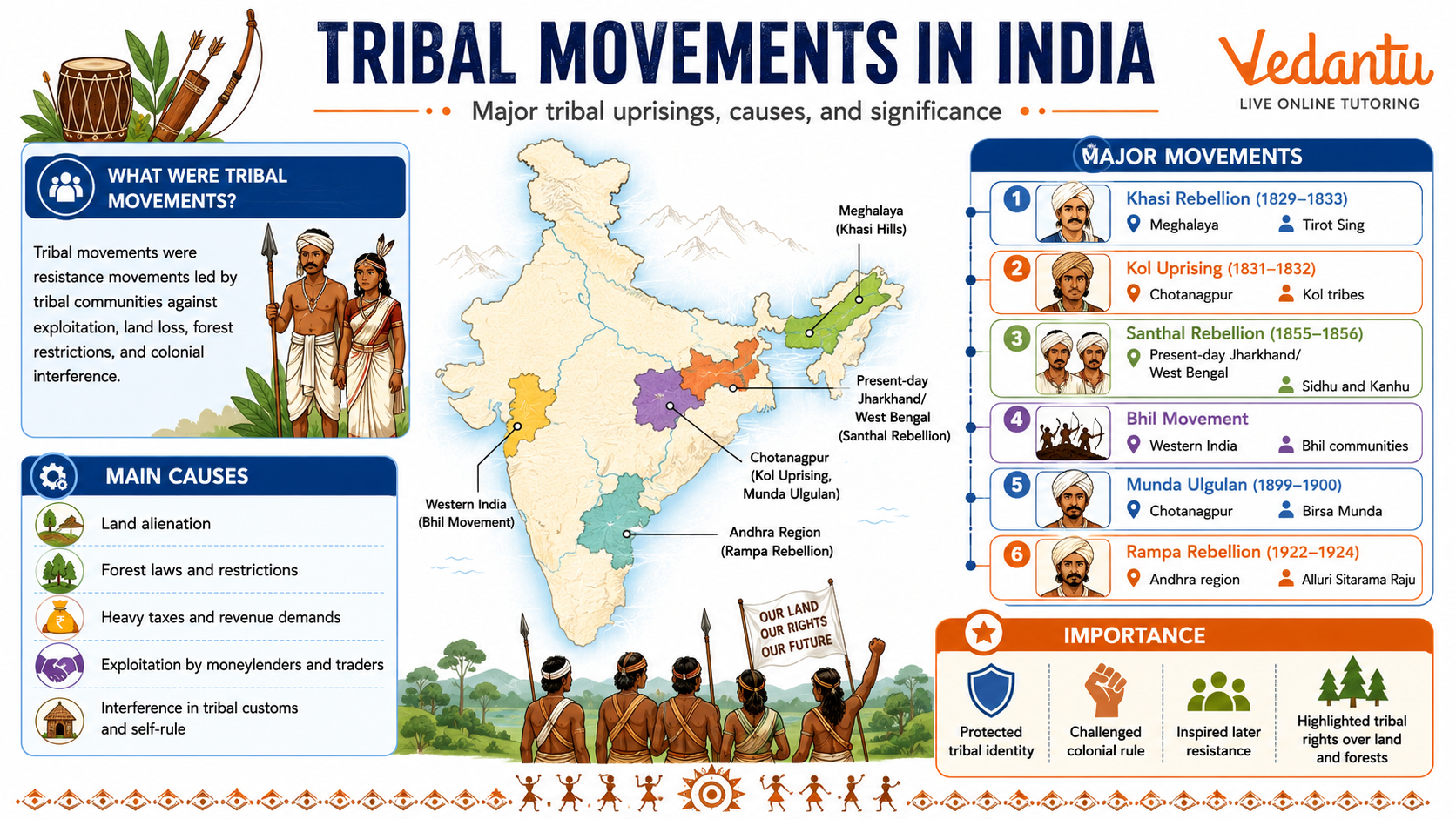
Who Are Tribes in India?
Tribes in India are indigenous communities that traditionally lived in forests, hills, and remote areas. They have distinct languages, cultures, customs, and social structures. The Indian Constitution recognizes them as Scheduled Tribes and provides special safeguards for their development and protection.
- Close connection with forests and natural resources
- Community-based land ownership system
- Distinct cultural and religious practices
- Economic dependence on agriculture, hunting, and forest produce
Causes of Tribal Movements in India
The tribal uprisings were mainly a reaction to colonial policies and socio-economic exploitation. The British administration disrupted the traditional lifestyle of tribal communities.
- Imposition of heavy land revenue and taxes
- Introduction of zamindari and landlord systems
- Forest laws restricting access to forest resources
- Exploitation by moneylenders and traders
- Loss of traditional land rights
- Forced labor practices
Classification of Tribal Movements
Tribal movements in India can be broadly classified based on their objectives and nature.
1. Religious and Social Reform Movements
These movements aimed at social reform and revival of traditional practices.
2. Agrarian Movements
Focused on land rights and opposition to landlords and revenue systems.
3. Political Movements
These were organized against British authority and aimed at political freedom.
Major Tribal Movements in India
Important Tribal Revolts in India
| Name of Revolt | Year | Region and Leader |
|---|---|---|
| Santhal Rebellion | 1855-56 | Jharkhand - Sidhu and Kanhu |
| Munda Rebellion | 1899-1900 | Chotanagpur - Birsa Munda |
| Bhil Revolt | 1818 | Western India - Local Bhil Leaders |
| Kol Rebellion | 1831-32 | Chotanagpur Region |
| Rampa Rebellion | 1922-24 | Andhra Pradesh - Alluri Sitarama Raju |
These revolts highlighted tribal resistance against exploitation and played an important role in weakening colonial authority in tribal regions.
Detailed Overview of Key Movements
Santhal Rebellion 1855-56
The Santhal Rebellion was one of the earliest large-scale tribal revolts against British rule. Led by Sidhu and Kanhu Murmu, the Santhals revolted against oppressive moneylenders, zamindars, and British officials. The revolt was suppressed but led to administrative reforms in the region.
Munda Rebellion 1899-1900
Led by Birsa Munda, this movement is also known as Ulgulan meaning the great upheaval. The Mundas protested against the British land revenue system and demanded restoration of their traditional land rights. Birsa Munda became a symbol of tribal resistance.
Rampa Rebellion 1922-24
This revolt was led by Alluri Sitarama Raju against the Madras Forest Act. The tribal people opposed restrictions on forest usage and forced labor. The movement had strong anti-colonial elements.
Impact of Tribal Movements
Tribal movements had both immediate and long-term impacts on Indian society and governance.
- Forced the British government to reform administrative policies
- Recognition of tribal land rights in certain areas
- Strengthened the overall freedom movement
- Inspired later social and political movements
Tribal Movements After Independence
After independence, tribal movements shifted focus towards development, autonomy, and protection of identity. Demands for separate states such as Jharkhand and Chhattisgarh were part of tribal political movements. The government introduced protective laws and constitutional safeguards for Scheduled Tribes.
- Fifth and Sixth Schedule provisions
- Reservation in education and employment
- Tribal Sub-Plan for development
- Forest Rights Act 2006
Importance of Tribal Movements in Indian History
The Tribal Movement in India represents the struggle of marginalized communities to protect their land, culture, and dignity. These movements were not isolated incidents but part of a broader resistance against injustice and colonial exploitation. They contributed significantly to India's nationalist movement and continue to influence tribal policies in modern India.
Key Points for Quick Revision
- Tribal movements were mainly against land alienation and forest laws
- Santhal and Munda rebellions are the most significant uprisings
- Birsa Munda is a key tribal freedom fighter
- Post-independence policies aim to protect tribal rights
- Important for competitive exams like UPSC, SSC, State PSC, and other GK tests
In conclusion, the Tribal Movement in India highlights the courage and resilience of tribal communities in defending their rights and identity. A thorough understanding of these movements helps in appreciating India’s diverse social fabric and the continuous efforts toward social justice and equality.
FAQs on English – Understanding Tribal Movements in India
1. What were the Tribal Movements in India?
The Tribal Movements in India were organized uprisings by indigenous communities against British colonial rule and exploitation.
• These movements opposed land alienation, forest laws, high taxes, and forced labor.
• Major tribal revolts occurred during the 18th and 19th centuries.
• They aimed to protect tribal identity, culture, and traditional rights over land and forests.
• Examples include the Santhal Rebellion, Munda Ulgulan, and Bhil Revolt.
2. What were the main causes of Tribal Revolts during British rule?
The primary causes of Tribal Revolts in British India were economic exploitation and loss of traditional rights.
• Introduction of zamindari system and heavy land revenue.
• Restrictive Forest Acts limiting access to forest resources.
• Exploitation by moneylenders and traders.
• Missionary activities and interference in tribal customs and religion.
• Forced labor policies like begar.
3. What was the Santhal Rebellion of 1855?
The Santhal Rebellion (1855–56) was a major tribal uprising against British rule and zamindari oppression.
• Led by Sido and Kanhu Murmu in present-day Jharkhand.
• Targeted British officials, landlords, and moneylenders.
• Resulted in the creation of the Santhal Parganas region.
• It is one of the most significant tribal movements in Indian history.
4. Who led the Munda Rebellion (Ulgulan)?
The Munda Rebellion (Ulgulan) was led by Birsa Munda in the late 19th century.
• Occurred between 1899–1900 in Chotanagpur.
• Protested against British land policies and missionary influence.
• Promoted the slogan of “Abua Raj” (self-rule).
• Led to the enactment of the Chotanagpur Tenancy Act, 1908.
5. What was the Bhil Revolt?
The Bhil Revolt was a series of tribal uprisings by the Bhil community against British control.
• Took place in Western and Central India.
• Caused by economic hardship and administrative changes.
• The British later formed the Bhil Corps to control the region.
• It reflects early resistance to colonial expansion.
6. What was the Kol Rebellion of 1831-32?
The Kol Rebellion (1831–32) was an armed uprising by the Kol tribes of Chotanagpur.
• Directed against zamindars, moneylenders, and British officials.
• Triggered by land alienation and administrative reforms.
• Suppressed by British military forces.
• It marked an important chapter in early tribal resistance movements.
7. How did British forest policies affect tribal communities?
The British Forest Policies severely impacted tribal livelihoods and traditional rights.
• The Forest Acts of 1865 and 1878 restricted forest access.
• Tribals were denied rights to hunting, grazing, and shifting cultivation.
• Forests were declared government property.
• These policies became a major cause of tribal uprisings in India.
8. What is the significance of Tribal Movements in Indian history?
The Tribal Movements played a crucial role in India's freedom struggle and social reform.
• Highlighted exploitation under colonial rule.
• Strengthened the broader anti-British resistance.
• Led to protective laws like the Chotanagpur Tenancy Act.
• Preserved tribal identity, culture, and autonomy.
9. What was the Rampa Rebellion?
The Rampa Rebellion (1922–24) was a tribal revolt in the Godavari region of Andhra Pradesh.
• Led by Alluri Sitarama Raju.
• Opposed the Madras Forest Act and colonial oppression.
• Used guerrilla warfare tactics against British forces.
• It became an important tribal participation in the Indian freedom movement.
10. How are Tribal Movements important for competitive exams?
The topic of Tribal Movements in India is important for UPSC, SSC, State PSC, and other competitive exams.
• Frequently asked in General Studies and History sections.
• Covers key revolts like Santhal, Munda, Kol, Bhil, and Rampa.
• Important leaders include Birsa Munda, Sido-Kanhu, and Alluri Sitarama Raju.
• Helps in understanding colonial policies and tribal resistance.
