






Rise, Administration, and Cultural Achievements of the Rashtrakuta Empire
The Rashtrakutas were one of the most powerful dynasties of early medieval India, ruling large parts of the Indian subcontinent from the 8th to the 10th century CE. They played a crucial role in shaping the political, cultural, and architectural history of India. Known for their military strength, administrative efficiency, and patronage of art and literature, the Rashtrakutas established a vast empire that stretched across the Deccan region and influenced both North and South India. Their contributions, especially in temple architecture and literature, remain significant in Indian history.
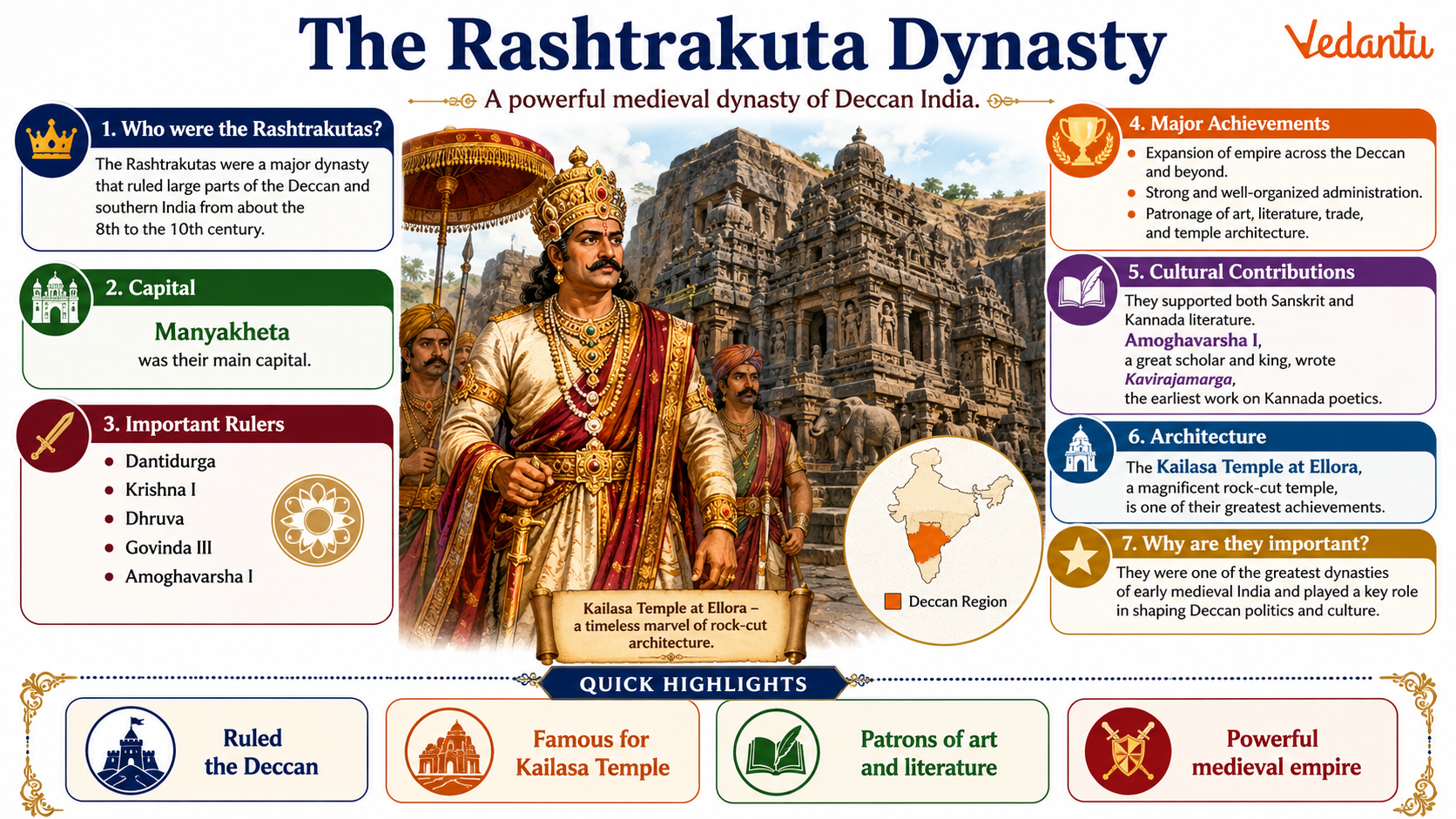
Origin and Rise of the Rashtrakutas
The Rashtrakutas originally served as feudatories under the Chalukyas of Badami. They rose to power in the mid-8th century when Dantidurga overthrew the Chalukya ruler and established Rashtrakuta supremacy in the Deccan. Their capital was located at Manyakheta in present-day Karnataka.
- Founder of Rashtrakuta power - Dantidurga
- Important early ruler - Krishna I
- Capital city - Manyakheta
- Region of control - Deccan plateau and beyond
Major Rulers of the Rashtrakuta Dynasty
Important Rashtrakuta Rulers
| Ruler | Reign Period | Major Contributions |
|---|---|---|
| Dantidurga | 735 - 756 CE | Founded Rashtrakuta power by defeating Chalukyas |
| Krishna I | 756 - 773 CE | Built the famous Kailasa Temple at Ellora |
| Amoghavarsha I | 814 - 878 CE | Promoted literature and Jainism |
Among the rulers, Amoghavarsha I is especially remembered for his peaceful rule and patronage of scholars. He was a follower of Jainism and encouraged literary works in Kannada and Sanskrit.
Political History and Expansion
The Rashtrakutas were involved in continuous conflicts with other powerful dynasties such as the Pratiharas and the Palas. This struggle for control over northern India is known as the Tripartite Struggle.
Tripartite Struggle
- Involved three dynasties - Rashtrakutas, Pratiharas, and Palas
- Main objective - Control over Kannauj
- Demonstrated the military strength of the Rashtrakutas
The Rashtrakutas expanded their empire from the Narmada River in the north to the Kaveri River in the south. Their influence extended even into parts of central and northern India.
Administration Under the Rashtrakutas
The administration of the Rashtrakutas was well organized and efficient. The empire was divided into provinces called Rashtras, which were further divided into districts and villages.
- King was the supreme authority
- Provinces governed by Rashtrapatis
- Local administration managed by village assemblies
- Revenue mainly collected from land taxes
Economy and Trade
The Rashtrakuta economy was primarily agrarian, but trade and commerce were also important. The Deccan region had fertile land, and agriculture formed the backbone of the economy.
- Cultivation of crops like rice, millet, and cotton
- Active trade with Arab merchants
- Export of textiles, spices, and precious stones
- Use of gold and silver coins
Art, Architecture, and Culture
The Rashtrakutas were great patrons of art and architecture. Their most remarkable contribution is the rock cut Kailasa Temple at Ellora, built by Krishna I. This temple is considered a masterpiece of Indian architecture.
Architectural Achievements
- Kailasa Temple at Ellora
- Rock cut cave temples
- Patronage of Jain monuments
Literature
The Rashtrakutas supported scholars and poets. Literature flourished in Sanskrit and Kannada during their rule.
- Amoghavarsha I wrote Kavirajamarga in Kannada
- Jinasena wrote Adipurana
- Trivikrama composed Nalachampu
Religion During Rashtrakuta Rule
The Rashtrakutas were tolerant rulers who supported multiple religions. Hinduism and Jainism received royal patronage, and there was religious harmony in the empire.
- Patronage to Shaivism and Vaishnavism
- Strong support for Jainism
- Construction of temples and monasteries
Decline of the Rashtrakuta Dynasty
The decline of the Rashtrakutas began in the late 10th century due to internal conflicts and external invasions. In 973 CE, the Chalukyas of Kalyani overthrew the last Rashtrakuta ruler, bringing their rule to an end.
- Weak successors after strong rulers
- Revolts by feudatories
- Defeat by the Chalukyas of Kalyani
Historical Significance of the Rashtrakutas
The Rashtrakutas left a lasting impact on Indian history through their political achievements, cultural contributions, and architectural marvels. Their role in the Tripartite Struggle shaped the political landscape of northern India, while their artistic achievements enriched Indian heritage. The Kailasa Temple remains one of the finest examples of rock cut architecture in the world. The dynasty also played an important role in promoting regional languages like Kannada and encouraging literary excellence.
Understanding the Rashtrakutas is essential for students preparing for competitive examinations, as questions frequently appear regarding their administration, architecture, and role in the Tripartite Struggle. Their balanced approach to governance and culture makes them one of the most remarkable dynasties of early medieval India.
FAQs on Rashtrakutas Dynasty: Complete History for Students
1. Who were the Rashtrakutas?
The Rashtrakutas were a powerful South Indian dynasty that ruled large parts of the Indian subcontinent between the 8th and 10th centuries CE.
• Founded by Dantidurga around 753 CE
• Capital city: Manyakheta (in present-day Karnataka)
• Ruled over the Deccan Plateau and parts of North and South India
• Known for military strength, cultural patronage, and temple architecture
This dynasty is frequently asked about in GK, UPSC, SSC, and state PSC exams.
2. Who was the founder of the Rashtrakuta dynasty?
The founder of the Rashtrakuta dynasty was Dantidurga, who established the empire in the 8th century CE.
• Defeated the Chalukyas of Badami
• Laid the foundation of Rashtrakuta political power in the Deccan
• Expanded control over Maharashtra and Karnataka regions
He is considered the architect of Rashtrakuta supremacy in early medieval India.
3. Who was the most powerful Rashtrakuta ruler?
The most powerful Rashtrakuta ruler was Govinda III, known for his vast military conquests.
• Reigned during 793–814 CE
• Defeated rulers of Kannauj, Bengal, and South India
• Expanded the empire from the Himalayas to Kanyakumari
His reign marked the peak of Rashtrakuta political dominance in Indian history.
4. What is the significance of the Kailasa Temple at Ellora?
The Kailasa Temple at Ellora is a magnificent rock-cut temple built by the Rashtrakutas and is a UNESCO World Heritage Site.
• Constructed during the reign of Krishna I
• Carved out of a single monolithic rock
• Dedicated to Lord Shiva
• Represents Dravidian architectural excellence
This temple is a masterpiece of Indian temple architecture and Rashtrakuta art.
5. What were the major achievements of the Rashtrakutas?
The Rashtrakutas made significant contributions in politics, culture, and architecture during early medieval India.
• Military expansion across North and South India
• Patronage of Sanskrit and Kannada literature
• Construction of the Ellora cave temples
• Promotion of trade with Arab merchants
Their rule strengthened the Deccan’s position in Indian history and global trade networks.
6. What was the Tripartite Struggle involving the Rashtrakutas?
The Tripartite Struggle was a three-way battle for control over Kannauj between the Rashtrakutas, Palas, and Gurjara-Pratiharas.
• Took place during the 8th–10th centuries CE
• Key rulers involved: Dhruva and Govinda III
• Kannauj was strategically and politically important
This struggle is a major topic in medieval Indian history and competitive exams.
7. What language and literature flourished under the Rashtrakutas?
Under the Rashtrakutas, both Sanskrit and Kannada literature flourished significantly.
• Famous work: Kavirajamarga by Amoghavarsha I
• Patronage to Jain scholars and poets
• Growth of classical Kannada writing
The dynasty played a crucial role in the development of South Indian literary traditions.
8. What was the administrative system of the Rashtrakutas?
The Rashtrakutas followed a well-structured administrative system based on decentralization and efficient governance.
• Empire divided into Rashtras (provinces)
• Provinces managed by appointed governors
• Local administration handled by village assemblies
• Strong military organization
This system helped maintain stability across their vast Deccan empire.
9. How did the Rashtrakuta dynasty decline?
The decline of the Rashtrakutas began in the late 10th century due to internal conflicts and external invasions.
• Weak successors after Krishna III
• Revolts by feudatories
• Rise of the Western Chalukyas
By 973 CE, the dynasty lost power, marking the end of Rashtrakuta rule in the Deccan.
10. Why are the Rashtrakutas important in Indian history?
The Rashtrakutas are important for their political power, cultural achievements, and architectural wonders in early medieval India.
• Controlled large parts of the Indian subcontinent
• Contributed to the Tripartite Struggle
• Built the iconic Kailasa Temple
• Encouraged trade, religion, and literature
Their legacy remains significant in Indian art, architecture, and Deccan history.
