






Causes and Impact of the Swadeshi Campaign in India
The Swadeshi Movement was a major phase of the Indian freedom struggle that began in 1905 in response to the partition of Bengal by the British government. The term "Swadeshi" means of one's own country, and the movement encouraged Indians to boycott British goods and promote indigenous products and industries. It marked a shift from moderate political methods to mass participation and economic resistance. The movement not only strengthened national consciousness but also laid the foundation for future mass movements led by Mahatma Gandhi. For students and competitive exam aspirants, understanding the Swadeshi Movement is essential to grasp the evolution of Indian nationalism.
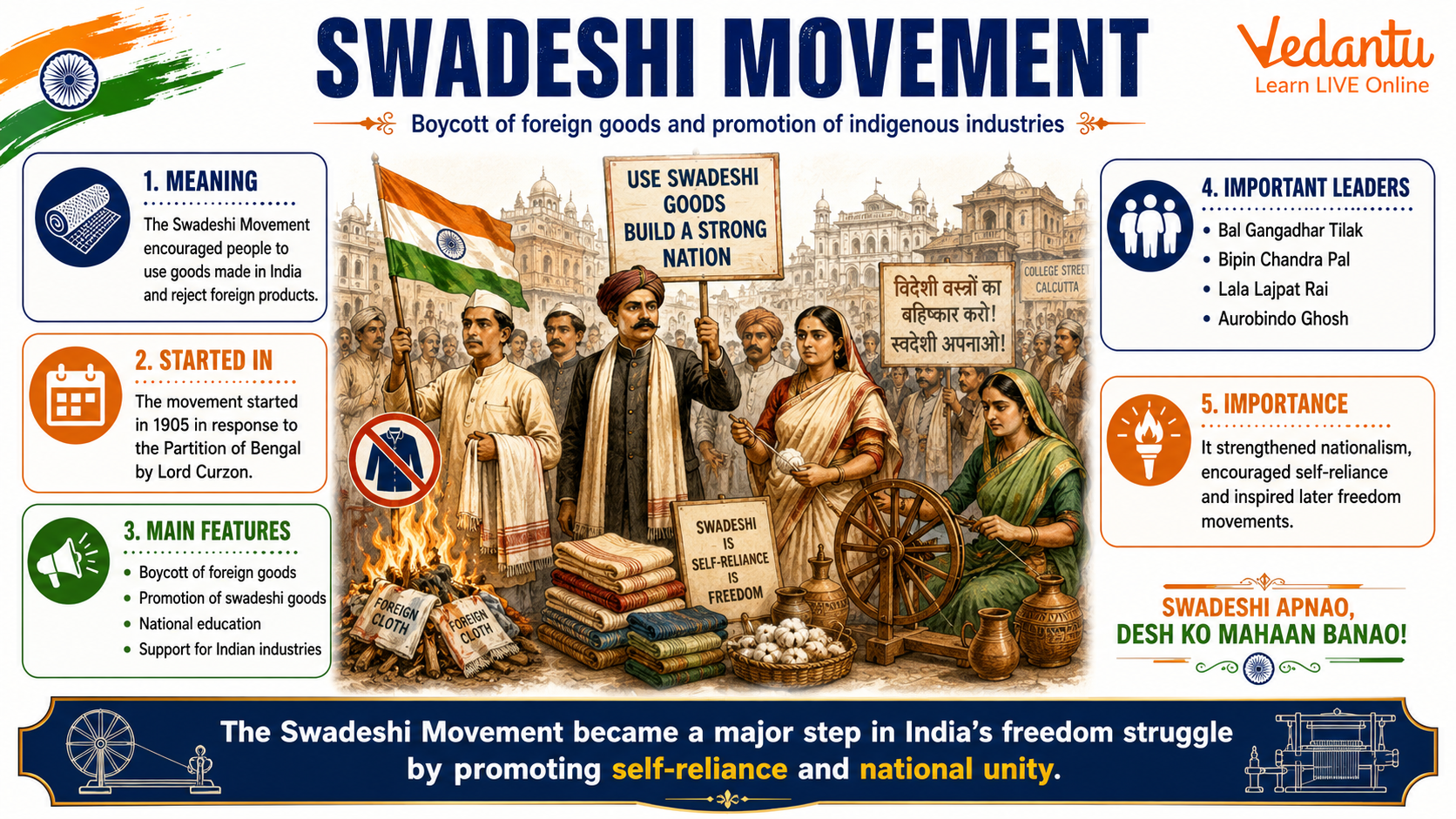
Background of the Swadeshi Movement
The immediate cause of the Swadeshi Movement was the partition of Bengal in 1905 by Lord Curzon, the then Viceroy of India. The British government claimed that the partition was for administrative convenience, but Indians believed it was an attempt to divide and weaken nationalist forces by separating Hindus and Muslims. This decision triggered widespread protests across Bengal and later in other parts of India.
- Partition of Bengal announced on 19 July 1905 and implemented on 16 October 1905
- Division of Bengal into East Bengal and Assam, and West Bengal
- Widespread dissatisfaction among Indians against British policies
Objectives of the Swadeshi Movement
The movement aimed to oppose British economic exploitation and promote self-reliance among Indians. It encouraged people to depend on Indian-made goods and revive traditional industries.
- Boycott of British goods and institutions
- Promotion of Swadeshi goods and industries
- Encouragement of national education
- Strengthening Indian nationalism
Major Leaders of the Swadeshi Movement
Several prominent nationalist leaders played a key role in organizing and spreading the Swadeshi Movement across India. They mobilized masses through speeches, writings, and public meetings.
Key Leaders and Their Contributions
| Leader | Region | Contribution |
|---|---|---|
| Bal Gangadhar Tilak | Maharashtra | Promoted boycott and mass participation |
| Bipin Chandra Pal | Bengal | Popularized Swadeshi through speeches and writings |
| Lala Lajpat Rai | Punjab | Spread the movement in northern India |
Other important leaders included Aurobindo Ghosh and Rabindranath Tagore, who inspired people through literature and cultural programs. The trio of Lal Bal Pal became symbolic of assertive nationalism during this period.
Methods Adopted During the Movement
The Swadeshi Movement used peaceful yet assertive methods to oppose British rule. It marked the beginning of organized mass protests in India.
- Boycott of foreign goods and burning of British cloth
- Promotion of Indian handloom and cottage industries
- Establishment of national schools and colleges
- Public meetings, processions, and patriotic songs
Impact and Significance
The Swadeshi Movement had a lasting impact on the Indian freedom struggle. It broadened the base of the national movement by involving students, women, and workers. It also promoted economic self-reliance and revived indigenous industries.
- Rise of extremist ideology within the Indian National Congress
- Growth of indigenous industries and national education institutions
- Spread of nationalist ideas to different parts of India
- Annulment of the partition of Bengal in 1911
Limitations of the Movement
Despite its achievements, the Swadeshi Movement had certain limitations. It was mainly confined to urban and educated sections of society and did not fully reach rural masses. Internal differences between moderates and extremists also weakened its momentum.
- Limited participation from peasants and workers in early stages
- Repression by British authorities through arrests and bans
- Split in the Indian National Congress in 1907
Swadeshi Movement in the Indian Freedom Struggle
The Swadeshi Movement was a turning point in India's struggle for independence. It introduced the idea of economic nationalism and mass agitation, which later became central to Gandhian movements like Non Cooperation and Civil Disobedience. The emphasis on self-reliance and indigenous production remains relevant in modern India under initiatives promoting local industries.
In conclusion, the Swadeshi Movement was not just a protest against the partition of Bengal but a powerful assertion of Indian identity and self-confidence. It played a crucial role in shaping the course of the Indian national movement and continues to be an important topic in General Knowledge and competitive examinations.
FAQs on Swadeshi Movement of 1905: Complete Guide for Students
1. What was the Swadeshi Movement?
The Swadeshi Movement was a mass nationalist movement launched in 1905 to oppose the Partition of Bengal by the British government.
• It promoted the use of Indian-made goods and boycott of British products.
• It encouraged self-reliance (Swadeshi) and national education.
• It became a major phase of the Indian National Movement.
• Key ideas included economic nationalism, boycott, and passive resistance.
2. Why was the Swadeshi Movement started?
The Swadeshi Movement was started in response to the Partition of Bengal in 1905 by Lord Curzon.
• The British claimed administrative convenience as the reason.
• Indians believed it was a policy of divide and rule.
• The partition aimed to divide Hindus and Muslims politically.
• It triggered widespread protests, leading to the Boycott and Swadeshi Movement.
3. Who were the main leaders of the Swadeshi Movement?
The Swadeshi Movement was led by prominent nationalist leaders advocating self-rule and economic independence.
• Bal Gangadhar Tilak
• Bipin Chandra Pal
• Lala Lajpat Rai
• Aurobindo Ghosh
• Supported by leaders of the Indian National Congress and extremist nationalists.
4. What were the main objectives of the Swadeshi Movement?
The main objective of the Swadeshi Movement was to achieve self-reliance and national unity against British rule.
• Boycott of foreign goods.
• Promotion of Swadeshi industries and indigenous products.
• Development of national education.
• Strengthening the demand for Swaraj (self-government).
5. What methods were used during the Swadeshi Movement?
The Swadeshi Movement used peaceful protest and economic boycott as its main strategies.
• Boycott of British goods and burning of foreign cloth.
• Promotion of khadi and indigenous industries.
• Organizing public meetings, processions, and strikes.
• Establishment of national schools and colleges.
• Use of songs like Vande Mataram to inspire nationalism.
6. What was the impact of the Swadeshi Movement?
The Swadeshi Movement had a significant impact on India’s freedom struggle and economic nationalism.
• Boosted Indian industries and local enterprises.
• Spread nationalist ideas across Bengal and other regions.
• Led to the growth of extremist leadership in Congress.
• The partition of Bengal was finally annulled in 1911.
• Strengthened the foundation of future movements like Non-Cooperation Movement.
7. What is the meaning of the term 'Swadeshi'?
The term Swadeshi means ‘of one’s own country’ and promotes the use of indigenous goods.
• Derived from Sanskrit: Swa (self) + Desh (country).
• Encourages self-sufficiency and economic independence.
• Opposes dependence on foreign imports.
• Closely linked with economic nationalism in India.
8. How did the Swadeshi Movement promote national education?
The Swadeshi Movement promoted national education by establishing Indian-controlled institutions.
• Setup of National Council of Education in Bengal.
• Establishment of Bengal National College.
• Emphasis on Indian history, culture, and science.
• Reduced dependence on British-controlled educational institutions.
9. When did the Swadeshi Movement end?
The Swadeshi Movement gradually declined after 1908 but achieved partial success in 1911.
• Government repression and arrests weakened the movement.
• Internal differences within the Indian National Congress.
• The Partition of Bengal was revoked in 1911.
• However, its spirit continued in later freedom movements.
10. What is the significance of the Swadeshi Movement in Indian history?
The Swadeshi Movement is significant as it marked the rise of mass nationalism and economic resistance in India.
• First large-scale use of boycott and passive resistance.
• Encouraged indigenous industries and self-reliance.
• Strengthened the demand for Swaraj.
• Inspired later movements like Non-Cooperation and Civil Disobedience Movement.
• Played a crucial role in shaping the Indian Freedom Struggle.
