






What Does the IND Mark on Indian Number Plates Signify Under RTO Rules?
The word IND written on Indian vehicle number plates stands for India. It represents the country of registration of the vehicle and is part of the standardized High Security Registration Plate system introduced by the Government of India. The inclusion of IND on number plates enhances vehicle identification, promotes uniformity across states, and aligns Indian vehicle registration with international standards. Understanding why IND is written on number plates is important for general knowledge, competitive exams, and awareness of transport regulations in India.
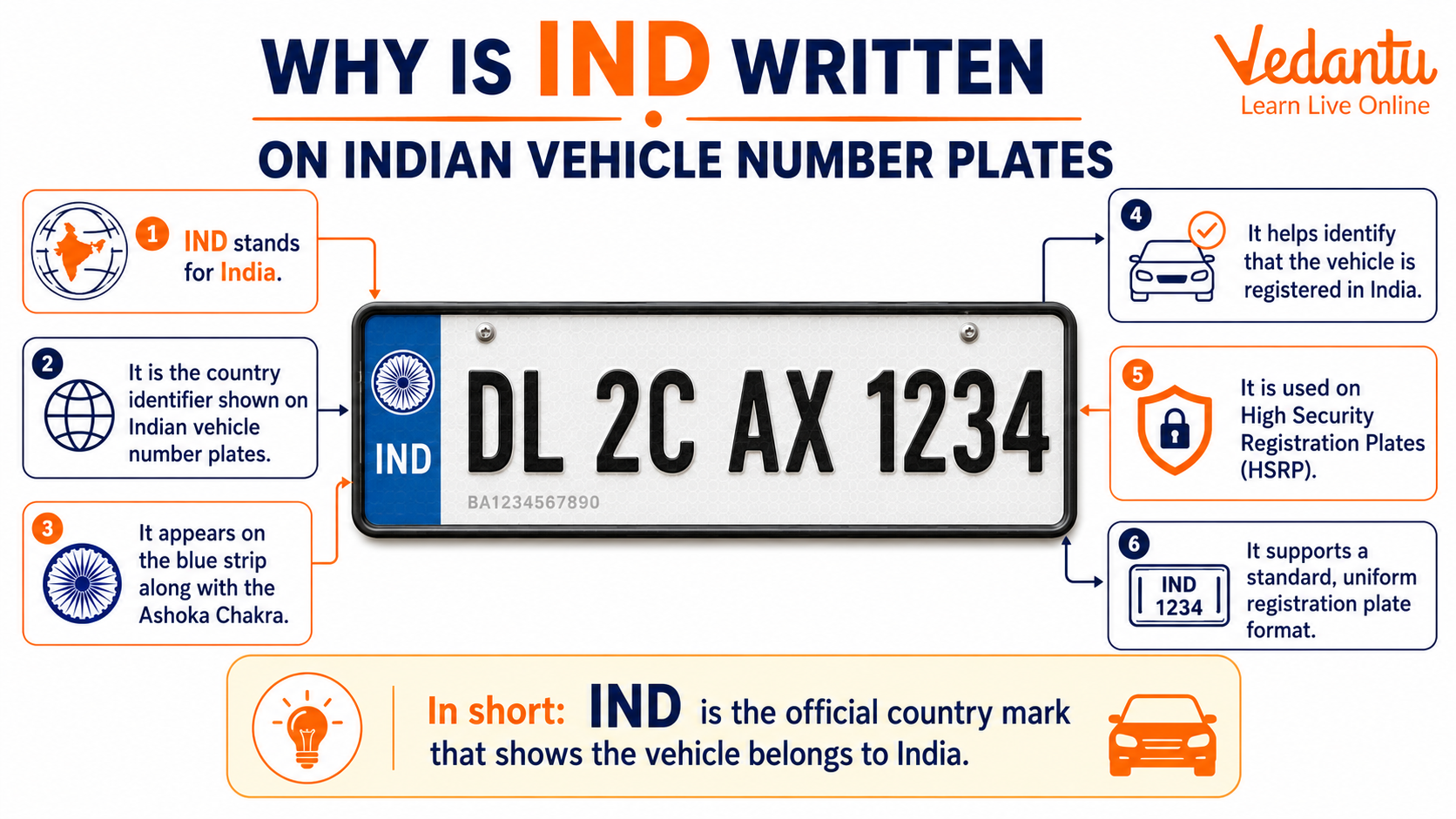
What Does IND Mean on Indian Number Plates?
IND is the international country code for India. It is printed in blue color on the left side of the number plate along with the Ashoka Chakra symbol. This marking identifies the vehicle as registered in India and complies with global vehicle registration norms.
- IND stands for India.
- It is part of the High Security Registration Plate (HSRP).
- It appears on the left side of the number plate.
- It includes the Ashoka Chakra symbol above it.
Why Is IND Written on Indian Vehicle Number Plates?
The Government of India introduced the IND marking to standardize vehicle registration plates across the country and to improve security. It serves multiple purposes related to identification, regulation, and international compliance.
1. International Identification
When Indian vehicles travel abroad or are identified internationally, the IND code helps recognize the country of registration. Similar codes are used by many countries worldwide.
2. Uniformity Across States
India has different states and union territories, each with its own registration code. The IND marking ensures a common national identity regardless of the state code.
3. Enhanced Security
The IND mark is part of the High Security Registration Plate system introduced in 2001. These plates are tamper-proof and reduce vehicle theft and duplication.
4. Compliance with Central Motor Vehicles Rules
As per the Central Motor Vehicles Rules, 1989, the inclusion of IND and HSRP features is mandatory for vehicles registered in India.
Structure of an Indian Vehicle Number Plate
An Indian vehicle number plate consists of multiple components that provide specific information about the vehicle's registration.
Components of an Indian Number Plate
| Component | Example | Meaning |
|---|---|---|
| Country Code | IND | Represents India |
| State Code | MH | Represents State (Maharashtra) |
| RTO Code | 12 | Specific Regional Transport Office |
| Unique Number | AB 1234 | Unique vehicle registration number |
Each part of the number plate provides important information about the vehicle's origin and registration authority. The IND mark confirms the vehicle is registered in India, while the state and RTO codes specify the exact location.
Features of High Security Registration Plates (HSRP)
The IND marking is part of the High Security Registration Plate system, which includes several security features to prevent fraud and misuse.
- Chromium-based hologram of the Ashoka Chakra.
- Laser-etched IND inscription.
- Unique serial number for tracking.
- Non-removable snap lock to prevent tampering.
Importance in Competitive Exams
Questions related to vehicle registration, national symbols, and transport rules are commonly asked in competitive exams such as SSC, Banking, Railways, State PSC, and other government exams. Knowing that IND represents India and is part of the HSRP system can help in answering objective type questions accurately.
Key Points to Remember
- IND stands for India and is the international country code.
- It appears on all High Security Registration Plates in India.
- It ensures uniformity and international identification.
- It is mandatory under the Central Motor Vehicles Rules.
Conclusion
The word IND on Indian vehicle number plates is more than just a label. It represents national identity, ensures compliance with international standards, and enhances vehicle security. Introduced as part of the High Security Registration Plate system, it plays a crucial role in standardizing vehicle registration across India. Understanding this concept strengthens general knowledge and helps in competitive exam preparation.
FAQs on Why Is Ind Written On Indian Vehicle Number Plates and What Does It Mean?
1. Why is IND written on Indian vehicle number plates?
The term IND on Indian vehicle number plates represents India as per international vehicle registration standards.
- It is the official international country code for India.
- Introduced under the High-Security Registration Plate (HSRP) system.
- Helps identify Indian vehicles in international travel and border crossings.
- Enhances authenticity and prevents vehicle registration fraud.
This marking aligns with global transport norms and improves identification of vehicles registered in India.
2. What does IND stand for on number plates?
The abbreviation IND stands for Republic of India in vehicle registration systems.
- It is India’s official ISO country code for road transport.
- Printed in blue on the left side of number plates.
- Placed along with the Ashoka Chakra symbol.
The use of IND ensures that Indian vehicles are easily recognized both nationally and internationally.
3. When was IND introduced on Indian number plates?
The IND marking was introduced in the early 2000s with the launch of the High-Security Registration Plate (HSRP) scheme.
- Implemented under the Ministry of Road Transport and Highways.
- Made mandatory to reduce vehicle theft and duplication.
- Standardized across all Indian states and union territories.
This reform modernized India’s vehicle registration system and improved security features.
4. Is IND mandatory on all Indian vehicles?
Yes, IND is mandatory on all new vehicles registered under the HSRP system in India.
- Required for cars, bikes, trucks, and commercial vehicles.
- Older vehicles were also directed to shift to HSRP plates.
- Ensures uniformity in vehicle identification.
The rule promotes standardization and strengthens transport law enforcement across India.
5. What is the significance of the blue strip with IND on number plates?
The blue strip with IND signifies international registration compliance and national identity.
- Contains the Ashoka Chakra symbol.
- Displays the country code IND.
- Follows global vehicle registration norms.
This feature improves security, prevents counterfeiting, and clearly marks the vehicle as registered in India.
6. How does IND on number plates help in international travel?
The IND code helps foreign authorities quickly identify vehicles registered in India.
- Required during cross-border road travel.
- Recognized under international transport conventions.
- Simplifies customs and verification procedures.
Thus, IND ensures smooth vehicle identification beyond Indian borders.
7. What is HSRP and how is it connected to IND?
The High-Security Registration Plate (HSRP) is a tamper-proof number plate system that includes the IND marking.
- Made of aluminum with laser-etched codes.
- Includes a unique identification number.
- Features the blue IND strip for authenticity.
HSRP was introduced to enhance vehicle security and reduce registration fraud in India.
8. Does IND replace the state code on number plates?
No, IND does not replace the state code; it appears alongside it.
- IND indicates the country (India).
- The state code (like DL, MH, KA) shows the registration state.
- Both are essential parts of the vehicle registration number.
Together, they provide complete information about the vehicle’s registration origin.
9. What are the main features of Indian number plates with IND?
Indian number plates with IND include several standardized security features.
- Blue strip with IND and Ashoka Chakra.
- Chromium-based hologram sticker.
- Laser-engraved serial number.
- Tamper-proof locking system.
These features improve road safety, prevent duplication, and ensure compliance with transport regulations.
10. Why was the IND marking introduced in India?
The IND marking was introduced to enhance security and standardization in vehicle registration.
- To prevent fake and duplicate number plates.
- To comply with international vehicle identification norms.
- To create a uniform system across Indian states.
This reform strengthened India’s transport system and improved vehicle tracking and law enforcement.
