






How Eco-Friendly Firecrackers Help Reduce Pollution
Green Crackers are eco-friendly fireworks designed to reduce air and noise pollution compared to traditional crackers. They were introduced in India as a sustainable alternative to conventional firecrackers, especially during festivals like Diwali. Developed under the guidance of scientific institutions such as the Council of Scientific and Industrial Research - CSIR, green crackers aim to minimize harmful emissions while preserving the celebratory spirit. They are considered a significant step toward balancing cultural traditions with environmental protection.
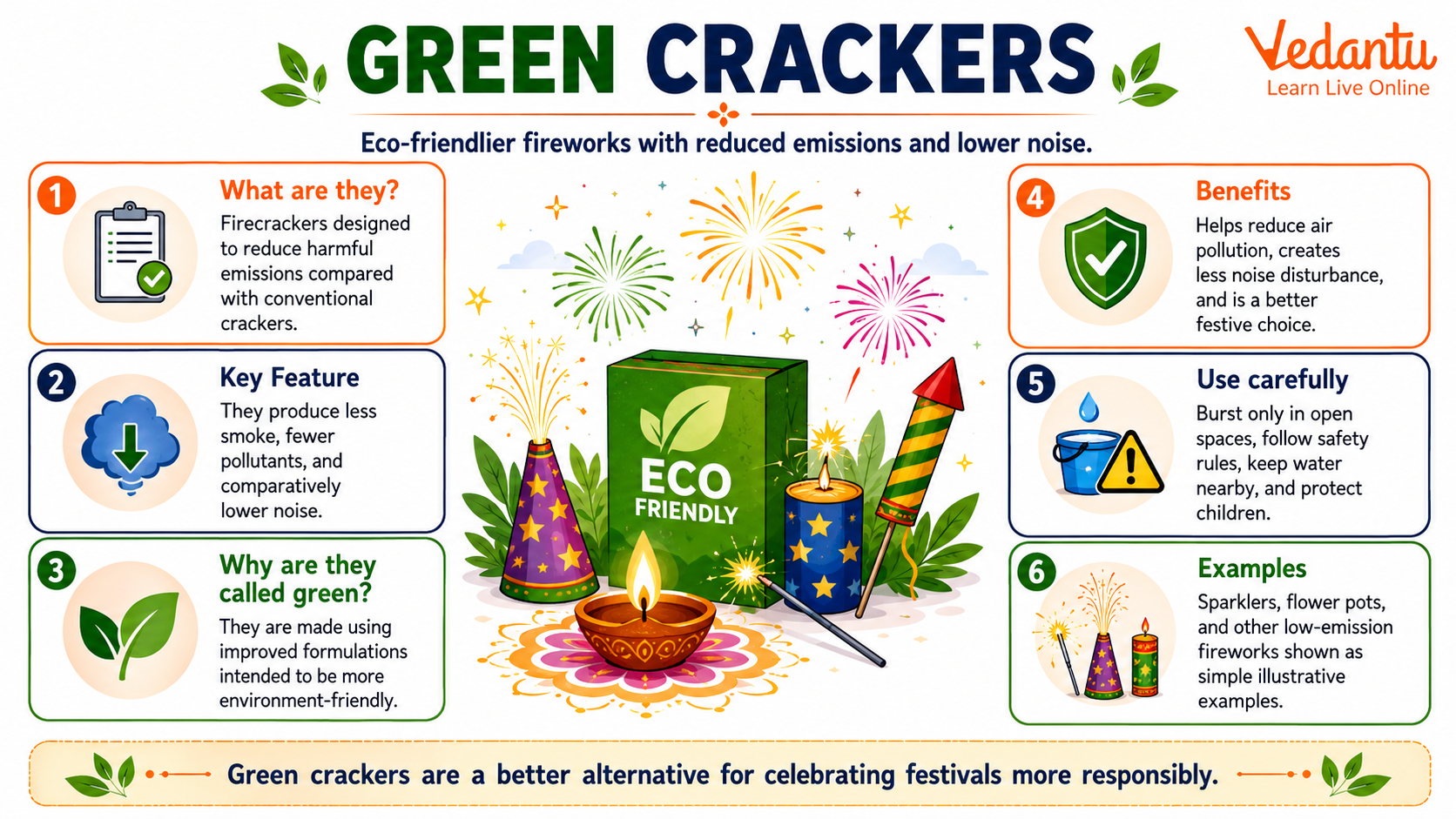
What Are Green Crackers?
Green crackers are modified fireworks that emit lower levels of particulate matter and harmful gases. They are manufactured using reduced quantities of hazardous chemicals and are designed to produce less noise and smoke. These crackers are approved by authorized scientific bodies and must carry a unique QR code for verification.
- Emit up to 30 percent less particulate matter compared to traditional crackers
- Produce lower noise levels within prescribed limits
- Contain fewer toxic chemicals such as barium compounds
- Carry QR codes for authenticity and traceability
Why Were Green Crackers Introduced?
Air pollution levels in India, especially during festivals, often exceed safe limits due to the bursting of firecrackers. Traditional crackers release harmful pollutants such as sulfur dioxide, nitrogen oxides, and particulate matter, which worsen respiratory problems. To address these concerns, the Supreme Court of India encouraged the development and use of green crackers.
Green crackers were introduced to reduce environmental damage while respecting cultural practices. Their use helps in controlling smog formation and protecting vulnerable groups such as children, elderly people, and individuals with asthma.
Types of Green Crackers
CSIR has developed different categories of green crackers based on composition and emission control technologies.
1. SWAS - Safe Water Releaser
SWAS crackers release small amounts of water vapor to suppress dust and reduce particulate emissions. They are designed to lower smoke levels significantly.
2. STAR - Safe Thermite Cracker
STAR crackers eliminate the use of potassium nitrate and sulfur, thereby reducing harmful emissions. They produce reduced noise and light effects.
3. SAFAL - Safe Minimal Aluminium
SAFAL crackers use minimal aluminum content to decrease particulate matter release. They are designed to generate lower environmental impact compared to conventional fireworks.
Difference Between Traditional Crackers and Green Crackers
| Feature | Traditional Crackers | Green Crackers |
|---|---|---|
| Pollution Level | High emission of smoke and gases | Reduced emission up to 30 percent |
| Noise Level | Often exceeds safe limits | Within prescribed noise limits |
| Chemical Composition | Contains harmful chemicals like barium | Reduced toxic chemical content |
The above table highlights the key differences between traditional and green crackers. Green crackers are specifically engineered to lower environmental and health risks while maintaining festive enjoyment.
Advantages of Green Crackers
- Reduced air pollution and smog formation
- Lower risk of respiratory and cardiovascular issues
- Compliance with environmental regulations
- Safer noise levels for humans and animals
Limitations of Green Crackers
Although green crackers are less harmful, they are not completely pollution-free. They still release some amount of particulate matter and gases. In areas with already high pollution levels, even reduced emissions can contribute to health concerns. Therefore, controlled and limited use is recommended.
Regulations and Guidelines
The Supreme Court of India has laid down guidelines for the manufacture and sale of green crackers. Only licensed manufacturers can produce them, and each product must have a QR code for verification. Fireworks are permitted only during specified time slots to minimize environmental impact.
- Use only certified green crackers
- Burst crackers during permitted hours
- Avoid use in highly polluted areas
Importance in Environmental Conservation
Green crackers represent an important environmental initiative in India. They promote awareness about sustainable celebrations and encourage scientific innovation for pollution control. By choosing eco-friendly alternatives, individuals contribute to cleaner air and healthier communities.
Conclusion
Green Crackers are a practical solution aimed at reducing the environmental impact of festive celebrations. While they are not completely pollution-free, they significantly reduce harmful emissions and noise levels compared to traditional crackers. Their development reflects a balance between cultural traditions and environmental responsibility, making them an important topic in general knowledge and environmental studies.
FAQs on Green Crackers: Meaning, Benefits, and Uses
1. What are Green Crackers?
Green Crackers are eco-friendly firecrackers designed to reduce air and noise pollution during celebrations like Diwali.
- Developed by the Council of Scientific and Industrial Research (CSIR)
- Emit 30–40% less harmful pollutants than traditional crackers
- Produce lower levels of PM2.5, PM10, sulfur dioxide, and nitrogen oxides
- Designed to control noise pollution within permissible limits
They are often searched as eco-friendly crackers, low-pollution firecrackers, and environment-friendly fireworks.
2. Who invented Green Crackers in India?
Green Crackers were developed by the CSIR-NEERI (National Environmental Engineering Research Institute) in India.
- Introduced in 2018
- Created to reduce the environmental impact of traditional firecrackers
- Approved by the Supreme Court of India under regulated use
This initiative supports clean air campaigns and pollution control measures during festive seasons.
3. How are Green Crackers different from traditional crackers?
Green Crackers differ from traditional crackers mainly in their reduced emission and safer chemical composition.
- Use less harmful chemicals
- Reduce particulate matter (PM) emission by 30–40%
- Produce lower noise levels (within 125 decibels limit)
- Contain unique formulations like SWAS, SAFAL, and STAR
They are considered better alternatives to conventional fireworks for sustainable celebrations.
4. What are the types of Green Crackers?
Green Crackers are categorized into three main types based on their chemical formulation.
- SWAS (Safe Water Releaser) – Releases water vapor to reduce dust
- STAR (Safe Thermite Crackers) – Reduces particulate emissions
- SAFAL (Safe Minimal Aluminium) – Minimizes aluminium content
These types aim to control air pollution and promote eco-conscious festival practices.
5. Why are Green Crackers important for the environment?
Green Crackers are important because they help reduce the harmful environmental impact of festive fireworks.
- Lower emission of toxic gases
- Reduce smog formation in cities
- Decrease respiratory health risks
- Help maintain better Air Quality Index (AQI)
They support campaigns against air pollution, climate change, and environmental degradation.
6. Are Green Crackers completely pollution-free?
Green Crackers are not completely pollution-free but are less harmful than traditional firecrackers.
- Reduce emissions by about 30–40%
- Still produce some smoke and sound
- Must be used within government-approved time limits
They are a better alternative, but not a zero-pollution solution for sustainable celebrations.
7. How can you identify genuine Green Crackers?
Genuine Green Crackers can be identified through official markings and QR codes.
- Look for the CSIR logo on packaging
- Check the QR code for authenticity
- Verify manufacturer details approved by authorities
This helps avoid fake products and ensures compliance with environmental safety standards.
8. What are the rules for using Green Crackers in India?
The use of Green Crackers is regulated by the Supreme Court of India and pollution control boards.
- Allowed only during specified time slots (usually 2 hours during festivals)
- Only licensed manufacturers can produce them
- Complete ban in highly polluted zones if AQI is severe
These rules aim to control noise pollution and maintain safe air quality levels.
9. What chemicals are reduced in Green Crackers?
Green Crackers reduce or replace harmful chemicals used in traditional fireworks.
- Lower use of barium salts
- Reduced aluminium content
- Controlled emission of sulfur dioxide and nitrogen oxides
- Use of alternative oxidizers for safer combustion
This makes them relatively safer for people with asthma and respiratory problems.
10. Why are Green Crackers promoted during Diwali?
Green Crackers are promoted during Diwali to reduce the spike in air and noise pollution caused by fireworks.
- Help prevent severe smog after celebrations
- Protect children, elderly, and pets from harmful effects
- Support the idea of a safe and sustainable Diwali
- Encourage environmental awareness among citizens
They align with campaigns like Say No to Pollution and promote eco-friendly festive traditions.
