






Chronological List of INC Sessions Before 1947 with Presidents and Key Resolutions
The Sessions of Indian National Congress Before Independence played a crucial role in shaping the Indian freedom struggle. Established in 1885, the Indian National Congress - INC became the central platform for political dialogue, reform demands, and mass movements against British rule. Each annual session marked important resolutions, leadership changes, and strategic shifts in the freedom movement. Understanding these sessions is essential for students preparing for competitive exams and for anyone interested in Indian history.
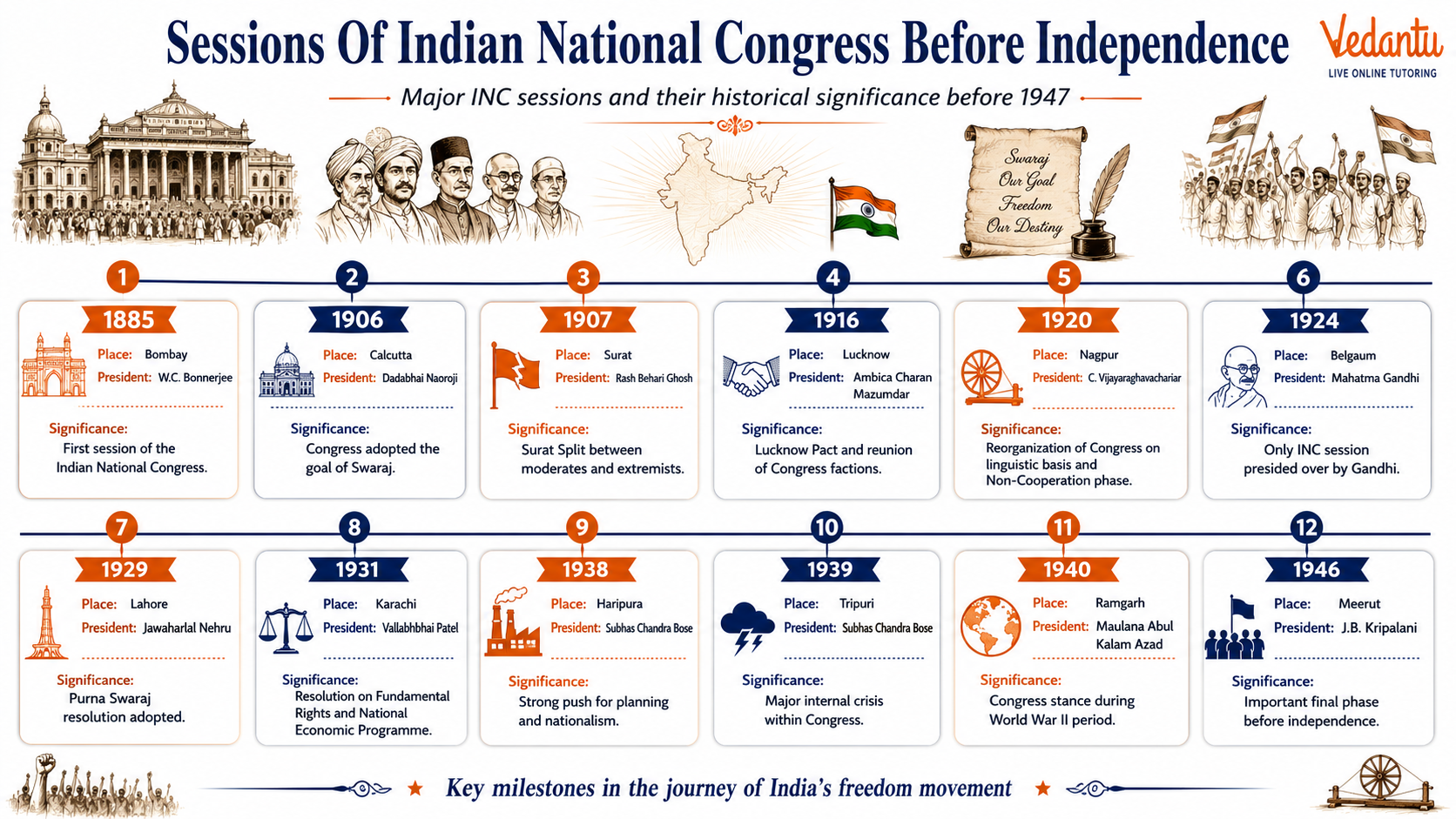
Introduction to Indian National Congress Sessions
The Indian National Congress was founded on 28 December 1885 in Bombay by A.O. Hume along with Indian leaders like Dadabhai Naoroji and Dinshaw Wacha. The annual sessions of the Congress provided a platform to discuss political reforms, constitutional demands, and later complete independence from British rule. These sessions were presided over by prominent national leaders and often marked turning points in the freedom struggle.
Phases of Congress Before Independence
- Moderate Phase - 1885 to 1905
- Extremist Phase - 1905 to 1919
- Gandhian Phase - 1919 to 1947
Each phase reflected changes in leadership, ideology, and methods of protest against British policies.
Important Sessions of Indian National Congress Before Independence
Major INC Sessions and Their Significance
| Year and Place | President | Significance |
|---|---|---|
| 1885 - Bombay | W.C. Bonnerjee | First session of INC |
| 1906 - Calcutta | Dadabhai Naoroji | Demand for Swaraj |
| 1907 - Surat | Rash Behari Ghosh | Split between Moderates and Extremists |
| 1916 - Lucknow | Ambica Charan Mazumdar | Lucknow Pact with Muslim League |
| 1917 - Calcutta | Annie Besant | First woman president of INC |
| 1920 - Nagpur | C. Vijayaraghavachariar | Reorganization and Non Cooperation approval |
| 1924 - Belgaum | Mahatma Gandhi | Only session presided by Gandhi |
| 1929 - Lahore | Jawaharlal Nehru | Poorna Swaraj resolution |
| 1931 - Karachi | Sardar Vallabhbhai Patel | Resolution on Fundamental Rights |
| 1938 - Haripura | Subhas Chandra Bose | National Planning Committee formation |
| 1939 - Tripuri | Subhas Chandra Bose | Internal conflict leading to resignation |
| 1942 - Bombay | Maulana Abul Kalam Azad | Quit India Movement resolution |
These sessions reflect the evolution of Congress from a moderate reform body to a mass movement demanding complete independence from British rule.
Key Resolutions Passed in Important Sessions
Swaraj Resolution - 1906
At the Calcutta session of 1906, Dadabhai Naoroji declared Swaraj as the goal of the Congress. This marked a shift from mere constitutional reforms to self government.
Poorna Swaraj Resolution - 1929
During the Lahore session under Jawaharlal Nehru, the Congress declared complete independence as its ultimate goal. 26 January 1930 was celebrated as Independence Day across India.
Karachi Resolution - 1931
The Karachi session emphasized Fundamental Rights and National Economic Program. It laid the foundation for future constitutional development in independent India.
Quit India Resolution - 1942
The Bombay session of 1942 launched the Quit India Movement under Mahatma Gandhi with the slogan Do or Die. This became one of the most intense phases of the freedom struggle.
Importance of INC Sessions in Freedom Struggle
- Provided a united political platform for Indians
- Formulated strategies against British policies
- Promoted national unity across regions and communities
- Introduced democratic practices through debates and elections
- Laid the foundation for constitutional governance in India
Frequently Asked Facts for Exams
- First session of INC - 1885, Bombay
- First woman president - Annie Besant, 1917
- First Indian woman president - Sarojini Naidu, 1925 Kanpur session
- Only session presided by Mahatma Gandhi - 1924 Belgaum
- Poorna Swaraj resolution - 1929 Lahore
- Quit India resolution - 1942 Bombay
Conclusion
The Sessions of Indian National Congress Before Independence were milestones in India’s journey toward freedom. From demanding administrative reforms to declaring complete independence, each session reflected the changing aspirations of the Indian people. These sessions not only shaped the national movement but also laid the groundwork for democratic governance in independent India. A clear understanding of these sessions is essential for academic studies and competitive examinations.
FAQs on Sessions of the Indian National Congress Before Independence: Complete List and Historical Importance
1. What was the first session of the Indian National Congress?
The first session of the Indian National Congress (INC) was held in 1885 in Bombay (Mumbai) under the leadership of Womesh Chandra Bonnerjee.
• Founded by A.O. Hume, a retired British civil servant.
• Held from 28–31 December 1885.
• Attended by 72 delegates from across India.
• Marked the beginning of the Indian National Movement and organized political activity against British rule.
2. Who founded the Indian National Congress and why?
The Indian National Congress was founded in 1885 by A.O. Hume to create a platform for political dialogue between Indians and the British government.
• Objective: Promote civil and political rights for Indians.
• Provided a forum for expressing nationalist demands.
• Initially followed a moderate approach seeking constitutional reforms.
• Played a key role in shaping the freedom struggle before independence.
3. Which INC session demanded Purna Swaraj (Complete Independence)?
The demand for Purna Swaraj (Complete Independence) was adopted in the Lahore Session of 1929 under Jawaharlal Nehru.
• Declared 26 January 1930 as Independence Day.
• Shifted demand from Dominion Status to full independence.
• Led to the launch of the Civil Disobedience Movement.
• Marked a turning point in the Indian freedom movement.
4. What was special about the Surat Session of 1907?
The Surat Session (1907) is known for the split between the Moderates and Extremists in the Indian National Congress.
• Leaders involved: Bal Gangadhar Tilak, Lala Lajpat Rai, Bipin Chandra Pal.
• Conflict over methods of protest against British rule.
• Moderates favored constitutional methods; Extremists supported aggressive nationalism.
• Resulted in weakening of Congress unity for several years.
5. Which session of INC was presided over by Mahatma Gandhi?
Mahatma Gandhi presided over the Belgaum Session of 1924, the only INC session he chaired.
• Focused on promoting Hindu-Muslim unity.
• Strengthened the principles of non-violence (Ahimsa) and Satyagraha.
• Emphasized constructive programs like Khadi and rural development.
• Significant in consolidating Gandhian leadership in the national movement.
6. What was the importance of the Lucknow Session of 1916?
The Lucknow Session (1916) is famous for the Lucknow Pact between the INC and the Muslim League.
• President: Ambika Charan Mazumdar.
• Agreement on separate electorates for Muslims.
• Promoted Hindu-Muslim unity against British rule.
• Strengthened the national movement during World War I.
7. Which INC session led to the launch of the Non-Cooperation Movement?
The Calcutta Session (1920) followed by the Nagpur Session (1920) approved the Non-Cooperation Movement under Mahatma Gandhi.
• Protest against the Rowlatt Act and Jallianwala Bagh Massacre.
• Boycott of British goods, schools, and courts.
• Promotion of Swadeshi and national education.
• Marked the beginning of mass participation in the freedom struggle.
8. What was the significance of the Karachi Session of 1931?
The Karachi Session (1931) is known for adopting the resolution on Fundamental Rights and National Economic Programme.
• President: Sardar Vallabhbhai Patel.
• Endorsed the Gandhi-Irwin Pact.
• Laid the foundation for future constitutional rights in India.
• Emphasized civil liberties, labor rights, and equality.
9. Which INC session accepted the Cabinet Mission Plan?
The Bombay Session of 1946 accepted the Cabinet Mission Plan, paving the way for India’s independence.
• Formation of the Constituent Assembly.
• Proposed a federal structure for India.
• Attempted to prevent partition.
• Crucial step before the Indian Independence Act 1947.
10. How did the sessions of the Indian National Congress contribute to India’s independence?
The sessions of the Indian National Congress before independence shaped policies, strategies, and mass movements against British rule.
• Passed key resolutions like Purna Swaraj and Non-Cooperation.
• United leaders such as Gandhi, Nehru, Patel, and Tilak.
• Promoted national unity and political awareness.
• Laid the foundation for the Indian Constitution and democratic governance.
