






Key Socioreligious Reformers in 19th Century India and Their Contributions
Socioreligious Reform Movements in India were significant efforts undertaken during the 19th and early 20th centuries to reform Indian society and religion. These movements emerged as a response to social evils, rigid traditions, caste discrimination, gender inequality, and the impact of British colonial rule. Reformers aimed to purify religion, promote rational thinking, encourage education, and bring social justice. Understanding these movements is important for students and competitive exam aspirants as they shaped modern Indian society and contributed to the national awakening.
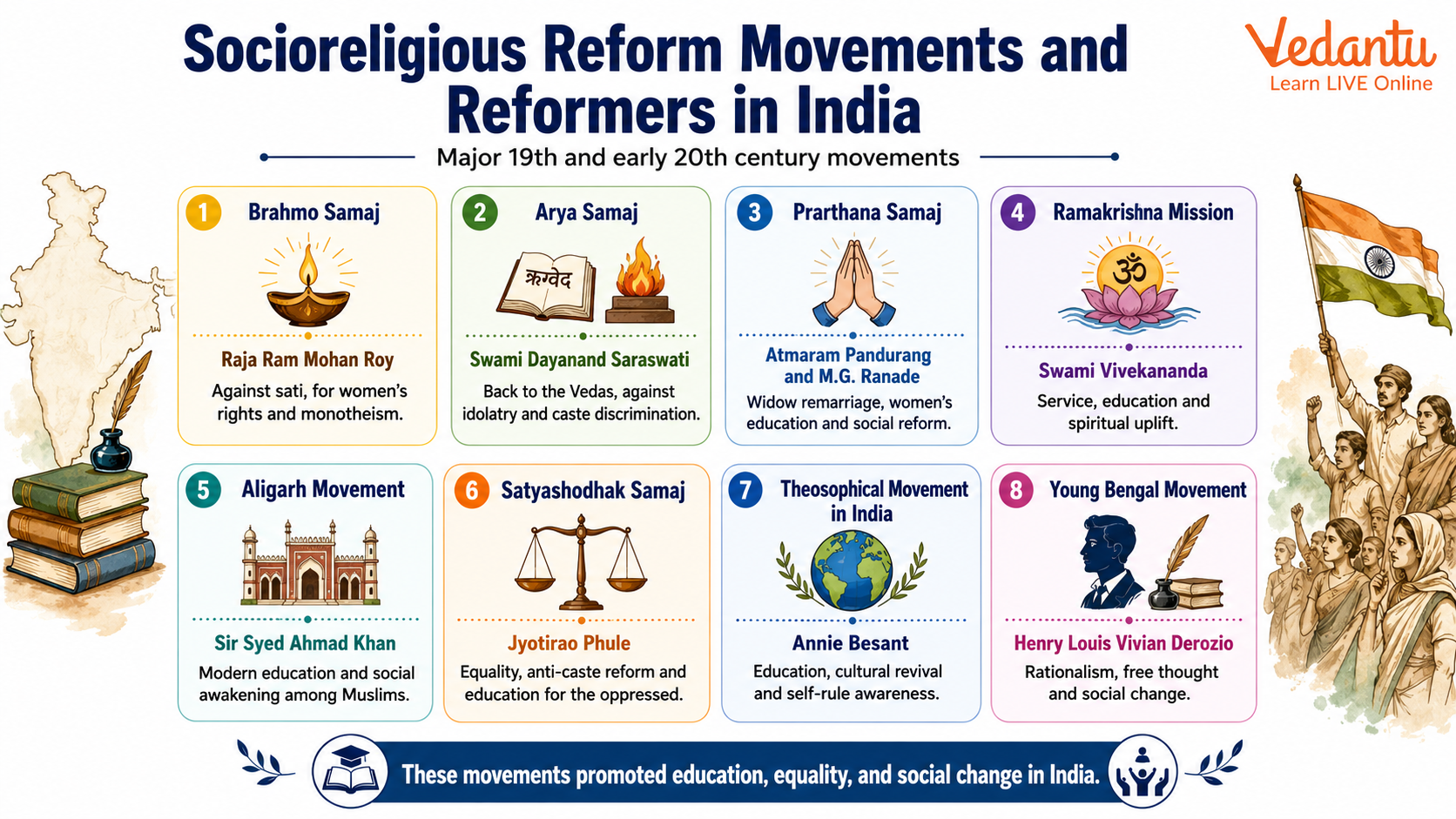
Background of Socioreligious Reform Movements
The 19th century witnessed major changes in India due to British rule. Western education, Christian missionary activities, and exposure to modern ideas such as liberty, equality, and rationalism influenced Indian thinkers. At the same time, Indian society was suffering from social evils like sati, child marriage, caste rigidity, and lack of women's education. Reformers sought to remove these evils while preserving the core spiritual values of Indian religions.
- Spread of Western education and modern ideas
- Influence of Christian missionaries
- Social evils like sati, child marriage, and caste discrimination
- Growth of print media and newspapers
- Need for social and religious reform
Major Socioreligious Reform Movements in India
Brahmo Samaj
Founded by Raja Ram Mohan Roy in 1828, the Brahmo Samaj aimed to reform Hinduism by removing idol worship, caste discrimination, and superstitions. It promoted monotheism, women's education, and the abolition of sati. Raja Ram Mohan Roy is often called the Father of Indian Renaissance.
Arya Samaj
Founded by Swami Dayanand Saraswati in 1875, Arya Samaj emphasized returning to the pure teachings of the Vedas. It opposed idol worship, caste by birth, and social inequalities. The movement also promoted education through the establishment of DAV schools and colleges.
Prarthana Samaj
Established in 1867 in Bombay by Atmaram Pandurang, this movement focused on social reform, including widow remarriage, women's education, and abolition of caste restrictions. It was influenced by the Brahmo Samaj.
Ramakrishna Mission
Founded by Swami Vivekananda in 1897, based on the teachings of Ramakrishna Paramahamsa, the mission promoted practical Vedanta and social service. It worked in the fields of education, healthcare, and relief activities.
Aligarh Movement
Started by Sir Syed Ahmad Khan, this movement aimed to promote modern education among Muslims. The establishment of the Muhammadan Anglo Oriental College, later Aligarh Muslim University, was a major achievement.
Theosophical Society
Founded in India by Annie Besant and others, the society promoted universal brotherhood and revival of ancient Indian religions. It also contributed to the spread of education and nationalist ideas.
Important Reformers and Their Contributions
| Reformer | Movement | Key Contributions |
|---|---|---|
| Raja Ram Mohan Roy | Brahmo Samaj | Abolition of sati, promotion of women's rights |
| Swami Dayanand Saraswati | Arya Samaj | Return to Vedas, opposition to idol worship |
| Swami Vivekananda | Ramakrishna Mission | Promotion of practical Vedanta and service |
| Sir Syed Ahmad Khan | Aligarh Movement | Modern education for Muslims |
These reformers played a crucial role in modernizing Indian society and laying the foundation for social equality and national unity.
Key Features of Socioreligious Reform Movements
- Emphasis on monotheism and rejection of superstitions
- Promotion of women's rights and education
- Opposition to caste discrimination and untouchability
- Encouragement of rational thinking and scientific temper
- Revival and reinterpretation of ancient scriptures
Impact on Indian Society
The socioreligious reform movements had a lasting impact on Indian society. They helped in the abolition of social evils such as sati and promoted widow remarriage. These movements encouraged education among women and marginalized communities. They also fostered a spirit of nationalism and unity, which later contributed to the Indian freedom struggle.
Importance for Competitive Exams
Questions related to socioreligious reform movements are frequently asked in General Knowledge sections of competitive exams. Students should focus on founders, years of establishment, objectives, and major contributions of each movement. Comparative understanding of different movements is also important for multiple choice and descriptive questions.
- Remember founders and years of establishment
- Understand the main objectives and reforms
- Link movements with their social impact
- Revise contributions of major reformers
Conclusion
Socioreligious Reform Movements and Reformers in India played a transformative role in shaping modern Indian society. They challenged outdated customs, promoted equality, and encouraged intellectual awakening. These movements not only reformed religion and society but also strengthened the foundation of Indian nationalism. A clear understanding of these movements helps students appreciate India's social evolution and prepares them effectively for competitive examinations.
FAQs on Socioreligious Reform Movements in India and Their Reform Leaders
1. What were the Socioreligious Reform Movements in India?
The Socioreligious Reform Movements in India were 19th and early 20th century movements aimed at reforming Indian society and religion.
Key features include:
• Removal of social evils like sati, child marriage, and caste discrimination
• Promotion of women’s education and widow remarriage
• Revival and reinterpretation of Hinduism, Islam, and other religions
• Spread of modern education and rational thinking
These movements played a major role in the Indian Renaissance and laid the foundation for Indian nationalism.
2. Who was Raja Ram Mohan Roy and what was his contribution?
Raja Ram Mohan Roy was a pioneer of the Brahmo Samaj and a key leader of socioreligious reform in India.
His major contributions include:
• Abolition of Sati system (1829)
• Promotion of women’s rights and education
• Opposition to idol worship and caste rigidity
• Support for modern education and press freedom
He is often called the Father of Modern India for initiating social and religious reforms.
3. What was the Brahmo Samaj and why was it important?
The Brahmo Samaj, founded in 1828 by Raja Ram Mohan Roy, aimed to reform Hindu society and promote monotheism.
Its importance lies in:
• Belief in one God and rejection of idol worship
• Campaign against social evils
• Promotion of women’s education and widow remarriage
• Encouragement of rationalism and social equality
It was a major force in the Indian social reform movement.
4. What were the objectives of the Arya Samaj?
The Arya Samaj, founded by Swami Dayanand Saraswati in 1875, aimed to revive Vedic values.
Main objectives include:
• Return to the teachings of the Vedas
• Opposition to idol worship and caste discrimination
• Promotion of women’s education
• Support for the Shuddhi Movement (reconversion)
The Arya Samaj strengthened Hindu reform movements and social awakening in India.
5. What role did Swami Vivekananda play in socioreligious reform?
Swami Vivekananda spread the message of Vedanta and universal brotherhood through the Ramakrishna Mission.
His contributions include:
• Emphasis on service to humanity
• Promotion of religious tolerance and harmony
• Inspiring Indian youth towards nationalism
• Representing Hinduism at the Chicago Parliament of Religions (1893)
He linked spiritual reform with national awakening.
6. What was the Aligarh Movement?
The Aligarh Movement, led by Sir Syed Ahmed Khan, aimed to modernize Muslim society in India.
Key aspects include:
• Promotion of Western education
• Establishment of Mohammedan Anglo-Oriental College (1875)
• Encouragement of scientific and rational thinking
• Social reform within the Muslim community
It played a significant role in Muslim social and educational reform.
7. How did socioreligious reform movements impact Indian society?
The socioreligious reform movements transformed Indian society by promoting equality and modern values.
Major impacts include:
• Abolition of Sati and other harmful practices
• Growth of women’s rights and education
• Decline of caste discrimination
• Rise of national consciousness
These reforms contributed to the development of modern India and strengthened the freedom movement.
8. What was the Prarthana Samaj?
The Prarthana Samaj, founded in 1867 in Bombay, aimed at social reform within Hindu society.
Its main goals were:
• Promotion of monotheism
• Support for widow remarriage and women’s education
• Opposition to caste discrimination
• Emphasis on social service
It was influenced by the Brahmo Samaj and contributed to social reform in Western India.
9. What was the Theosophical Society and its role in India?
The Theosophical Society, led by Annie Besant in India, promoted spiritual unity and revival of ancient religions.
Its role includes:
• Promotion of Hindu and Buddhist philosophy
• Support for women’s education
• Establishment of educational institutions
• Encouragement of Indian self-rule (Home Rule Movement)
It helped revive pride in Indian culture and heritage.
10. Why are Socioreligious Reform Movements important for competitive exams?
The Socioreligious Reform Movements are important for exams as they form a key part of Modern Indian History and GK.
Exam relevance includes:
• Questions on reformers and their organizations
• Important dates, acts, and movements
• Impact on Indian nationalism
• Connection with the Indian Renaissance
Understanding these movements helps in preparing for UPSC, SSC, State PSC, and other competitive exams.
