






Sardar Sarovar River Valley Project Location, Benefits and Issues
The Sardar Sarovar Dam is one of the largest and most important multipurpose river valley projects in India. Built on the Narmada River in Gujarat, it plays a crucial role in irrigation, hydroelectric power generation, and drinking water supply. The dam is a part of the larger Narmada Valley Project and has significantly contributed to the development of Gujarat, Madhya Pradesh, Maharashtra, and Rajasthan. Due to its economic importance and social impact, the Sardar Sarovar Dam is frequently covered in General Knowledge and competitive examinations.
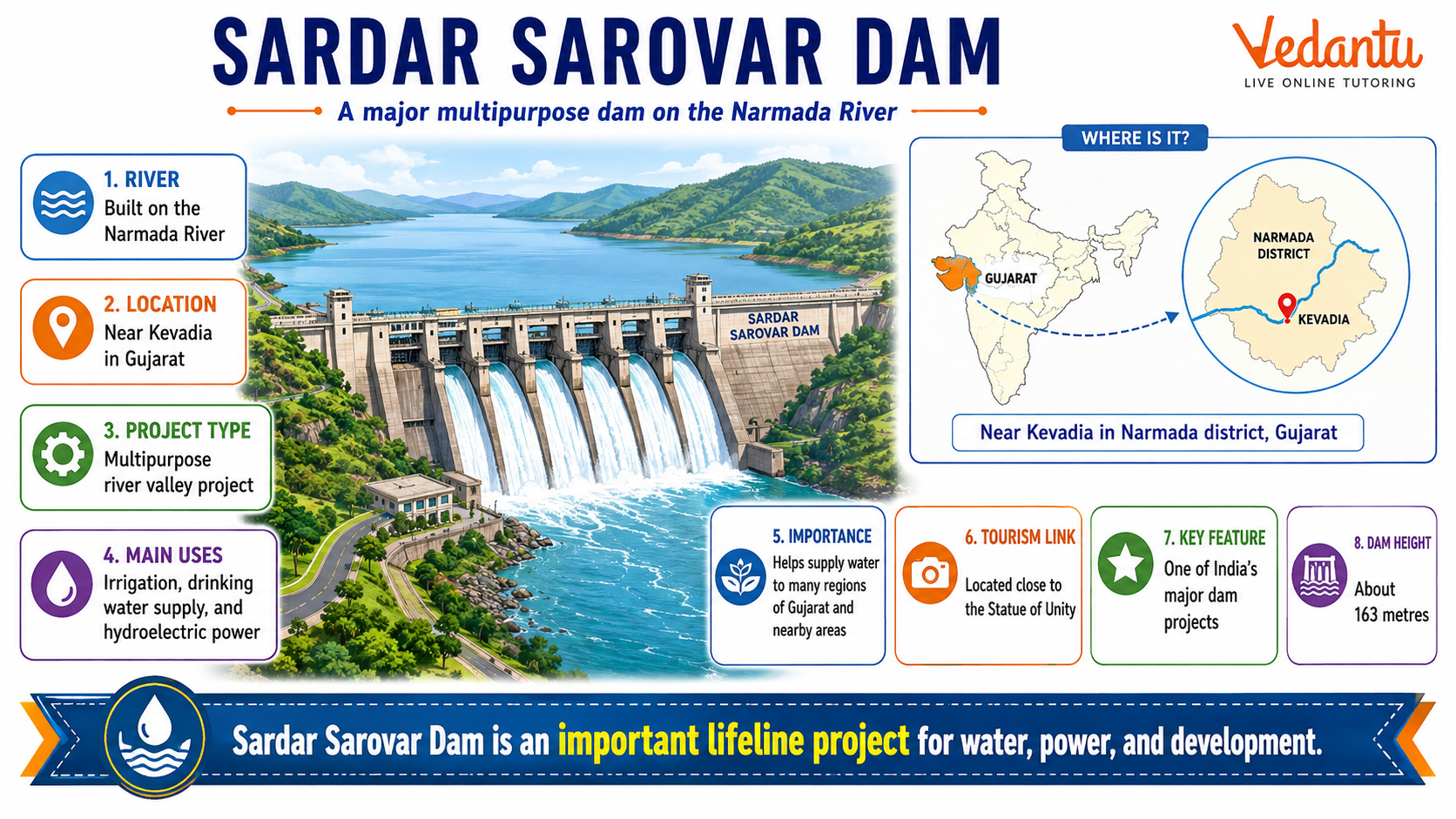
Overview of Sardar Sarovar Dam
The Sardar Sarovar Dam is located near Kevadia in the Narmada district of Gujarat. It is constructed across the Narmada River, which flows westward into the Arabian Sea. The project was conceptualized to address water scarcity, boost agricultural productivity, and generate hydroelectric power for western India.
Key Facts about Sardar Sarovar Dam
| Feature | Details | Significance |
|---|---|---|
| River | Narmada River | Major west-flowing river of India |
| Location | Kevadia, Gujarat | Supplies water to multiple states |
| Height | 138.68 meters | One of the tallest dams in India |
The dam is a concrete gravity dam designed to store large quantities of water for irrigation and power generation. It is considered an engineering landmark in India.
Historical Background
The idea of building a dam on the Narmada River was proposed in the 1940s. The foundation stone of the Sardar Sarovar Dam was laid by Prime Minister Jawaharlal Nehru in 1961. Due to inter-state disputes over water sharing, the Narmada Water Disputes Tribunal was established in 1969. The tribunal gave its award in 1979, clearing the way for construction. The dam reached its full height in 2017.
Objectives of the Project
- Provide irrigation facilities to drought-prone regions of Gujarat and Rajasthan.
- Supply drinking water to thousands of villages and urban areas.
- Generate hydroelectric power for multiple states.
- Control floods in downstream areas.
Power Generation Capacity
The Sardar Sarovar Dam has two main power houses - the River Bed Power House and the Canal Head Power House. Together, they have an installed capacity of 1450 MW. The electricity generated is shared among Gujarat, Madhya Pradesh, Maharashtra, and Rajasthan.
Irrigation and Water Supply Benefits
The dam irrigates millions of hectares of agricultural land, especially in arid regions of Kutch and Saurashtra. It also provides drinking water to thousands of villages and several towns in Gujarat and Rajasthan, reducing dependency on groundwater.
Major Beneficiary States
- Gujarat
- Madhya Pradesh
- Maharashtra
- Rajasthan
Controversies and Environmental Concerns
The Sardar Sarovar Dam has been associated with significant environmental and social debates. The Narmada Bachao Andolan, led by activists such as Medha Patkar, opposed the project due to displacement of tribal communities and submergence of forests and villages. Issues related to rehabilitation, compensation, and environmental impact were widely discussed at national and international levels.
Importance in General Knowledge and Exams
The Sardar Sarovar Dam is an important topic for GK and competitive exams because it relates to Indian geography, river valley projects, inter-state water disputes, and sustainable development. Questions may be asked about its location, height, river, power generation capacity, and beneficiary states.
Sample Exam Focus Areas
- River on which the dam is built.
- States benefiting from the project.
- Installed power generation capacity.
- Associated social movements.
Conclusion
The Sardar Sarovar Dam stands as a major infrastructure project that has transformed water management and agricultural development in western India. While it has delivered significant economic benefits, it has also highlighted the challenges of large-scale development projects, including environmental protection and rehabilitation. Understanding its features, benefits, and controversies is essential for students and aspirants preparing for competitive examinations.
FAQs on Sardar Sarovar Dam Project: Complete Guide for Students
1. What is the Sardar Sarovar Dam and where is it located?
Sardar Sarovar Dam is a major multipurpose river valley project built on the Narmada River in Gujarat, India.
• Located near Kevadia in Narmada district, Gujarat
• Part of the larger Narmada Valley Project
• One of the tallest concrete gravity dams in India
• Provides irrigation, hydroelectric power, and drinking water
It is frequently searched under terms like Narmada Dam, Sardar Sarovar Project, and Kevadia Dam.
2. On which river is the Sardar Sarovar Dam built?
Sardar Sarovar Dam is built on the Narmada River, one of the longest west-flowing rivers in India.
• Originates from Amarkantak Plateau, Madhya Pradesh
• Flows through Madhya Pradesh, Maharashtra, and Gujarat
• Drains into the Arabian Sea
The Narmada River Basin is vital for irrigation, hydropower, and water supply projects in western India.
3. What is the height of the Sardar Sarovar Dam?
The height of the Sardar Sarovar Dam is 138.68 meters (455 feet), making it one of India’s tallest dams.
• Foundation height: around 163 meters
• Type: Concrete gravity dam
• Reservoir: Sardar Sarovar Reservoir
It is often compared with other major dams like Bhakra Nangal Dam and Tehri Dam in GK exams.
4. What are the main objectives of the Sardar Sarovar Project?
The main objective of the Sardar Sarovar Project is irrigation, power generation, and drinking water supply.
• Irrigation for drought-prone areas of Gujarat and Rajasthan
• Hydroelectric power generation
• Drinking water supply to thousands of villages
• Flood control and regional development
The project is a key part of the Narmada Valley Development Plan.
5. When was the Sardar Sarovar Dam inaugurated?
The Sardar Sarovar Dam was inaugurated on 17 September 2017 by Prime Minister Narendra Modi.
• Construction began in 1987
• Final height approval granted in 2017
• Dedicated to the nation on the birth anniversary of Sardar Vallabhbhai Patel
The inauguration marked the completion of decades-long development and legal processes.
6. Which states benefit from the Sardar Sarovar Dam?
Four Indian states benefit from the Sardar Sarovar Dam project.
• Gujarat – Major share of irrigation and drinking water
• Rajasthan – Irrigation in arid regions
• Madhya Pradesh – Hydropower benefits
• Maharashtra – Power and water benefits
Water sharing disputes among these states were resolved by the Narmada Water Disputes Tribunal (NWDT).
7. What is the power generation capacity of the Sardar Sarovar Dam?
The total installed power generation capacity of Sardar Sarovar Dam is about 1,450 MW.
• River Bed Power House: 1,200 MW
• Canal Head Power House: 250 MW
• Generates hydroelectric power using renewable water energy
It is one of India’s important hydropower projects in western India.
8. Why was the Sardar Sarovar Dam controversial?
The Sardar Sarovar Dam was controversial due to environmental and rehabilitation concerns.
• Displacement of thousands of families
• Submergence of villages and forest land
• Environmental impact on the Narmada Valley
• Protests led by the Narmada Bachao Andolan
Issues of resettlement, rehabilitation, and ecological balance were widely debated nationally and internationally.
9. Who was Sardar Sarovar Dam named after?
The dam is named after Sardar Vallabhbhai Patel, India’s first Deputy Prime Minister and Home Minister.
• Known as the Iron Man of India
• Played a key role in the integration of princely states
• The nearby Statue of Unity is dedicated to him
The naming honors his contribution to national unity and development.
10. What is the significance of the Sardar Sarovar Dam in India’s development?
Sardar Sarovar Dam is significant for boosting irrigation, water security, and regional development in western India.
• Supports agriculture in drought-prone regions
• Provides drinking water to millions of people
• Generates clean hydroelectric power
• Promotes tourism near Statue of Unity and Kevadia
It is often cited in GK, UPSC, SSC, and state PSC exams as a major multi-purpose river valley project in India.
