






Why Lysosomes Are Known as the Cell’s Suicidal Bags
Lysosomes are commonly known as the Suicidal Bags of the Cell because they contain powerful digestive enzymes capable of breaking down cellular waste, foreign particles, and even damaged organelles. These membrane-bound organelles play a crucial role in maintaining cellular cleanliness and survival. The term is widely used in Biology and is especially important for NEET aspirants and students studying cell biology. Understanding lysosomes helps in grasping fundamental cellular processes such as intracellular digestion, autophagy, and programmed cell death.
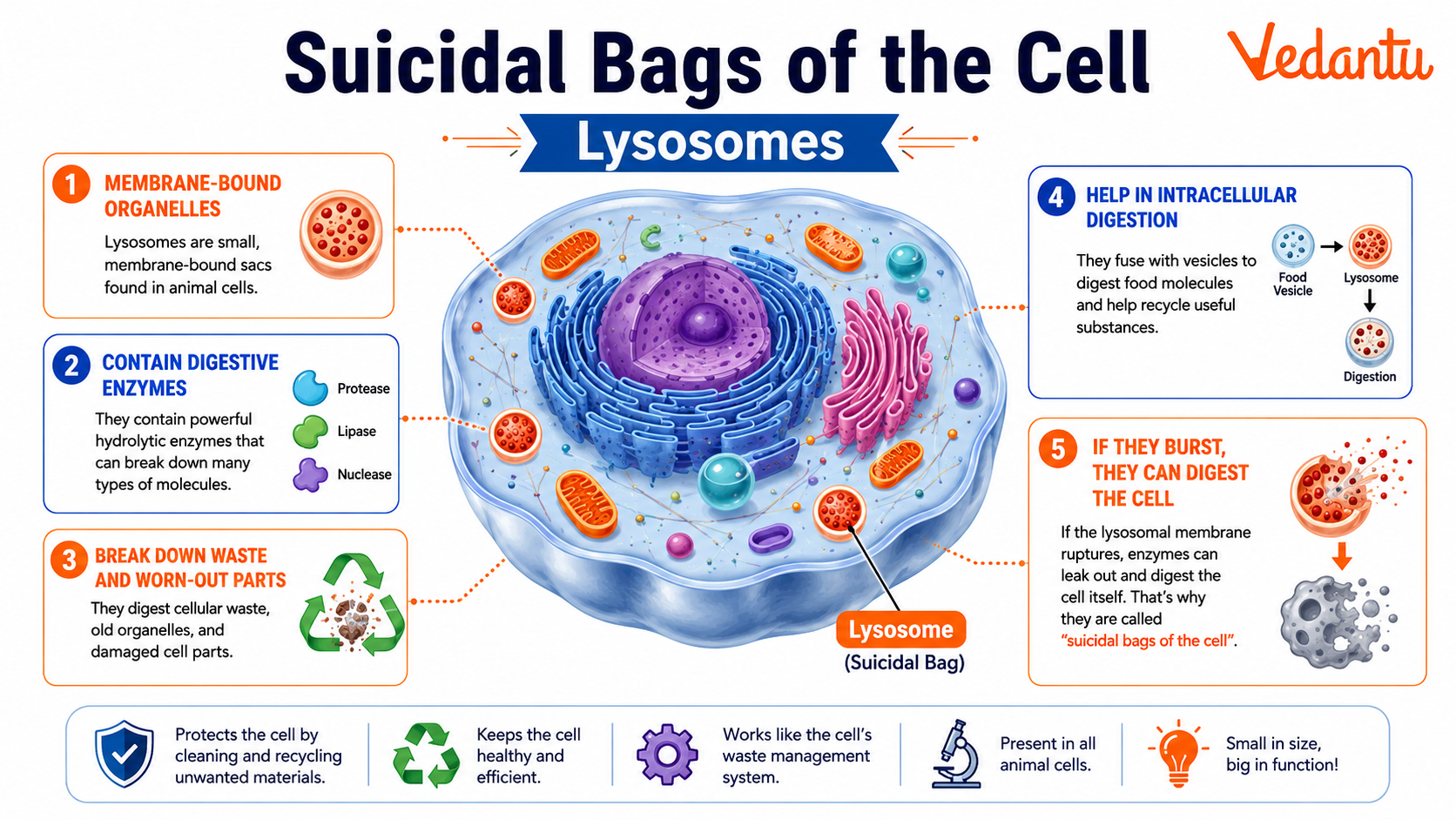
Why Are Lysosomes Called Suicidal Bags?
Lysosomes are called suicidal bags because they contain hydrolytic enzymes that can digest all types of biological polymers such as proteins, nucleic acids, carbohydrates, and lipids. If the lysosomal membrane ruptures, these enzymes are released into the cytoplasm and can destroy the entire cell. This process is known as autolysis.
- Contain digestive enzymes like proteases, lipases, nucleases.
- Perform intracellular digestion.
- Destroy worn-out organelles through autophagy.
- Cause autolysis when the cell is severely damaged.
Structure of Lysosomes
Lysosomes are small, spherical, membrane-bound organelles found mainly in animal cells. They are surrounded by a single membrane that protects the cytoplasm from the powerful enzymes inside. The internal environment of lysosomes is acidic, which is essential for the optimal activity of digestive enzymes.
Key Structural Features
- Single membrane bound structure.
- Acidic pH maintained by proton pumps.
- Contains around 40 types of hydrolytic enzymes.
- Formed from Golgi apparatus.
Functions of Lysosomes
Lysosomes perform several vital functions that are essential for cell survival and maintenance. They help in recycling cellular materials and protecting the cell from harmful substances.
- Intracellular digestion of food particles.
- Destruction of pathogens like bacteria and viruses.
- Removal of damaged organelles by autophagy.
- Cell death through autolysis in damaged cells.
Key Facts About Suicidal Bags of the Cell
| Feature | Description | Importance |
|---|---|---|
| Discovery | Discovered by Christian de Duve | Nobel Prize in 1974 |
| Nature | Membrane-bound organelle | Prevents enzyme leakage |
| Main Role | Intracellular digestion | Maintains cell health |
The above table summarizes essential points about lysosomes that are frequently asked in competitive exams like NEET. Students should remember the discoverer, structure, and main function for quick revision.
Types of Lysosomes
Based on their function and stage, lysosomes can be classified into different types. This classification helps in understanding their dynamic role in the cell.
- Primary Lysosomes - Newly formed and contain inactive enzymes.
- Secondary Lysosomes - Formed after fusion with food vacuoles.
- Autophagic Vacuoles - Digest worn-out organelles.
- Residual Bodies - Contain undigested waste materials.
Importance for NEET Preparation
Questions related to lysosomes are frequently asked in NEET under the chapter Cell - The Unit of Life. Students should focus on their structure, functions, discovery, and the reason behind the name suicidal bags. Conceptual clarity about autophagy and autolysis is also important for objective type questions.
- Remember the discoverer Christian de Duve.
- Understand why enzyme leakage causes cell death.
- Revise functions and types thoroughly.
- Practice MCQs related to cell organelles.
Conclusion
Lysosomes, known as the Suicidal Bags of the Cell, are essential organelles responsible for digestion and recycling within the cell. Their ability to break down complex molecules and remove damaged components makes them vital for cellular health. A strong understanding of lysosomes not only helps in academic learning but also strengthens preparation for competitive exams like NEET.
FAQs on Suicidal Bags of the Cell – Lysosomes Explained Simply
1. Why are lysosomes called "Suicidal Bags of the Cell"?
The lysosomes are called "Suicidal Bags of the Cell" because they contain powerful digestive enzymes that can destroy the cell if released.
• Lysosomes contain hydrolytic enzymes that break down waste materials.
• If the lysosome bursts, these enzymes digest the entire cell.
• This process is known as autolysis (self-digestion).
• Hence, they are also known as suicide bags or digestive sacs of the cell.
2. What are lysosomes and where are they found?
Lysosomes are small membrane-bound organelles responsible for intracellular digestion.
• Found mainly in animal cells.
• Rare or less prominent in plant cells.
• Surrounded by a single membrane.
• Contain digestive enzymes active in acidic conditions.
They are essential for cell cleaning, waste removal, and recycling functions.
3. Who discovered lysosomes?
Lysosomes were discovered by Christian de Duve in 1955.
• He was a Belgian cytologist.
• Awarded the Nobel Prize in Physiology or Medicine (1974).
• His discovery explained the mechanism of intracellular digestion.
This discovery greatly advanced knowledge about cell organelles and cell biology.
4. What are the main functions of lysosomes?
Lysosomes perform digestion, recycling, and defense functions inside the cell.
• Break down waste materials and debris.
• Destroy foreign particles like bacteria (cell defense).
• Recycle worn-out organelles (autophagy).
• Help in cell renewal and metabolism.
They are vital for maintaining cell health and homeostasis.
5. What is autolysis in cells?
Autolysis is the self-destruction of a cell due to the bursting of lysosomes.
• Triggered during severe cell damage.
• Lysosomal enzymes digest cell components.
• Plays a role in tissue breakdown and development.
This process explains why lysosomes are termed suicidal bags in biology.
6. How do lysosomes help in defense against infections?
Lysosomes protect the cell by destroying harmful microorganisms.
• Fuse with food vacuoles containing bacteria.
• Release digestive enzymes to kill pathogens.
• Support the immune response in white blood cells.
Thus, lysosomes act as the cell’s protective system against infections.
7. What enzymes are present in lysosomes?
Lysosomes contain strong digestive (hydrolytic) enzymes that break down biomolecules.
• Proteases – digest proteins.
• Lipases – break down fats.
• Amylases – digest carbohydrates.
• Nucleases – break nucleic acids.
These enzymes function best in an acidic pH environment.
8. Are lysosomes present in plant cells?
Lysosomes are mostly found in animal cells and are rare in plant cells.
• In plants, vacuoles perform similar digestive functions.
• Plant cells have large central vacuoles with enzymes.
• Therefore, vacuoles act as functional equivalents of lysosomes.
This is an important concept in cell biology and exams.
9. Why are lysosomes important for cell survival?
Lysosomes are essential because they remove waste and recycle cell materials.
• Prevent accumulation of cellular waste.
• Help in cell repair and renewal.
• Maintain internal balance (cell homeostasis).
Without lysosomes, cells would accumulate toxins and die.
10. What happens if lysosomes do not function properly?
Malfunctioning lysosomes can cause serious genetic disorders known as lysosomal storage diseases.
• Accumulation of undigested substances.
• Leads to diseases like Tay-Sachs disease and Gaucher’s disease.
• Affects metabolism and organ function.
Proper lysosomal activity is crucial for healthy cellular metabolism and growth.
