






Key Provisions and Exceptions under Article 15 in the Indian Constitution
Article 15 of the Indian Constitution is a crucial provision under the Fundamental Rights that guarantees the right to equality and prohibits discrimination. It specifically protects citizens against discrimination on certain grounds and promotes social justice in India. This article plays an important role in ensuring equality in public spaces, educational institutions, and access to state benefits. For students and competitive exam aspirants, understanding Article 15 is essential as it frequently appears in exams related to Polity, Law, and General Knowledge.
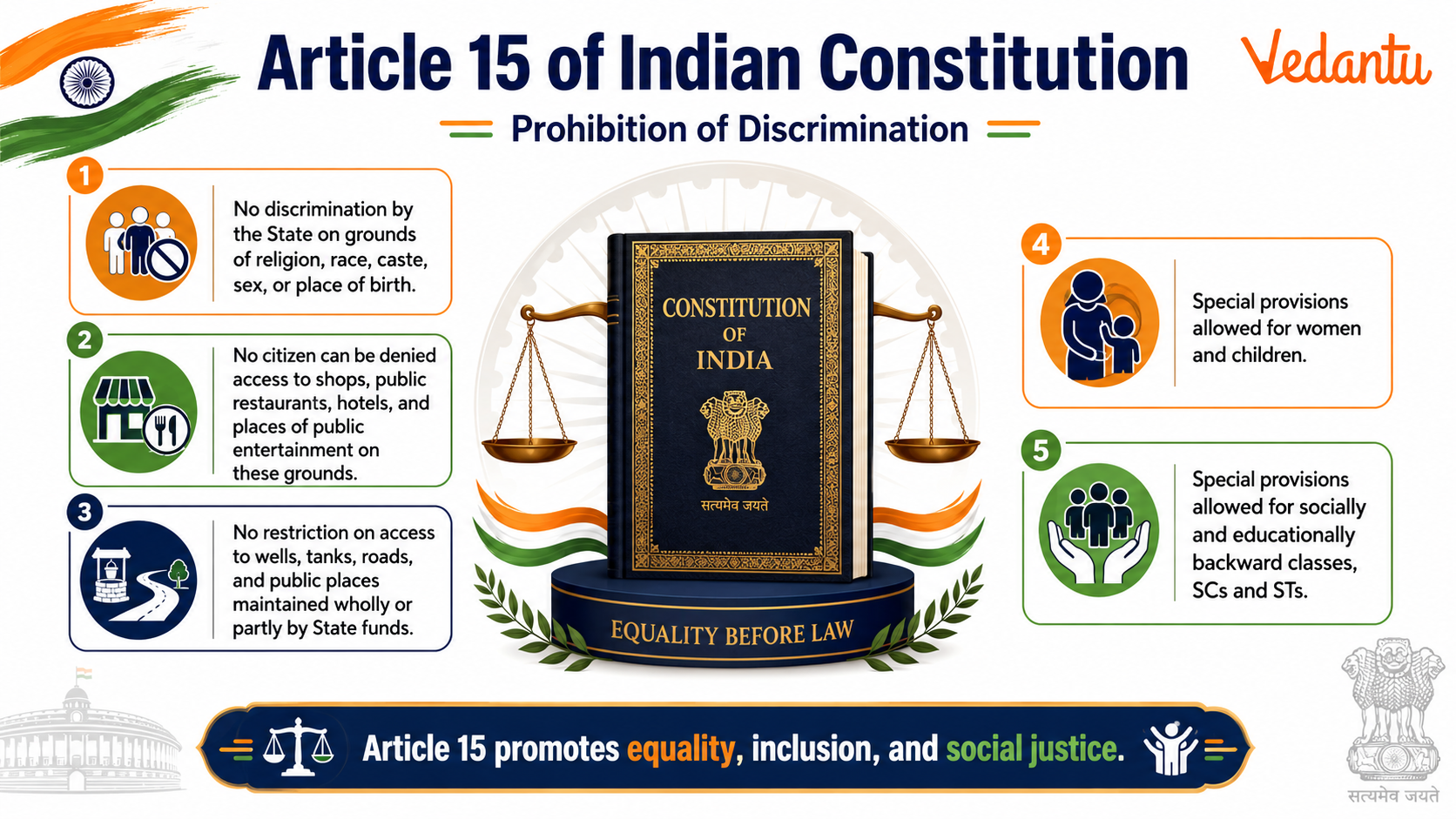
Overview of Article 15
Article 15 is part of Part III of the Indian Constitution, which deals with Fundamental Rights. It primarily prohibits the State from discriminating against any citizen on specific grounds. At the same time, it allows the State to make special provisions for socially and educationally backward classes, women, children, and certain other categories to promote equality in real terms.
Key Provisions of Article 15
| Clause | Provision | Purpose |
|---|---|---|
| Article 15(1) | Prohibits discrimination by the State on grounds of religion, race, caste, sex, or place of birth | Ensures equality before law |
| Article 15(2) | Prohibits restriction of access to shops, public restaurants, hotels, and places of public entertainment | Guarantees equal access to public spaces |
| Article 15(3), 15(4), 15(5), 15(6) | Allows special provisions for women, children, backward classes, SCs, STs, and economically weaker sections | Promotes social justice and affirmative action |
These clauses collectively ensure both formal equality and substantive equality by preventing discrimination while permitting affirmative action.
Grounds of Prohibited Discrimination
Article 15 clearly mentions specific grounds on which discrimination is not allowed. These are:
- Religion
- Race
- Caste
- Sex
- Place of birth
The inclusion of these grounds reflects the historical social inequalities in India and aims to create a more inclusive society.
Special Provisions Under Article 15
Article 15(3) - Women and Children
The Constitution allows the State to make special provisions for women and children. This includes reservations, welfare schemes, and protective laws. It recognizes that certain groups may need additional support to achieve true equality.
Article 15(4) - Socially and Educationally Backward Classes
Inserted by the First Constitutional Amendment Act, 1951, this clause empowers the State to make special provisions for the advancement of socially and educationally backward classes, as well as Scheduled Castes and Scheduled Tribes. It provides the constitutional basis for reservations in education.
Article 15(5) - Educational Institutions
This clause enables the State to provide reservations in admissions to educational institutions, including private institutions, except minority educational institutions. It strengthens affirmative action policies in higher education.
Article 15(6) - Economically Weaker Sections (EWS)
Added by the 103rd Constitutional Amendment Act, 2019, this clause allows up to 10 percent reservation for Economically Weaker Sections among citizens who are not covered under existing reservations.
Importance of Article 15
- Promotes equality and prevents discrimination in public life
- Provides constitutional backing for reservation policies
- Protects marginalized and vulnerable groups
- Ensures equal access to public facilities and services
By balancing non-discrimination and affirmative action, Article 15 helps India move toward social and economic justice.
Difference Between Article 14 and Article 15
| Basis | Article 14 | Article 15 |
|---|---|---|
| Scope | Equality before law and equal protection of laws | Prohibition of discrimination on specific grounds |
| Applicability | Applies to all persons | Applies only to citizens |
While Article 14 provides a broad guarantee of equality, Article 15 focuses specifically on preventing discrimination on particular grounds and enabling affirmative action.
Important Facts for Competitive Exams
- Article 15 is part of Part III of the Constitution
- It applies only to citizens of India
- The First Amendment Act, 1951 added Article 15(4)
- The 103rd Amendment Act, 2019 added Article 15(6) for EWS reservation
- It provides the constitutional foundation for reservation policies in education
Understanding Article 15 is essential for exams such as UPSC, State PSC, SSC, banking exams, and other competitive tests. It is also important for building a strong foundation in Indian Polity and constitutional law.
Conclusion
Article 15 of the Indian Constitution is a powerful instrument for ensuring equality and promoting social justice. By prohibiting discrimination and allowing special provisions for disadvantaged groups, it seeks to create a fair and inclusive society. Its role in shaping reservation policies and protecting marginalized communities makes it one of the most significant provisions under the Fundamental Rights. A clear understanding of Article 15 helps students grasp the broader vision of equality and justice enshrined in the Constitution of India.
FAQs on Article 15 of the Indian Constitution: Understanding the Right Against Discrimination
1. What is Article 15 of the Indian Constitution?
Article 15 of the Indian Constitution prohibits discrimination by the State on specific grounds and ensures equality for all citizens.
• It is a part of Fundamental Rights (Right to Equality, Articles 14–18).
• It forbids discrimination based on religion, race, caste, sex, or place of birth.
• It promotes social justice and equal treatment under law.
• It allows the State to make special provisions for women, children, and backward classes.
This article strengthens the principle of equality before law and prevents social discrimination in India.
2. What are the main provisions of Article 15?
The main provisions of Article 15 define the scope of non-discrimination and protective discrimination.
• Article 15(1): Prohibits State discrimination on religion, race, caste, sex, or place of birth.
• Article 15(2): Prohibits restriction of access to public places like shops, hotels, wells, and roads.
• Article 15(3): Allows special provisions for women and children.
• Article 15(4) & 15(5): Permits reservation for Socially and Educationally Backward Classes (SEBCs), SCs, and STs.
• Article 15(6): Provides reservation for Economically Weaker Sections (EWS).
These clauses balance equality and affirmative action in India.
3. On which grounds is discrimination prohibited under Article 15?
Article 15 prohibits discrimination on five specific grounds to ensure equal rights for citizens.
• Religion
• Race
• Caste
• Sex (Gender)
• Place of Birth
This provision prevents unequal treatment in public institutions, access to facilities, and government policies, making it a core part of the Right to Equality.
4. Does Article 15 allow reservation in India?
Yes, Article 15 allows reservation as a form of protective discrimination to uplift disadvantaged groups.
• Reservation for SCs and STs under Article 15(4).
• Reservation for Socially and Educationally Backward Classes (OBCs).
• Reservation for Economically Weaker Sections (EWS) under Article 15(6).
• Special provisions for women and children under Article 15(3).
This ensures affirmative action, social justice, and inclusive development in India.
5. What is Article 15(3) of the Indian Constitution?
Article 15(3) empowers the State to make special provisions for women and children.
• It supports women empowerment and child welfare policies.
• Enables laws like maternity benefits and reservations for women.
• Does not violate equality, as it promotes substantive equality.
This clause reflects India’s commitment to gender justice and social protection.
6. How is Article 15 different from Article 14?
Article 14 and Article 15 both ensure equality but differ in scope and application.
• Article 14: Guarantees equality before law and equal protection of laws.
• Article 15: Specifically prohibits discrimination on five listed grounds.
• Article 15 includes provisions for affirmative action and reservations.
Together, they form the backbone of the Right to Equality in the Indian Constitution.
7. Does Article 15 apply to private individuals?
Article 15 mainly restricts the State, but certain clauses extend to private entities in public access matters.
• Article 15(1) applies against State actions.
• Article 15(2) prevents discrimination in shops, restaurants, hotels, and public places.
• Ensures equal access to public facilities regardless of caste, religion, or gender.
Thus, it protects citizens from both state-sponsored and public discrimination.
8. What is the significance of Article 15 in competitive exams?
Article 15 is important for UPSC, SSC, State PCS, and other competitive exams under Polity and Constitution topics.
• Frequently asked in Prelims and Mains.
• Linked with topics like Reservation Policy, Fundamental Rights, and Social Justice.
• Important amendments like the 93rd and 103rd Constitutional Amendments are related to it.
Understanding Article 15 helps in answering questions on Indian Constitution and Equality.
9. What amendments are related to Article 15?
Several Constitutional Amendments have expanded the scope of Article 15.
• First Amendment Act, 1951: Inserted Article 15(4) for backward classes.
• 93rd Amendment Act, 2005: Added Article 15(5) for reservation in educational institutions.
• 103rd Amendment Act, 2019: Introduced Article 15(6) for EWS reservation.
These amendments strengthened affirmative action and reservation policies in India.
10. Why is Article 15 important in Indian democracy?
Article 15 is vital for protecting equality and preventing discrimination in Indian democracy.
• Promotes social harmony and inclusiveness.
• Protects marginalized groups like SCs, STs, OBCs, women, and EWS.
• Supports the ideals of justice, liberty, equality, and fraternity in the Preamble.
It ensures that India functions as a welfare state committed to equal rights and opportunities.
