






How Razia Sultan Became the First Woman to Rule the Delhi Sultanate
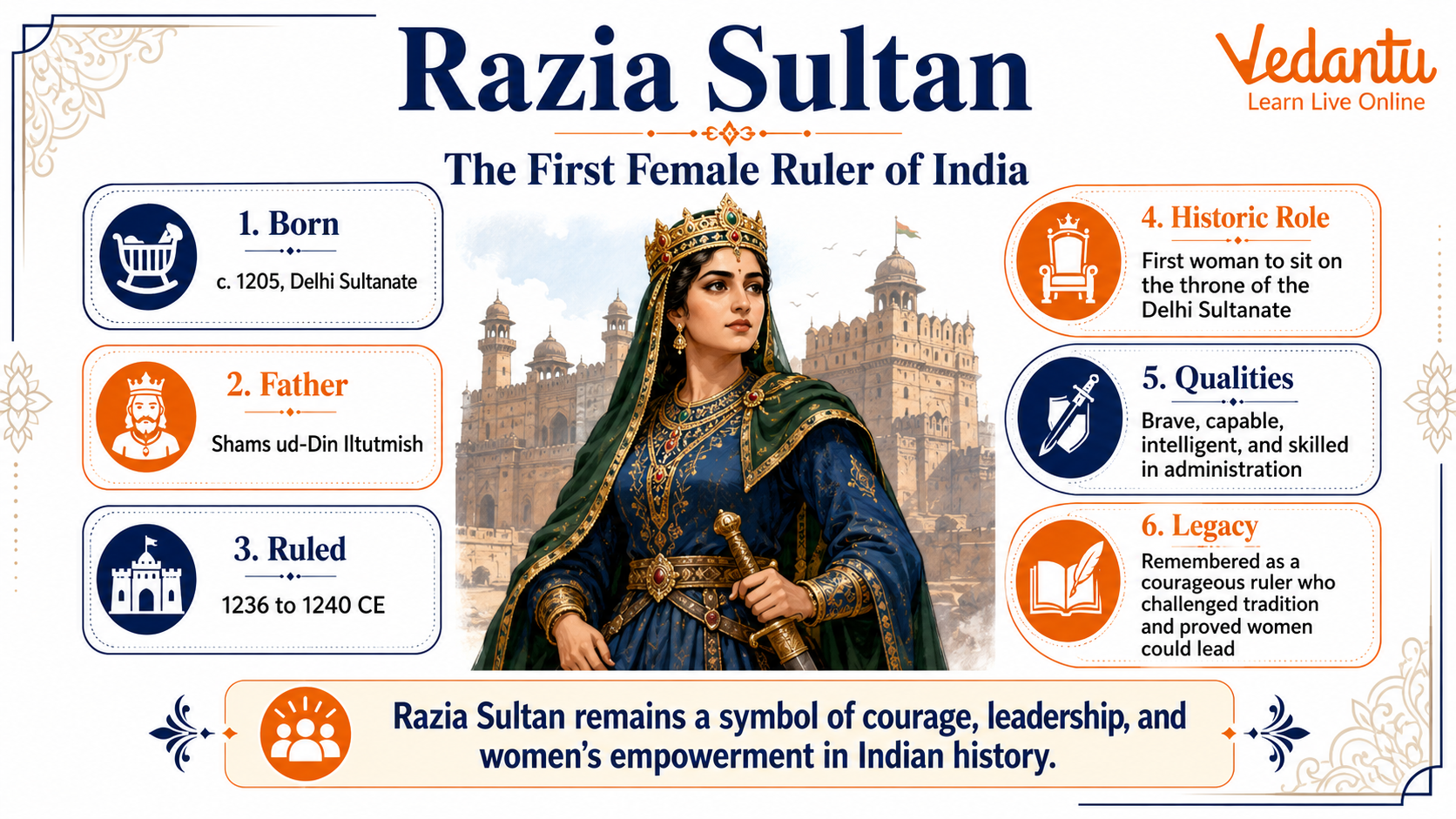
Razia Sultan, also known as Razia Sultana, was the first and only woman ruler of the Delhi Sultanate. She ruled from 1236 to 1240 CE and is remembered as one of the most capable and courageous rulers of medieval India. At a time when society was deeply patriarchal, Razia broke traditional barriers and proved her administrative and military skills. Her reign marks an important chapter in Indian history, especially in the context of women's leadership and the early Delhi Sultanate period.
Early Life and Background
Razia Sultan was born in 1205 CE to Shams-ud-din Iltutmish, the ruler of the Delhi Sultanate and a prominent member of the Mamluk or Slave dynasty. Unlike many princesses of her time, Razia received training in administration, military strategy, and governance. Iltutmish recognized her talent and nominated her as his successor, considering her more capable than his sons.
- Born in 1205 CE in Budaun, India
- Daughter of Sultan Iltutmish
- Belonged to the Mamluk or Slave dynasty
- Trained in statecraft and military leadership
Accession to the Throne
After the death of Iltutmish in 1236 CE, Razia's brother Rukn-ud-din Firoz Shah initially became the Sultan. However, his misrule and lack of administrative skills led to dissatisfaction among nobles and the public. Within a few months, he was removed, and Razia was placed on the throne.
Razia adopted the title of Sultan instead of Sultana, as the latter term was used for the wife of a Sultan. She wanted to establish herself as an independent and sovereign ruler rather than merely a queen consort.
Administration and Policies
Razia Sultan proved to be a competent and just ruler. She focused on strengthening the administration and reducing the influence of powerful Turkish nobles known as the Chahalgani or the Forty. She appointed capable individuals to important positions, even if they were not from noble Turkish families.
- Promoted merit over nobility in appointments
- Reduced the power of Turkish nobles
- Encouraged education and learning
- Maintained law and order in the empire
She held open courts and interacted directly with her subjects, which was uncommon for women during that era. Razia also appeared unveiled in public and dressed in male attire while leading her army, challenging social norms of the time.
Challenges and Opposition
Razia Sultan faced strong opposition from Turkish nobles who were uncomfortable with a woman ruling the Sultanate. Her decision to appoint Jamal-ud-din Yaqut, an Abyssinian officer, to a high position angered the Turkish nobility.
The nobles conspired against her, and several rebellions broke out. Eventually, she was defeated by Malik Altunia, the governor of Bhatinda. Later, Razia married Altunia in an attempt to regain her throne, but she was defeated by her brother Bahram Shah in 1240 CE.
- Opposition from the Chahalgani group
- Rebellions by provincial governors
- Political conspiracy against her leadership
- Defeated and killed in 1240 CE
Key Facts about Razia Sultan
| Aspect | Details | Period |
|---|---|---|
| Full Name | Razia al-Din | 1205 CE |
| Dynasty | Mamluk or Slave Dynasty | Delhi Sultanate |
| Reign | Sultan of Delhi | 1236 to 1240 CE |
Razia Sultan's reign lasted only four years, but her leadership left a lasting impression on Indian history. She remains a symbol of courage, capability, and progressive governance during medieval times.
Death and Legacy
Razia Sultan was defeated and killed in 1240 CE near Kaithal. Despite her short rule, she is remembered as a pioneer who challenged gender norms and proved that women could govern effectively. Her tomb is believed to be located in Delhi.
Her legacy is significant for the following reasons:
- First and only woman ruler of the Delhi Sultanate
- Promoted merit-based administration
- Symbol of women's empowerment in Indian history
- Important topic in competitive exams and General Knowledge
Important Points for Competitive Exams
- Razia Sultan was the first woman ruler of the Delhi Sultanate.
- She belonged to the Mamluk or Slave dynasty.
- She ruled from 1236 to 1240 CE.
- She was the daughter of Iltutmish.
- She was defeated by Bahram Shah in 1240 CE.
Razia Sultan's life is an inspiring example of leadership, determination, and courage. Her reign highlights the political complexities of the Delhi Sultanate and the challenges faced by a woman ruler in medieval India. Understanding her contributions is essential for students preparing for school exams and competitive examinations, as well as for anyone interested in Indian history and women's empowerment.
FAQs on Razia Sultan – The First Female Ruler of India
1. Who was Razia Sultan and why is she famous in Indian history?
Razia Sultan was the first and only woman ruler of the Delhi Sultanate, known for breaking gender barriers in medieval India.
• Daughter of Shams-ud-din Iltutmish
• Ruled from 1236 to 1240 CE
• First Muslim woman ruler of India
• Known for administrative reforms and bravery
• A significant figure in Medieval Indian History and competitive exams
2. When did Razia Sultan rule the Delhi Sultanate?
Razia Sultan ruled from 1236 CE to 1240 CE during the early period of the Delhi Sultanate.
• Became ruler after the death of Iltutmish
• Belonged to the Mamluk (Slave) Dynasty
• Her reign lasted about four years
• Faced strong opposition from Turkish nobles
3. Why was Razia Sultan chosen as the successor by Iltutmish?
Iltutmish selected Razia Sultan because of her intelligence and administrative skills.
• Proved capable in handling state affairs
• Showed leadership qualities during her father’s absence
• Her brothers were considered less competent
• Mentioned as heir in official court declaration
4. What challenges did Razia Sultan face during her rule?
Razia Sultan faced political opposition and gender bias throughout her reign.
• Strong resistance from Turkish nobles (Chahalgani)
• Opposition to a woman ruling the Sultanate
• Rebellions in different provinces
• Internal court conspiracies
5. What were the major achievements of Razia Sultan?
Razia Sultan is remembered for her administrative reforms and bold leadership.
• Promoted merit over nobility
• Appointed capable officials like Jamal-ud-din Yakut
• Encouraged education and justice
• Appeared in public without purdah, challenging traditions
6. How did Razia Sultan die?
Razia Sultan died in 1240 CE after being defeated in a rebellion.
• Overthrown by nobles led by Malik Altunia
• Attempted to regain the throne
• Defeated near Kaithal (Haryana)
• Killed during political conflict
7. What dynasty did Razia Sultan belong to?
Razia Sultan belonged to the Mamluk or Slave Dynasty of the Delhi Sultanate.
• Also known as the Ghulam Dynasty
• Founded by Qutb-ud-din Aibak
• Iltutmish was one of its greatest rulers
• Important topic in Medieval History GK
8. Why is Razia Sultan considered an important figure in women’s history?
Razia Sultan is important because she was the first female Muslim ruler of India.
• Broke patriarchal traditions
• Ruled independently without being a figurehead
• Symbol of women empowerment in history
• Frequently asked in GK, UPSC, SSC exams
9. What was the role of the Chahalgani in Razia Sultan’s reign?
The Chahalgani were a group of forty powerful Turkish nobles who opposed Razia Sultan.
• Controlled major administrative posts
• Resisted her authority as a woman ruler
• Played a key role in her downfall
• Important concept in Delhi Sultanate politics
10. Where is the tomb of Razia Sultan located?
The tomb of Razia Sultan is located in Delhi, India.
• Situated near Turkman Gate
• Considered a historical monument
• Reflects her legacy in Indian history
• Popular site for students studying Medieval India
