






Reign, Policies and Fall of Qutb-ud-din Mubarak Shah
Qutbuddin Mubarak Shah Khilji was the third ruler of the Khilji dynasty of the Delhi Sultanate. He ruled from 1316 to 1320 CE and was the son of Alauddin Khilji. His reign marked the final phase of the Khilji dynasty and is often remembered for political instability, administrative changes, and eventual decline of centralized power. His rule is an important topic in medieval Indian history, especially for competitive exams and General Knowledge preparation.
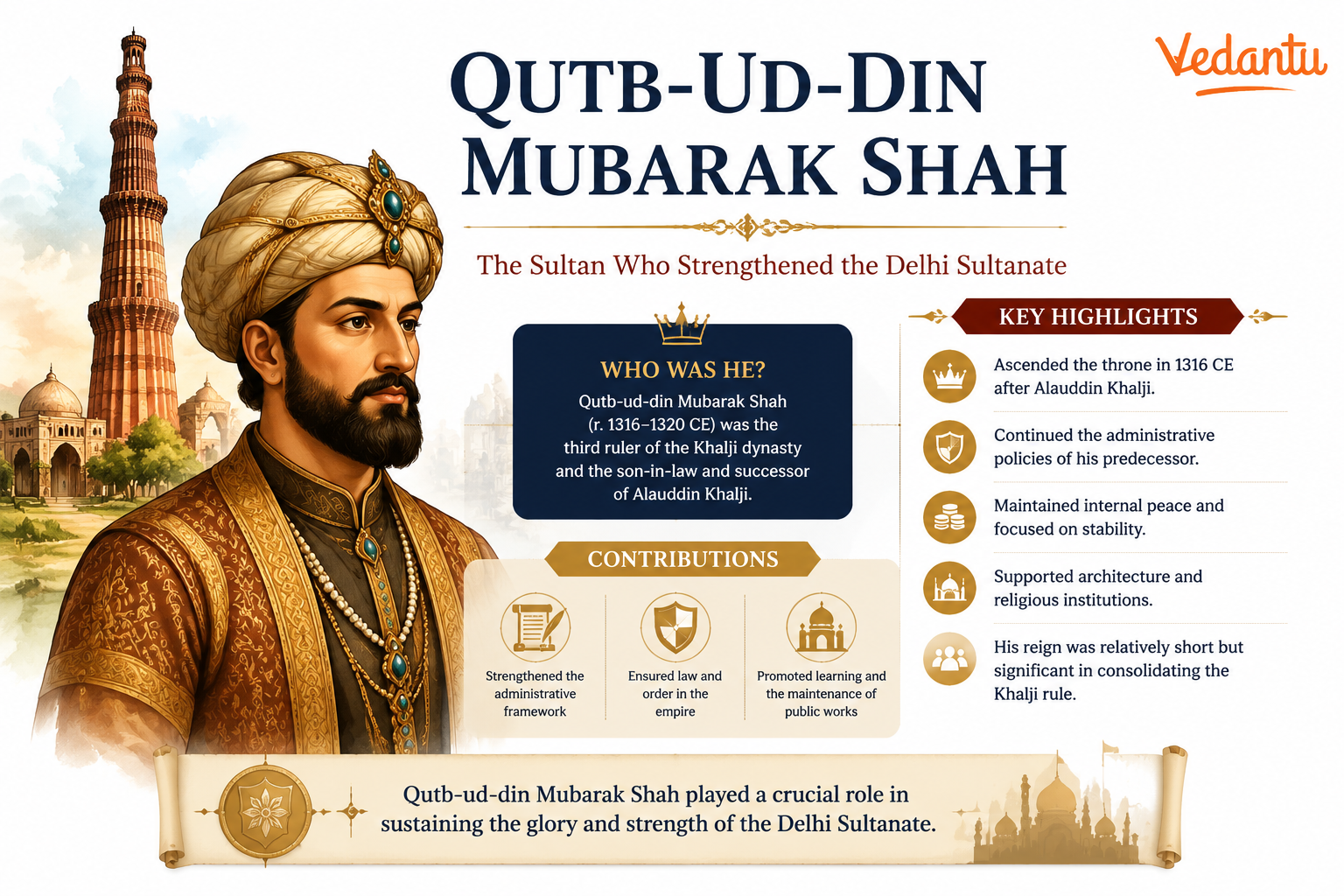
Basic Information about Qutbuddin Mubarak Shah Khilji
| Particular | Details | Period |
|---|---|---|
| Full Name | Qutbuddin Mubarak Shah Khilji | Reign 1316 to 1320 CE |
| Dynasty | Khilji Dynasty | Delhi Sultanate |
| Father | Alauddin Khilji | Medieval India |
Qutbuddin Mubarak Shah succeeded his brother Shihabuddin Omar, who was placed on the throne after Alauddin Khilji's death but was only a nominal ruler under the control of Malik Kafur. Mubarak Shah later removed Malik Kafur and assumed full authority.
Early Life and Accession
After the death of Alauddin Khilji in 1316 CE, political instability began in the Delhi Sultanate. Malik Kafur, a powerful general, tried to control the throne by placing the young Shihabuddin Omar as Sultan. However, Mubarak Shah eliminated Malik Kafur and became the ruler. He first acted as regent and later declared himself Sultan with the title Qutbuddin Mubarak Shah.
Administrative Policies
One of the most significant aspects of Mubarak Shah's reign was the reversal of many strict policies introduced by his father Alauddin Khilji.
Major Administrative Changes
- Abolished the harsh market control system introduced by Alauddin Khilji.
- Released political prisoners and confiscated properties.
- Reduced strict taxation policies.
- Restored privileges to nobles and military officers.
While these measures made him popular initially, they weakened central authority and reduced financial discipline in the Sultanate.
Military Campaigns
Qutbuddin Mubarak Shah continued military expeditions to maintain control over distant provinces.
Important Campaigns
- Suppression of rebellions in Gujarat.
- Campaigns in Devagiri to maintain control over the Deccan region.
- Reassertion of authority over territories that had shown signs of independence after Alauddin's death.
Although he achieved temporary success, internal court conspiracies weakened his position.
Court Politics and Decline
The later years of Mubarak Shah's reign were marked by favoritism and court intrigues. He showed excessive trust in a noble named Khusro Khan, who later betrayed him. Mubarak Shah appointed Khusro Khan to high positions, ignoring opposition from other nobles.
In 1320 CE, Khusro Khan assassinated Qutbuddin Mubarak Shah and seized the throne. This event led to the end of the Khilji dynasty. Shortly afterward, Ghiyasuddin Tughlaq defeated Khusro Khan and founded the Tughlaq dynasty.
Significance of His Reign
- Last effective ruler of the Khilji dynasty.
- Marked the decline of strong centralized administration established by Alauddin Khilji.
- His assassination led to political transition and the rise of the Tughlaq dynasty.
- Important example of how internal court politics can destabilize empires.
Comparison with Alauddin Khilji
| Aspect | Alauddin Khilji | Qutbuddin Mubarak Shah |
|---|---|---|
| Administrative Style | Strict and centralized | Liberal and relaxed |
| Market Control | Implemented strict controls | Abolished controls |
| Outcome | Strong empire | Political decline |
This comparison helps students understand how policy changes can impact the stability of a kingdom. The weakening of discipline and administrative control during Mubarak Shah's reign contributed to the fall of the Khilji dynasty.
Key Points for Exams
- Reign period - 1316 to 1320 CE.
- Son of Alauddin Khilji.
- Abolished Alauddin's economic and market reforms.
- Assassinated by Khusro Khan.
- End of the Khilji dynasty followed his death.
Qutbuddin Mubarak Shah Khilji remains a significant figure in medieval Indian history. His reign highlights the importance of strong administration, balanced policies, and careful management of court politics. Understanding his rule provides insight into the transition from the Khilji dynasty to the Tughlaq dynasty and the changing political landscape of the Delhi Sultanate.
FAQs on Qutb-ud-din Mubarak Shah of the Khilji Dynasty
1. Who was Qutbuddin Mubarak Shah Khilji?
Qutbuddin Mubarak Shah Khilji was the fourth ruler of the Khilji Dynasty who ruled the Delhi Sultanate from 1316 to 1320 CE.
- Son of Alauddin Khilji
- Became Sultan after the death of his brother Shihabuddin Omar
- Known for reversing many of Alauddin’s strict economic and administrative reforms
- His reign marked political instability and internal conspiracies
2. When did Qutbuddin Mubarak Shah rule the Delhi Sultanate?
Qutbuddin Mubarak Shah ruled from 1316 CE to 1320 CE during the later phase of the Khilji Dynasty.
- Ascended the throne after Alauddin Khilji’s death
- Ruled for nearly four years
- His reign ended with his assassination in 1320 CE
- His death led to the fall of the Khilji rule in India
3. What were the major policies of Qutbuddin Mubarak Shah Khilji?
Qutbuddin Mubarak Shah is known for abolishing many strict reforms introduced by Alauddin Khilji.
- Ended harsh market control policies and price regulations
- Released political prisoners
- Reduced heavy taxation on farmers
- Restored privileges to nobles and military officers
These decisions weakened central authority and increased corruption.
4. How did Qutbuddin Mubarak Shah come to power?
Qutbuddin Mubarak Shah came to power after eliminating rivals following Alauddin Khilji’s death.
- Initially acted as regent for his minor brother Shihabuddin Omar
- Imprisoned and later blinded his brother
- Declared himself Sultan in 1316 CE
- Consolidated authority by suppressing court conspiracies
5. Why is the reign of Qutbuddin Mubarak Shah considered weak?
His reign is considered weak due to administrative decline and court corruption.
- Abolished strong economic reforms of Alauddin Khilji
- Nobles regained excessive power
- Increased internal rebellions
- Overdependence on favorites like Khusro Khan
These factors led to instability in the Delhi Sultanate.
6. Who killed Qutbuddin Mubarak Shah Khilji?
Qutbuddin Mubarak Shah was assassinated by his general Khusro Khan in 1320 CE.
- Khusro Khan was a trusted court noble
- He led a conspiracy against the Sultan
- Murdered Mubarak Shah to seize the throne
- This event marked the end of the Khilji Dynasty
7. What role did Khusro Khan play in the fall of the Khilji Dynasty?
Khusro Khan played a decisive role in ending the Khilji rule.
- Served as a powerful noble under Mubarak Shah
- Assassinated the Sultan in 1320 CE
- Briefly declared himself ruler of Delhi
- Was later defeated by Ghiyasuddin Tughlaq, founder of the Tughlaq Dynasty
8. What were the achievements of Qutbuddin Mubarak Shah?
Qutbuddin Mubarak Shah maintained temporary political stability after Alauddin’s death.
- Suppressed early rebellions successfully
- Organized military expeditions in Gujarat and Deccan
- Attempted administrative relaxation to gain public support
However, these measures lacked long-term impact.
9. How did Qutbuddin Mubarak Shah’s policies differ from Alauddin Khilji’s?
Mubarak Shah reversed many strict reforms introduced by Alauddin Khilji.
- Removed price control system
- Relaxed taxation and revenue regulations
- Reduced surveillance and strict military discipline
- Restored noble privileges
Unlike Alauddin’s centralized rule, Mubarak’s approach weakened governance.
10. Why is Qutbuddin Mubarak Shah important for competitive exams?
Qutbuddin Mubarak Shah is important in GK and history exams due to his role in the decline of the Khilji Dynasty.
- Questions often focus on Delhi Sultanate rulers
- Asked in UPSC, SSC, State PSC, and school exams
- Important for understanding the transition from Khilji Dynasty to Tughlaq Dynasty
- Frequently appears in MCQs about medieval Indian history
