






Common Uses of a PAN Card and PAN Number in Banking and Taxes
A Permanent Account Number, commonly known as PAN, is a unique 10-digit alphanumeric identification number issued by the Income Tax Department of India. It plays a crucial role in financial transactions and taxation in the country. The PAN card serves as an important identity proof and is mandatory for various financial activities. Understanding PAN and its uses is essential for students, job seekers, business owners, and competitive exam aspirants as it forms a basic part of India’s taxation and financial system.
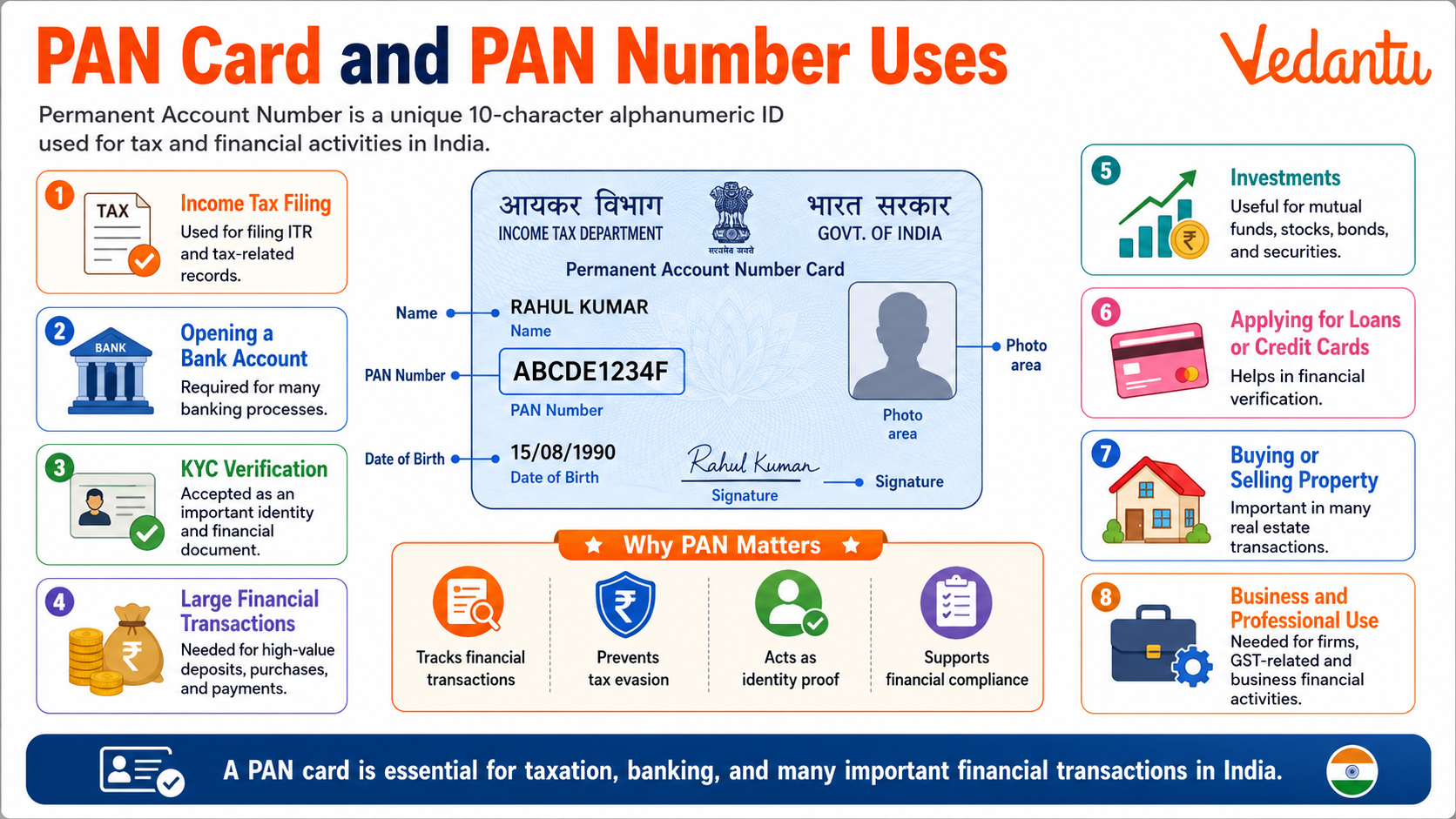
What is PAN Card?
PAN card is a laminated card that contains a unique Permanent Account Number allotted to individuals and entities such as companies, firms, and trusts. It is issued under the supervision of the Central Board of Direct Taxes (CBDT) under the Income Tax Act, 1961. The primary purpose of PAN is to track financial transactions and prevent tax evasion.
Structure of PAN Number
The PAN number is a 10-character alphanumeric code. Each character has a specific meaning.
Structure of PAN Number
| Position | Character Type | Meaning |
|---|---|---|
| First 3 Characters | Alphabets | Series of letters from AAA to ZZZ |
| 4th Character | Alphabet | Represents type of PAN holder such as P - Individual, C - Company |
| 5th Character | Alphabet | First letter of surname in case of individuals |
| Next 4 Characters | Numbers | Sequential numbers from 0001 to 9999 |
| Last Character | Alphabet | Alphabetic check digit |
This structured format ensures uniqueness and helps the Income Tax Department track financial records accurately.
Objectives of PAN
- To identify taxpayers uniquely across India.
- To prevent tax evasion and financial fraud.
- To track high-value financial transactions.
- To simplify the process of filing Income Tax Returns.
Uses of PAN Card and PAN Number
PAN card is required for various financial and legal transactions in India. It acts as proof of identity and helps maintain financial transparency.
Financial Transactions
- Opening a bank account.
- Depositing or withdrawing large amounts of cash.
- Purchasing or selling immovable property.
- Investing in mutual funds, shares, and bonds.
- Applying for credit or debit cards.
Tax Related Purposes
- Filing Income Tax Returns.
- Paying direct taxes.
- Claiming tax refunds.
- Tracking Tax Deducted at Source - TDS.
Business and Professional Uses
- Registering a company or partnership firm.
- Obtaining Goods and Services Tax - GST registration.
- Conducting import and export transactions.
Eligibility for PAN Card
Any individual, whether a minor or adult, can apply for a PAN card. It is also issued to Hindu Undivided Families, companies, firms, trusts, and foreign citizens who undertake financial transactions in India.
How to Apply for PAN Card
PAN card can be applied both online and offline through authorized service providers.
- Fill the PAN application form with correct personal details.
- Submit identity, address, and date of birth proof.
- Pay the prescribed application fee.
- Submit the form and wait for verification and processing.
Importance of PAN in Modern India
PAN has become a mandatory document for financial transparency and economic growth. It connects various financial activities under a single identification system, making it easier for the government to monitor tax compliance. Linking PAN with Aadhaar has further strengthened the identification process and reduced duplication.
Key Points to Remember
- PAN is a 10-digit alphanumeric unique number.
- Issued by the Income Tax Department of India.
- Mandatory for filing Income Tax Returns and high-value transactions.
- Helps prevent tax evasion and financial fraud.
- Applicable to individuals as well as business entities.
Conclusion
PAN card and PAN number are essential components of the Indian financial and taxation system. They ensure proper identification of taxpayers, promote transparency, and help regulate financial transactions. For students and competitive exam aspirants, understanding the structure, objectives, and uses of PAN is important from a General Knowledge perspective. It is not only a legal requirement but also a vital tool for responsible financial participation in India.
FAQs on PAN Card and PAN Number – Why They Matter for Students
1. What is a PAN Card and why is it important?
A PAN Card (Permanent Account Number) is a unique 10-digit alphanumeric identity issued by the Income Tax Department of India for financial transactions and tax purposes.
• It helps track tax payments and prevent tax evasion.
• It is mandatory for filing Income Tax Returns (ITR).
• Acts as a valid photo identity proof across India.
• Required for major financial activities like banking, investments, and property purchase.
• Commonly searched as: What is PAN number, PAN card meaning, importance of PAN card.
2. What is a PAN Number?
A PAN Number is a 10-character alphanumeric code that uniquely identifies taxpayers in India.
• Format example: ABCDE1234F.
• First five letters represent the holder type and surname.
• Next four digits are numeric.
• Last letter is a verification code.
• Also known as Permanent Account Number for tax identification and financial tracking.
3. What are the main uses of a PAN Card?
The PAN Card is primarily used for financial transactions and tax-related activities in India.
• Filing Income Tax Returns (ITR).
• Opening a bank account.
• Buying or selling property above a specified limit.
• Investing in mutual funds, shares, and bonds.
• Applying for loans and credit cards.
• Frequently asked as: Where is PAN card required, uses of PAN number.
4. Is PAN Card mandatory for opening a bank account?
Yes, a PAN Card is generally mandatory for opening a bank account in India.
• Required under RBI (Reserve Bank of India) guidelines.
• Needed for transactions above prescribed financial limits.
• Helps banks track high-value transactions.
• If not available, Form 60 may be submitted in specific cases.
5. Who issues the PAN Card in India?
The Income Tax Department of India under the Central Board of Direct Taxes (CBDT) issues the PAN Card.
• Applications are processed through NSDL and UTIITSL.
• It is governed by the Income Tax Act, 1961.
• Available for individuals, companies, firms, and NRIs.
• Common search query: Who provides PAN card in India.
6. What documents are required to apply for a PAN Card?
To apply for a PAN Card, you must submit identity, address, and date of birth proof.
• Identity Proof: Aadhaar Card, Voter ID, Passport.
• Address Proof: Utility bill, bank statement, passport.
• Date of Birth Proof: Birth certificate, matriculation certificate.
• Passport-size photograph for individuals.
• Often searched as: PAN card documents required, how to apply PAN card.
7. Can a person have more than one PAN Card?
No, a person is legally allowed to have only one PAN Number.
• Holding multiple PANs is illegal under the Income Tax Act.
• Duplicate PANs must be surrendered.
• Penalty of up to ₹10,000 may be imposed.
• Related queries: penalty for multiple PAN cards, duplicate PAN card rules.
8. Is PAN Card required for filing Income Tax Returns (ITR)?
Yes, a PAN Card is mandatory for filing Income Tax Returns (ITR) in India.
• It links all tax-related transactions.
• Required for claiming tax refunds.
• Necessary for tracking TDS (Tax Deducted at Source).
• Frequently asked as: Is PAN compulsory for income tax filing?
9. What is the difference between PAN Card and Aadhaar Card?
The PAN Card is mainly for tax identification, while the Aadhaar Card is a biometric identity proof.
• PAN is issued by the Income Tax Department.
• Aadhaar is issued by UIDAI (Unique Identification Authority of India).
• PAN is used for financial transactions.
• Aadhaar is used for identity verification and government schemes.
• Often searched as: PAN vs Aadhaar difference, is PAN linked with Aadhaar.
10. Is PAN Card required for buying property in India?
Yes, a PAN Card is mandatory for buying or selling property above specified financial limits in India.
• Required for property transactions above ₹10 lakh (may vary by rule updates).
• Ensures transparency in real estate transactions.
• Helps track high-value investments.
• Commonly searched as: PAN card for property purchase, documents required for buying property.
