






Office of the President of India Guidelines for Electors and Presidential Voting Process
The Office of the President of India is the highest constitutional office in the country. The President is elected indirectly by an Electoral College as provided under Article 54 of the Indian Constitution. To ensure free, fair, and uniform voting, the Election Commission of India issues detailed instructions to electors who participate in the presidential election. These instructions guide Members of Parliament and Members of Legislative Assemblies on the voting procedure, ballot marking, secrecy, and validity of votes. Understanding these instructions is important for General Knowledge and competitive examinations.
Constitutional Basis of Presidential Election
The election of the President of India is governed by constitutional provisions and statutory laws. The process is clearly defined to maintain transparency and fairness.
- Article 52 - Provides for the office of the President of India.
- Article 54 - Provides for the Election of the President by the Electoral College.
- Article 55 - Lays down the manner of election and proportional representation.
- Presidential and Vice Presidential Elections Act, 1952 - Governs procedural aspects.
- Presidential and Vice Presidential Elections Rules, 1974 - Provide detailed instructions including ballot marking.
Electoral College for Presidential Election
The President is elected by an Electoral College consisting of elected representatives at both the Union and State levels. Nominated members are not part of this Electoral College.
Composition of Electoral College
| Category | Included | Excluded |
|---|---|---|
| Members of Parliament | Elected MPs of Lok Sabha and Rajya Sabha | Nominated MPs |
| State Legislatures | Elected MLAs of States and UTs with legislature | MLCs and Nominated Members |
The inclusion of only elected representatives ensures that the President reflects the democratic will of the people through their chosen representatives.
System of Voting
The President is elected using the system of proportional representation by means of the single transferable vote. Voting is conducted by secret ballot.
Key Features of the Voting System
- Each elector has a ballot paper with names of candidates.
- Electors mark their preferences using numbers such as 1, 2, 3 and so on.
- Marking the first preference is compulsory for a valid vote.
- The value of votes differs for MPs and MLAs.
- Counting continues until a candidate secures the required quota.
Official Instructions to Electors
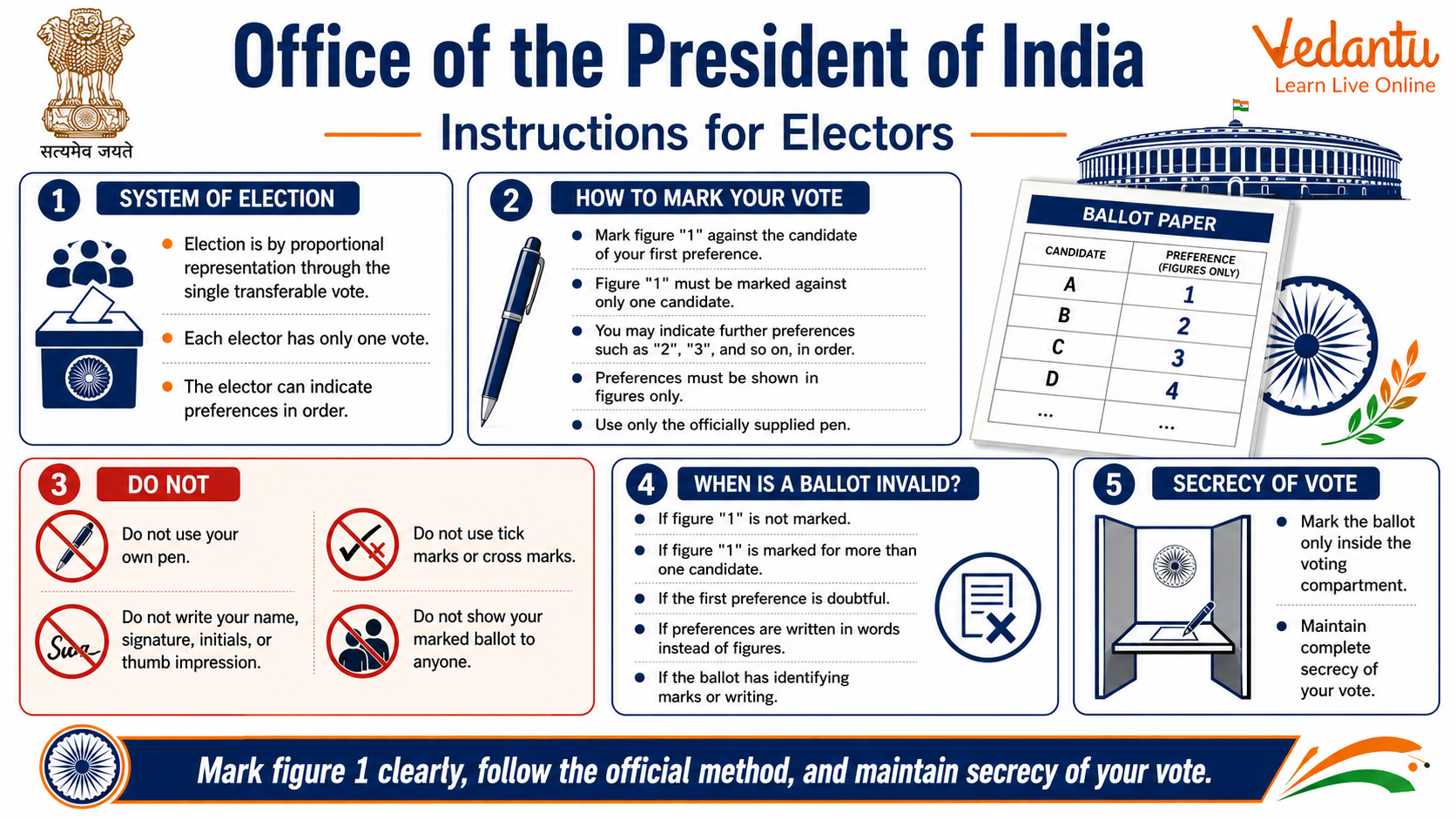
The Election Commission issues clear instructions to electors to avoid invalid votes and maintain secrecy.
Marking the Ballot Paper
- Use only the special pen provided at the polling booth.
- Mark the figure 1 opposite the name of the candidate for first preference.
- Additional preferences may be marked as 2, 3, 4 and so on.
- Do not sign or write your name on the ballot paper.
- Fold the ballot paper as instructed and drop it in the ballot box.
Secrecy of Voting
- Voting is by secret ballot.
- Electors cannot show their marked ballot to anyone.
- Political parties cannot issue binding whips for presidential elections.
- Violation of secrecy may lead to cancellation of the ballot.
Invalid Votes - Common Reasons
A ballot may be declared invalid if instructions are not properly followed. Electors must carefully adhere to guidelines.
- First preference not marked.
- Use of any mark other than prescribed numbers.
- Marking more than one candidate as first preference.
- Writing signature or identifiable marks on the ballot.
- Using a pen other than the one officially provided.
Importance of Instructions to Electors
Instructions ensure that the constitutional process remains transparent and uniform across the country. Since the President represents the unity and integrity of India, the election must be conducted with strict adherence to legal procedures. Proper instructions reduce invalid votes and protect the democratic character of the election.
Key Points for Competitive Exams
- The President is elected indirectly by an Electoral College.
- Election is based on proportional representation by single transferable vote.
- Voting is by secret ballot and no party whip is applicable.
- Marking first preference is compulsory for validity.
- Only elected MPs and MLAs participate in voting.
The Office of the President of India plays a central role in the constitutional framework. The detailed instructions to electors safeguard the fairness and integrity of the presidential election process. A clear understanding of these instructions is essential for students preparing for competitive examinations and for anyone interested in Indian polity and governance.
FAQs on Office of the President of India – Instructions for Electors Explained in Simple English
1. What are the instructions to electors for the election of the President of India?
The Instructions to Electors outline the official voting procedure for the Presidential Election of India conducted by the Election Commission of India.
• Electors must mark their preference using the prescribed ballot paper.
• Voting is done by secret ballot.
• Preferences are marked by writing the numeral 1, 2, 3 etc., against candidates' names.
• Only the official pen provided must be used.
• Ballot papers with improper markings are treated as invalid votes.
These rules ensure transparency, fairness, and constitutional compliance under Article 54 and 55 of the Indian Constitution.
2. Who are the electors in the Presidential Election of India?
The electors in the Presidential Election form the Electoral College of India.
• Elected members of Lok Sabha.
• Elected members of Rajya Sabha.
• Elected members of State Legislative Assemblies (MLAs).
• Elected members of Legislative Assemblies of Union Territories like Delhi and Puducherry.
Nominated members and Legislative Council members do not participate. This structure ensures federal representation in the election of the President of India.
3. How is the vote marked in the Presidential ballot paper?
The vote is marked by indicating numerical preferences under the proportional representation system.
• Write “1” for the first preference candidate.
• Additional preferences (2, 3, 4…) may be marked optionally.
• No tick marks, cross marks, or signatures are allowed.
• Only the official violet pen supplied should be used.
This method follows the Single Transferable Vote (STV) system to ensure proportional and fair counting.
4. What happens if an elector makes a mistake on the ballot paper?
If a mistake is made, the ballot may become invalid unless corrected properly before submission.
• Overwriting or unclear marking can invalidate the vote.
• Signing or writing any identifying mark leads to rejection.
• A fresh ballot may be issued only if the elector returns the spoiled ballot before casting it.
Strict rules maintain the secrecy and integrity of the Presidential Election process.
5. Why is secrecy important in the Presidential Election of India?
Secrecy ensures independent and unbiased voting by members of the Electoral College.
• Voting is conducted through a secret ballot system.
• Political parties cannot issue binding whips.
• Electors cannot show their marked ballot to anyone.
This principle protects democratic values and upholds the constitutional spirit behind electing the Head of the State.
6. What is the voting system used in the election of the President of India?
The President of India is elected through the Single Transferable Vote (STV) system under Proportional Representation.
• Electors rank candidates by preference.
• Vote value differs for MPs and MLAs.
• Counting continues until a candidate secures the required quota.
This system ensures balanced representation of states and Parliament in the Indian Presidential Election.
7. What makes a Presidential ballot invalid?
A ballot becomes invalid if it violates official election instructions.
• No first preference marked.
• More than one candidate marked as first preference.
• Use of unauthorized pen.
• Signature or identifiable marks on the ballot.
Invalid votes are excluded during counting, as per the rules framed under the Presidential and Vice-Presidential Elections Act, 1952.
8. Where does the Presidential voting take place?
Voting for the President of India takes place at designated polling stations.
• Parliament House for Members of Parliament (MPs).
• State Legislative Assembly premises for MLAs.
• Supervised by officials appointed by the Election Commission of India.
This arrangement ensures smooth conduct of the national-level constitutional election.
9. How is the value of votes calculated in the Presidential Election?
The value of votes is calculated to maintain federal balance between states and Parliament.
• Value of MLA vote = State population (1971 Census) ÷ (1000 × number of elected MLAs).
• Value of MP vote = Total value of MLA votes ÷ Total elected MPs.
This weighted voting system ensures equal representation in electing the President of India.
10. Under which constitutional provisions are the instructions to electors framed?
The instructions are framed under specific constitutional and legal provisions governing Presidential elections.
• Article 54 – Election of the President.
• Article 55 – Manner of election.
• Presidential and Vice-Presidential Elections Act, 1952.
• Rules issued by the Election Commission of India.
These provisions ensure that the election of the President of India is conducted lawfully, transparently, and democratically.
