






Major Borrowed Features of Indian Constitution and Their Sources Explained
The List of Borrowed Features of Indian Constitution is an important topic in Indian Polity and General Knowledge. The Constitution of India is known as a unique and comprehensive document that has borrowed several features from the constitutions of different countries. However, these borrowed provisions were not copied blindly. They were carefully selected and modified according to the needs, diversity, and democratic structure of India. Understanding these borrowed features helps students and competitive exam aspirants grasp the foundations of Indian governance and constitutional development.
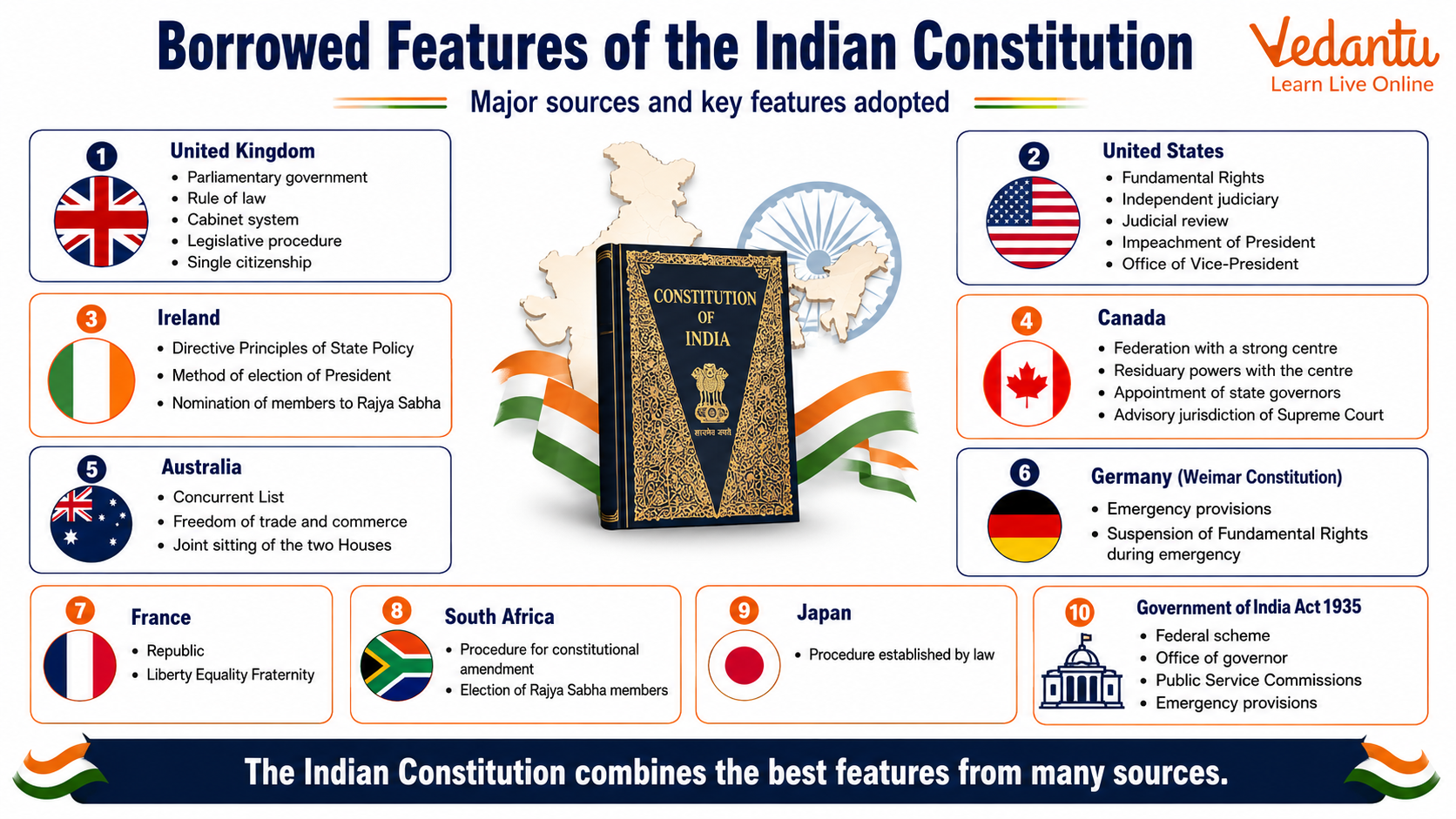
Why Did India Borrow Features from Other Constitutions?
While drafting the Constitution, the Constituent Assembly studied many world constitutions to adopt the best practices. India had just gained independence in 1947 and required a strong legal framework to ensure unity, democracy, justice, and equality.
- To adopt proven democratic principles
- To avoid mistakes already experienced by other nations
- To establish a stable and balanced political system
- To ensure rights, justice, and federal governance
Dr. B. R. Ambedkar, the Chairman of the Drafting Committee, ensured that borrowed provisions were suitable for Indian conditions.
List of Borrowed Features of Indian Constitution
| Country | Borrowed Features | Details |
|---|---|---|
| United Kingdom | Parliamentary System | Cabinet system, Rule of Law, Speaker position, Single citizenship |
| United States of America | Fundamental Rights | Judicial review, Independence of judiciary, Impeachment of President |
| Ireland | Directive Principles | Directive Principles of State Policy, Nomination to Rajya Sabha |
| Canada | Federal System | Division of powers, Strong center, Residuary powers |
| Australia | Concurrent List | Freedom of trade, Joint sitting of Parliament |
| Germany | Emergency Provisions | Suspension of Fundamental Rights during emergency |
| France | Republic Concept | Ideals of Liberty, Equality, Fraternity |
| South Africa | Amendment Procedure | Procedure for constitutional amendment, Election of Rajya Sabha members |
| Japan | Procedure Established by Law | Concept under Article 21 |
The above table highlights the major sources from which the Indian Constitution borrowed important features. These elements were adapted to suit Indian socio-political conditions.
Detailed Explanation of Major Borrowed Features
1. From the United Kingdom
India adopted the Parliamentary form of government from the UK. In this system, the executive is responsible to the legislature.
- Prime Minister as the real executive head
- Collective responsibility of the Council of Ministers
- Rule of Law
- Single citizenship
2. From the United States of America
The USA Constitution influenced India in protecting individual rights and maintaining judicial independence.
- Fundamental Rights
- Judicial Review
- Impeachment process of the President
- Vice President as ex-officio Chairman of Rajya Sabha
3. From Ireland
The Directive Principles of State Policy were inspired by the Irish Constitution. These principles guide the government in policy-making.
4. From Canada
India adopted a federal structure with a strong central government from Canada. Residuary powers are vested in the Union Government.
5. From Germany
Emergency provisions, especially the suspension of Fundamental Rights during national emergency, were influenced by the Weimar Constitution of Germany.
Significance of Borrowed Features
The borrowed features contribute to the strength and flexibility of the Indian Constitution. Instead of being a mere copy, the Constitution blends global best practices with Indian values.
- Ensures democratic governance
- Protects citizen rights
- Maintains balance between center and states
- Provides flexibility through amendment procedures
Important Points for Competitive Exams
- Fundamental Rights are borrowed from the USA.
- Directive Principles are borrowed from Ireland.
- Parliamentary system is borrowed from the UK.
- Emergency provisions are borrowed from Germany.
- Concurrent List is borrowed from Australia.
Questions related to borrowed features are frequently asked in competitive exams such as UPSC, SSC, State PSC, Banking exams, and other government examinations.
Conclusion
The List of Borrowed Features of Indian Constitution reflects the wisdom and vision of the framers of the Constitution. By incorporating the best elements from different countries, India created a balanced, flexible, and strong constitutional framework. These borrowed features ensure democracy, justice, equality, and federalism while maintaining the uniqueness of Indian governance. A clear understanding of this topic strengthens conceptual clarity in Indian Polity and improves performance in competitive examinations.
FAQs on List of Borrowed Features of the Indian Constitution Explained for Students
1. What are the borrowed features of the Indian Constitution?
The Indian Constitution has borrowed several important features from the constitutions of different countries to create a strong and flexible governance system.
• From Britain – Parliamentary system, Rule of Law, Single Citizenship
• From USA – Fundamental Rights, Judicial Review, Independence of Judiciary
• From Ireland – Directive Principles of State Policy (DPSP)
• From Canada – Federal system with strong Centre
• From Australia – Concurrent List, Freedom of Trade
• From Germany – Emergency provisions
These borrowed provisions make the Constitution a unique blend of federal and unitary features, often asked in GK and competitive exams.
2. Why did India borrow features from other constitutions?
India borrowed constitutional features to adopt the best practices of democratic governance from around the world.
• To ensure political stability and effective administration
• To incorporate proven principles like Fundamental Rights and Parliamentary Democracy
• To suit India’s diverse and federal structure
• To avoid repeating constitutional mistakes made by other nations
The Constituent Assembly carefully selected these features to frame a practical and adaptable Constitution.
3. Which features of the Indian Constitution are borrowed from the British Constitution?
The Indian Constitution adopted several key elements from the British Constitution to maintain a parliamentary form of government.
• Parliamentary System of Government
• Rule of Law
• Cabinet System
• Single Citizenship
• Office of the Speaker
These features ensure executive accountability to Parliament and are central to India’s democratic framework.
4. What features were borrowed from the US Constitution?
India adopted important democratic safeguards from the US Constitution.
• Fundamental Rights
• Judicial Review
• Independence of Judiciary
• Removal of judges through Impeachment
• Office of the Vice-President
These provisions protect citizens' rights and maintain the supremacy of the Constitution in India.
5. Which country inspired the Directive Principles of State Policy (DPSP)?
The Directive Principles of State Policy (DPSP) were borrowed from the Irish Constitution.
• Aim to establish social and economic democracy
• Guide the government in policy-making
• Promote welfare state principles
• Non-justiciable but fundamental to governance
DPSPs are frequently asked in GK under topics like constitutional features and governance.
6. What emergency provisions were borrowed in the Indian Constitution?
The emergency provisions in the Indian Constitution were mainly inspired by the Weimar Constitution of Germany.
• National Emergency (Article 352)
• President’s Rule (Article 356)
• Financial Emergency (Article 360)
These provisions allow temporary centralization of power during crises, ensuring national stability and security.
7. Which federal features were borrowed from Canada and Australia?
India adopted key federal elements from both Canada and Australia to strengthen its union structure.
From Canada:
• Federal system with a strong Centre
• Appointment of Governors by the Centre
From Australia:
• Concurrent List
• Freedom of trade and commerce
• Joint sitting of Parliament
These features support cooperative federalism in India.
8. What features were borrowed from the Government of India Act, 1935?
Many administrative provisions of the Indian Constitution were derived from the Government of India Act, 1935.
• Federal Scheme
• Office of the Governor
• Public Service Commissions
• Emergency provisions
• Administrative details
This Act served as a structural blueprint during the drafting of the Constitution.
9. Is the Indian Constitution completely borrowed from other countries?
No, the Indian Constitution is not merely a copied document but a unique blend of borrowed and indigenous features.
• Combines global best practices with Indian needs
• Includes unique concepts like Fundamental Duties
• Adapts features to suit Indian diversity
• Reflects values of sovereignty, socialism, secularism, and democracy
It is often called a “bag of borrowings”, but it remains distinctly Indian in spirit.
10. Which country influenced the concept of Fundamental Duties in India?
The concept of Fundamental Duties was borrowed from the Constitution of the USSR (Russia).
• Added by the 42nd Constitutional Amendment Act, 1976
• Listed under Article 51A
• Promote civic responsibility among citizens
• Complement Fundamental Rights
Fundamental Duties are an important topic in GK, civics, and competitive examinations.
