






Major Proposals of the Simon Commission and Their Impact on India
The Simon Commission Report Recommendations form an important chapter in modern Indian history, particularly in the struggle for independence. The Simon Commission was appointed by the British Government in 1927 to review the working of the Government of India Act, 1919 and suggest further constitutional reforms. However, the commission became highly controversial because it had no Indian members. The report, published in 1930, proposed several constitutional changes that influenced future developments, including the Government of India Act, 1935. Understanding its recommendations is essential for students and competitive exam aspirants.
Background of the Simon Commission
The Government of India Act, 1919 introduced a system of dyarchy in the provinces and promised a review after ten years. Instead of waiting until 1929, the British Government appointed the Indian Statutory Commission in 1927, popularly known as the Simon Commission after its chairman, Sir John Simon.
- Appointed in 1927 by the British Government.
- Headed by Sir John Simon.
- All seven members were British.
- Tasked with reviewing the Government of India Act, 1919.
The absence of Indian members led to widespread protests across the country with the slogan "Simon Go Back."
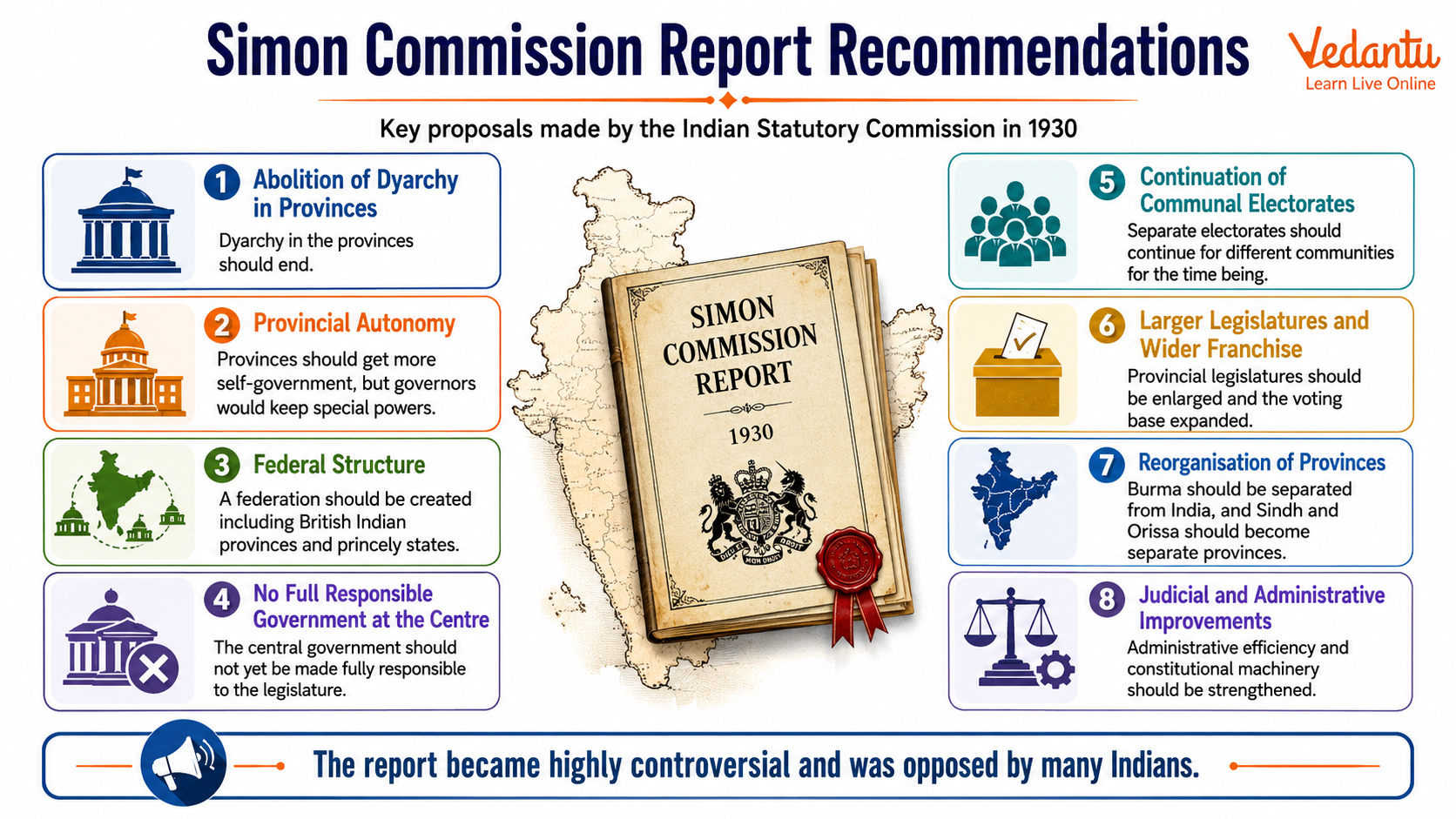
Major Recommendations of the Simon Commission Report
1. Abolition of Dyarchy in Provinces
The commission recommended the abolition of dyarchy introduced by the Government of India Act, 1919. It suggested that provinces should be given full responsible government, with ministers responsible to the provincial legislatures.
2. Introduction of Provincial Autonomy
It proposed granting greater autonomy to provinces. The provincial governments were to have more powers and freedom from central control, which later became a key feature of the Government of India Act, 1935.
3. Federal Constitution for India
The report recommended the establishment of a federal constitution for India. It suggested a federation consisting of British Indian provinces and princely states. However, the federation would come into existence only if princely states agreed to join.
4. Retention of Communal Electorates
The commission recommended the continuation of separate electorates for minorities. This proposal was criticized by many Indian leaders who believed it would deepen communal divisions.
5. Reorganization of Provinces
It suggested the reorganization of provinces on administrative grounds and recommended the creation of Sindh as a separate province and the separation of Burma from India.
6. Strengthening the Central Government
While recommending provincial autonomy, the commission proposed that the central government should remain strong. It did not suggest responsible government at the center.
7. Establishment of a Federal Court
The commission recommended the establishment of a Federal Court to interpret the constitution and settle disputes between provinces and the center.
Summary of Simon Commission Report Recommendations
| Recommendation | Key Feature | Impact |
|---|---|---|
| Abolition of Dyarchy | End of dual governance in provinces | Led to provincial autonomy |
| Federal Constitution | Union of provinces and princely states | Basis for 1935 Act |
| Separate Electorates | Continuation for minorities | Increased communal divisions |
These recommendations significantly influenced later constitutional developments, especially the Government of India Act, 1935, which incorporated many of the commission's proposals.
Criticism of the Simon Commission Report
The Simon Commission and its report faced strong criticism from Indian political leaders and the general public.
- No Indian representation in the commission.
- Failure to recommend responsible government at the center.
- Support for separate electorates.
- Limited political reforms compared to Indian expectations.
Indian leaders responded by drafting their own constitutional proposal, known as the Nehru Report in 1928.
Significance of the Simon Commission Report
Despite widespread opposition, the Simon Commission Report played an important role in shaping India's constitutional future. It provided the foundation for discussions at the Round Table Conferences and influenced the Government of India Act, 1935. The agitation against the commission also united various political groups and intensified the demand for complete independence.
- Strengthened the national movement.
- Encouraged constitutional debates among Indian leaders.
- Laid groundwork for future constitutional reforms.
Conclusion
The Simon Commission Report Recommendations marked a significant stage in India's constitutional evolution under British rule. While the commission faced intense opposition due to its exclusion of Indian members, its proposals influenced major reforms, particularly the Government of India Act, 1935. For students and exam aspirants, understanding these recommendations helps in analyzing the gradual development of constitutional governance in India and the growing momentum of the freedom struggle.
FAQs on Simon Commission Report Recommendations Explained for Students
1. What was the Simon Commission and why was it appointed?
The Simon Commission was a British committee appointed in 1927 to review the working of the Government of India Act, 1919 and suggest constitutional reforms.
- Officially called the Indian Statutory Commission
- Headed by Sir John Simon
- Tasked with examining constitutional progress in British India
- Aimed to recommend further steps toward self-government
- Became controversial because it had no Indian members, leading to nationwide protests
2. What were the main recommendations of the Simon Commission Report?
The main recommendations of the Simon Commission Report (1930) focused on constitutional reforms and provincial autonomy in India.
- Abolition of Dyarchy in Provinces
- Establishment of Provincial Autonomy
- Creation of a Federal Constitution for India
- Continuation of communal electorates
- Expansion of legislative councils
- Retention of strong powers for the Governor-General
3. Why was the Simon Commission boycotted by Indians?
The Simon Commission was boycotted because it did not include a single Indian member, which was seen as an insult to Indian political aspirations.
- All seven members were British parliamentarians
- Ignored demands for Indian representation
- Triggered the slogan "Simon Go Back"
- Led by parties like the Indian National Congress and supported by the Muslim League (initially divided)
- Resulted in widespread protests and nationalist movements
4. What was the impact of the Simon Commission on the Indian freedom movement?
The Simon Commission intensified the Indian freedom struggle and united various political groups against British rule.
- Sparked nationwide protests in 1928
- Led to the death of Lala Lajpat Rai after a police lathi charge
- Encouraged drafting of the Nehru Report (1928)
- Strengthened the demand for Poorna Swaraj (Complete Independence)
- Became a turning point in the Indian National Movement
5. What was Dyarchy and what did the Simon Commission say about it?
Dyarchy was a system introduced under the Government of India Act, 1919 that divided provincial subjects between elected ministers and British officials.
- Divided subjects into Reserved and Transferred categories
- Caused administrative conflicts and inefficiency
- The Simon Commission recommended its abolition in provinces
- Proposed giving provinces greater autonomous powers
6. Did the Simon Commission recommend complete independence for India?
No, the Simon Commission did not recommend complete independence but suggested gradual constitutional reforms within the British Empire.
- Supported Dominion Status in the future
- Emphasized step-by-step self-governance
- Retained significant powers for the British Governor-General
- Rejected immediate full responsible government at the center
7. How did the Simon Commission influence the Nehru Report?
The Simon Commission directly led to the drafting of the Nehru Report (1928) as an Indian response to British proposals.
- Indian leaders formed an All Parties Conference
- Drafted by Motilal Nehru
- Proposed a Dominion Constitution for India
- Rejected separate electorates
- Reflected Indian aspirations for self-rule
8. What was the reaction of British authorities to the protests against the Simon Commission?
British authorities responded to protests with repression but continued constitutional discussions.
- Imposed police actions and lathi charges
- Arrested nationalist leaders
- Ignored boycott demands initially
- Used the report as a basis for the Round Table Conferences (1930–32)
- Eventually influenced the Government of India Act, 1935
9. What role did Lala Lajpat Rai play during the Simon Commission protests?
Lala Lajpat Rai led a major protest against the Simon Commission and became a martyr of the freedom struggle.
- Organized demonstrations in Lahore (1928)
- Protested with the slogan "Simon Go Back"
- Injured in a brutal police lathi charge
- Died due to injuries, inspiring revolutionaries like Bhagat Singh
- Strengthened anti-British sentiments across India
10. How did the Simon Commission Report lead to the Government of India Act 1935?
The Simon Commission Report laid the foundation for the Government of India Act, 1935, which introduced major constitutional reforms.
- Recommended Provincial Autonomy
- Proposed a Federal Structure
- Expanded legislative representation
- Continued communal electorates
- Became a key reference during the Round Table Conferences and later reforms
