






Why the New 20 Rupee Coin in India Was Introduced and Its Unique Features
The New Rs 20 Coin of India is part of the latest series of coins introduced by the Government of India to modernize Indian currency. Issued by the Ministry of Finance and minted by the Security Printing and Minting Corporation of India Limited, the new Rs 20 coin was launched in 2019 to improve durability, security, and ease of identification. It is distinct in shape, size, and design compared to earlier Rs 20 coins. This topic is important for General Knowledge, competitive exams, and banking awareness as questions are frequently asked about new currency features, design elements, and issuing authorities.
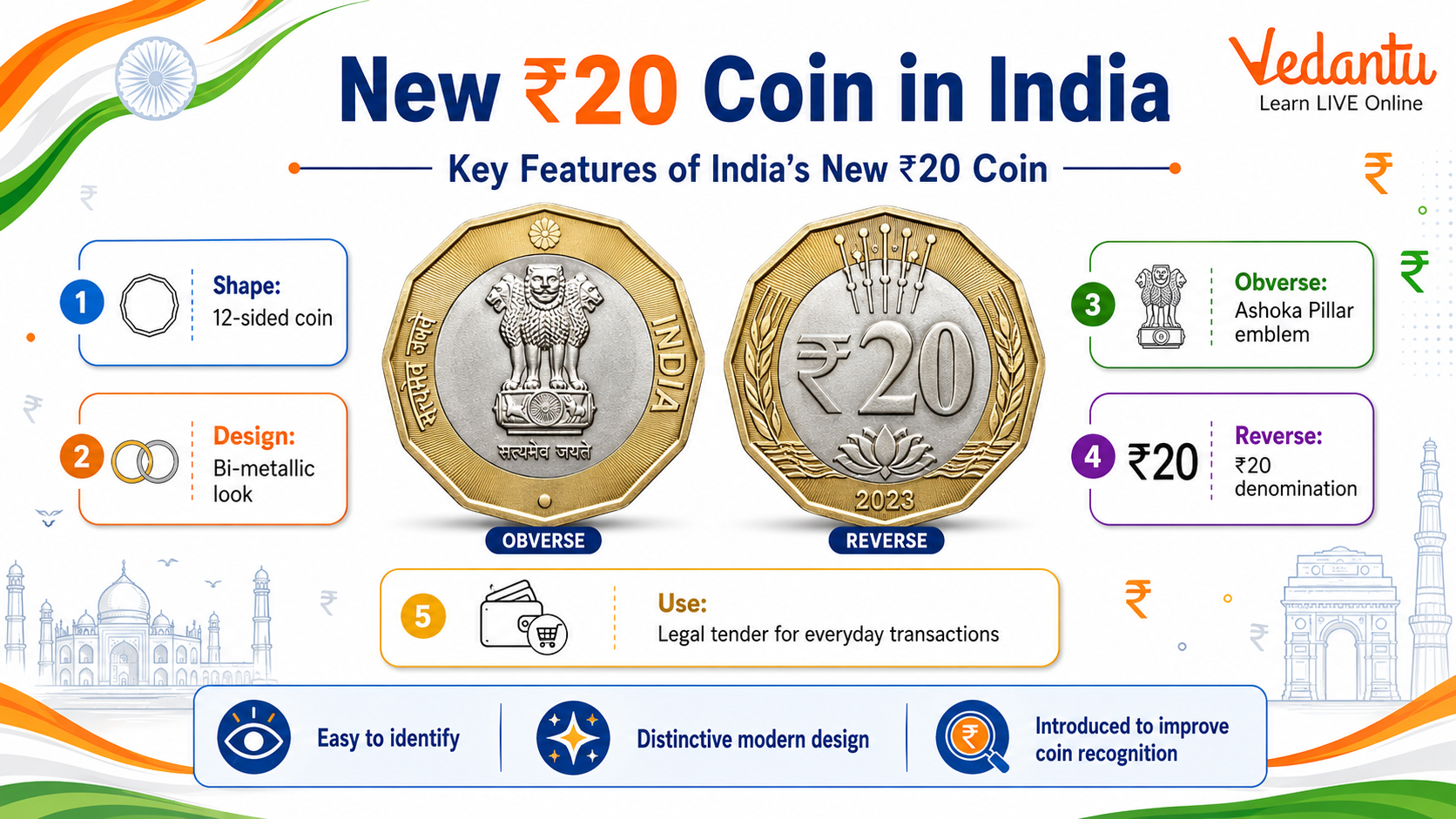
Background of the New Rs 20 Coin
The Government of India periodically introduces new coin series to enhance security features and improve accessibility for visually impaired individuals. In March 2019, a new series of coins in denominations of Re 1, Rs 2, Rs 5, Rs 10, and Rs 20 was announced. The new Rs 20 coin replaced the earlier round Rs 20 coin and introduced a unique 12-edged polygon shape for easy identification.
Key Features of the New Rs 20 Coin
Shape and Design
- The coin has a 12-edged polygon shape.
- It is bimetallic in appearance with a distinct outer ring and inner core.
- The Ashoka Lion Capital is engraved on the obverse side.
- The reverse side displays the denomination 20 along with the Rupee symbol.
Material Composition
- Outer ring - Nickel Silver
- Inner core - Nickel Brass
Weight and Dimensions
- Weight - Approximately 8.54 grams
- Diameter - 27 mm
- Thickness - 2.15 mm
Comparison Between Old and New Rs 20 Coin
| Feature | Old Rs 20 Coin | New Rs 20 Coin |
|---|---|---|
| Shape | Round | 12-edged Polygon |
| Design | Bimetallic | Distinct outer ring and inner core |
| Year of Introduction | 2009 | 2019 |
The new design was introduced mainly to make the coin easily distinguishable from other denominations and to incorporate improved security and accessibility features.
Inscriptions on the Coin
Obverse Side
- Lion Capital of Ashoka in the center.
- India written in Hindi and English.
- Satyameva Jayate inscribed below the emblem.
Reverse Side
- Denomination 20 with the Rupee symbol.
- Year of minting mentioned below.
- Grain design motif representing agriculture.
Importance of the New Rs 20 Coin
The introduction of the new Rs 20 coin reflects India’s efforts to modernize its currency system. The distinct 12-edged shape helps visually impaired individuals identify the coin easily. The improved metallic composition ensures durability and reduces wear and tear. Additionally, the redesign aligns with international standards of coin minting and security.
Issuing Authority and Mints
The new Rs 20 coin is issued by the Government of India under the authority of the Reserve Bank of India Act. The coins are minted at four major mints in India:
- Mumbai Mint
- Kolkata Mint
- Hyderabad Mint
- Noida Mint
Frequently Asked GK Points
- Launched in 2019 as part of a new coin series.
- 12-edged polygon shape makes it unique.
- Bimetallic composition with nickel silver and nickel brass.
- Frequently asked in banking, SSC, UPSC, and other competitive exams.
Conclusion
The New Rs 20 Coin India is an important development in the Indian currency system. With its distinctive 12-edged design, improved durability, and enhanced security features, it represents modernization in coin minting. For students and competitive exam aspirants, understanding its features, year of launch, composition, and design details is essential for General Knowledge preparation. Staying updated with such currency changes helps in performing better in banking and government examinations.
FAQs on New ₹20 Coin in India – Complete Guide for Students
1. What is the New Rs 20 Coin of India?
The New Rs 20 Coin is a redesigned bimetallic circulation coin introduced by the Reserve Bank of India (RBI) and the Government of India in 2020 to enhance security and accessibility.
- Part of the new series of Indian coins
- Introduced under the Coinage Act, 2011
- Features a unique 12-edged (dodecagonal) shape
- Includes improved visual and tactile identification features
2. When was the New Rs 20 Coin introduced in India?
The New Rs 20 Coin was officially introduced in March 2020 as part of a new coin series launched by the Government of India.
- Announced by the Ministry of Finance
- Released along with Re 1, Rs 2, Rs 5, and Rs 10 coins
- Aimed at improving security features and accessibility
- Circulated nationwide through banks and RBI branches
3. What are the features of the New Rs 20 Coin?
The New Rs 20 Coin has distinct physical and security features that differentiate it from earlier coins.
- Dodecagonal (12-edged) shape
- Bimetallic design with outer nickel silver ring and inner nickel brass core
- Weight: 8.54 grams
- Diameter: 27 mm
- Embossed ₹ symbol and denomination “20”
4. Why was the shape of the New Rs 20 Coin changed?
The shape of the New Rs 20 Coin was changed to a 12-edged design to improve identification and prevent counterfeiting.
- Helps visually impaired persons identify the coin easily
- Reduces confusion with Rs 10 coin
- Enhances security against fake coins
- Provides a modern and distinct appearance
5. What symbols are engraved on the New Rs 20 Coin?
The New Rs 20 Coin features national and monetary symbols that reflect India's identity and economy.
- Lion Capital of Ashoka Pillar on the obverse
- Inscription: “Satyameva Jayate”
- Denomination “20” and the ₹ symbol
- Grain motif representing agricultural prosperity
- Year of minting at the bottom
6. Is the Old Rs 20 Coin still valid in India?
Yes, the old Rs 20 coin remains legal tender in India unless officially withdrawn by the RBI.
- Both old and new Rs 20 coins are valid for transactions
- No demonetization notice issued for older coins
- Accepted in banks, markets, and public services
7. What is the material used in the New Rs 20 Coin?
The New Rs 20 Coin is made of two different metals forming a durable bimetallic structure.
- Outer ring: Nickel Silver
- Inner core: Nickel Brass
- Designed for durability and anti-counterfeiting
- Common in high-value coins worldwide
8. Who issues the Rs 20 Coin in India?
The Rs 20 Coin is issued by the Government of India and circulated under the authority of the Reserve Bank of India (RBI).
- Minted at Indian Government Mints (Mumbai, Kolkata, Hyderabad, Noida)
- Legal basis: Coinage Act, 2011
- Distributed through banks and RBI branches
9. What is the significance of the grain design on the New Rs 20 Coin?
The grain design on the New Rs 20 Coin symbolizes India’s agricultural strength and economic growth.
- Represents agricultural prosperity
- Highlights importance of farmers and food production
- Reflects India’s identity as an agrarian economy
10. How is the New Rs 20 Coin different from the Rs 10 Coin?
The New Rs 20 Coin differs from the Rs 10 Coin in shape, weight, and design to avoid confusion.
- Rs 20: 12-edged shape, 8.54 g weight
- Rs 10: Round shape, lighter weight
- Different metal composition and diameter
- Distinct denomination marking and tactile features
