






Major Government Health Schemes under India’s National Health Initiatives
National Health Programmes in India are government-led initiatives designed to address major public health challenges such as communicable diseases, non-communicable diseases, maternal and child health issues, and nutritional deficiencies. These programmes aim to improve healthcare access, reduce disease burden, enhance life expectancy, and promote overall well-being of the population. For students preparing for competitive exams like NEET and other entrance tests, understanding these programmes is important as they reflect India’s public health priorities, disease control strategies, and healthcare delivery framework.
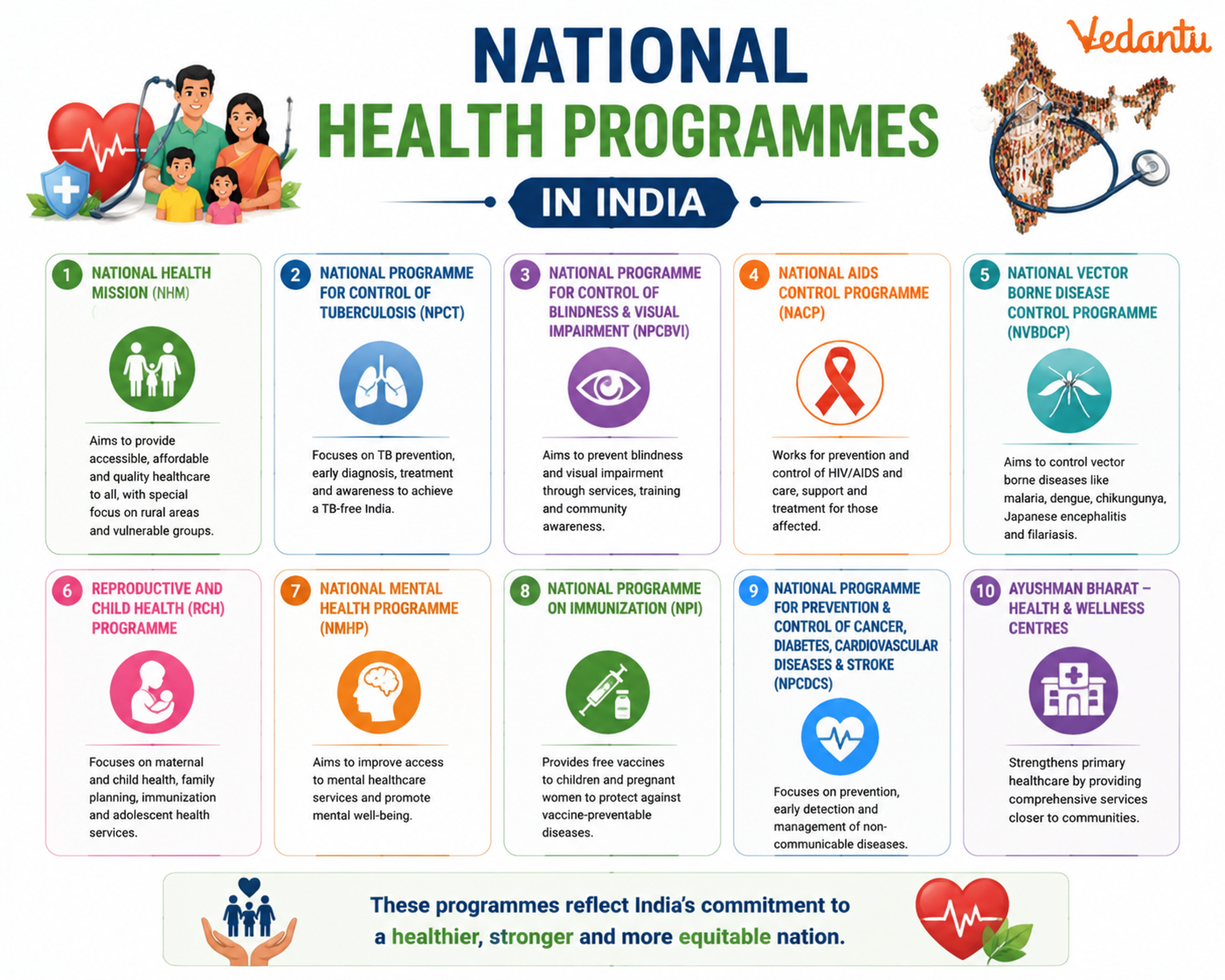
Objectives of National Health Programmes
The primary objective of National Health Programmes is to control, eliminate, or eradicate diseases that pose significant threats to public health. These programmes are implemented by the Ministry of Health and Family Welfare in coordination with state governments.
- Reduce morbidity and mortality due to communicable and non-communicable diseases.
- Improve maternal, neonatal, and child health indicators.
- Provide universal access to preventive, promotive, and curative healthcare services.
- Promote health awareness and healthy lifestyle practices.
- Strengthen disease surveillance and healthcare infrastructure.
Classification of National Health Programmes
National Health Programmes in India can broadly be classified into the following categories:
1. Communicable Disease Control Programmes
- National Tuberculosis Elimination Programme (NTEP)
- National AIDS Control Programme (NACP)
- National Vector Borne Disease Control Programme (NVBDCP)
- National Leprosy Eradication Programme (NLEP)
- Universal Immunization Programme (UIP)
2. Non-Communicable Disease Control Programmes
- National Programme for Prevention and Control of Cancer, Diabetes, Cardiovascular Diseases and Stroke (NPCDCS)
- National Mental Health Programme (NMHP)
- National Programme for Health Care of the Elderly (NPHCE)
3. Maternal and Child Health Programmes
- Reproductive, Maternal, Newborn, Child and Adolescent Health (RMNCH+A)
- Janani Suraksha Yojana (JSY)
- Rashtriya Bal Swasthya Karyakram (RBSK)
Major National Health Programmes in India
| Programme Name | Year Launched | Main Objective |
|---|---|---|
| National Tuberculosis Elimination Programme | 1962 (Revised 1997) | Eliminate tuberculosis from India |
| National AIDS Control Programme | 1992 | Prevent and control HIV/AIDS |
| Universal Immunization Programme | 1985 | Provide free vaccination to children and pregnant women |
These programmes are implemented through primary health centres, community health centres, district hospitals, and tertiary care institutions. They are supported by surveillance systems, awareness campaigns, and community participation to ensure effective coverage and impact.
Role of National Health Mission
The National Health Mission (NHM), launched in 2013, integrates various health programmes under a comprehensive framework. It includes the National Rural Health Mission (NRHM) and the National Urban Health Mission (NUHM).
- Strengthens public health systems in rural and urban areas.
- Improves availability of essential drugs and diagnostics.
- Promotes institutional deliveries and immunization coverage.
- Supports disease control and prevention initiatives.
Importance for NEET and Competitive Exams
National Health Programmes are important from a General Knowledge and public health perspective. Questions may be asked regarding the objectives, year of launch, target diseases, and implementing agencies. Understanding these programmes also helps students connect epidemiology, preventive medicine, and community health concepts.
- Remember key programmes related to major diseases like TB, HIV/AIDS, malaria, and cancer.
- Focus on immunization schedules under the Universal Immunization Programme.
- Understand maternal and child health initiatives and their impact indicators.
- Keep track of updated targets such as TB elimination goals.
Conclusion
National Health Programmes in India play a crucial role in reducing disease burden, improving healthcare access, and enhancing quality of life. They reflect the government’s commitment to public health and preventive care. For students, especially those preparing for NEET and other competitive examinations, a clear understanding of these programmes helps build a strong foundation in community medicine and public health awareness.
FAQs on National Health Programmes in India – Complete Guide for Students
1. What are National Health Programmes in India?
National Health Programmes in India are government-led initiatives designed to prevent, control, and eliminate major diseases and improve public health outcomes across the country.
Key objectives include:
• Disease prevention and control (TB, Malaria, HIV/AIDS)
• Maternal and child healthcare improvement
• Immunization and vaccination coverage
• Strengthening primary healthcare services
These programmes fall under the Ministry of Health and Family Welfare and aim to ensure affordable and accessible healthcare for all citizens.
2. What is the objective of National Health Programmes?
The main objective of National Health Programmes is to reduce disease burden and improve the overall health status of the Indian population.
Major goals include:
• Eradication of communicable diseases
• Reduction in maternal and infant mortality rates
• Promotion of preventive healthcare
• Ensuring universal health coverage (UHC)
These programmes support India’s commitment to the Sustainable Development Goals (SDGs) and public health reforms.
3. What are the major National Health Programmes in India?
India runs several major National Health Programmes to tackle critical health challenges.
Important programmes include:
• National Tuberculosis Elimination Programme (NTEP)
• National AIDS Control Programme (NACP)
• National Vector Borne Disease Control Programme (NVBDCP)
• Universal Immunization Programme (UIP)
• National Health Mission (NHM)
These initiatives focus on communicable diseases, immunization, reproductive health, and rural healthcare development.
4. What is the National Health Mission (NHM)?
The National Health Mission (NHM) is a flagship health programme launched in 2013 to strengthen healthcare delivery across India.
It includes:
• National Rural Health Mission (NRHM)
• National Urban Health Mission (NUHM)
• Focus on maternal, newborn, and child health
• Strengthening primary health centres (PHCs)
NHM aims to provide equitable, affordable, and quality healthcare services to both rural and urban populations.
5. What is the Universal Immunization Programme (UIP)?
The Universal Immunization Programme (UIP) is one of the world’s largest public health programmes providing free vaccines to children and pregnant women.
It covers vaccines against:
• Polio
• Measles
• Diphtheria, Pertussis, Tetanus (DPT)
• Hepatitis B
UIP aims to reduce child mortality and prevent vaccine-preventable diseases under India’s immunization strategy.
6. What is the National Tuberculosis Elimination Programme (NTEP)?
The National Tuberculosis Elimination Programme (NTEP) aims to eliminate TB in India by 2025.
Key features include:
• Free TB diagnosis and treatment
• Implementation of DOTS strategy (Directly Observed Treatment, Short-course)
• Nutritional and financial support to TB patients
NTEP is a crucial step in controlling tuberculosis (TB), one of India’s major public health concerns.
7. What is the National AIDS Control Programme (NACP)?
The National AIDS Control Programme (NACP) was launched in 1992 to prevent and control HIV/AIDS in India.
Main components include:
• HIV awareness and prevention campaigns
• Free Antiretroviral Therapy (ART)
• Blood safety and testing services
NACP focuses on reducing new HIV infections and eliminating AIDS-related stigma and discrimination.
8. Why are National Health Programmes important for India?
National Health Programmes are vital for improving public health infrastructure and reducing disease burden in India.
They help in:
• Controlling epidemics and pandemics
• Improving life expectancy
• Reducing maternal and infant mortality rates
• Promoting health awareness and preventive care
These programmes ensure inclusive healthcare for vulnerable and economically weaker sections.
9. Who implements National Health Programmes in India?
The Ministry of Health and Family Welfare (MoHFW) implements National Health Programmes in coordination with state governments.
Implementation involves:
• State Health Departments
• District Health Authorities
• Primary Health Centres (PHCs) and Community Health Centres (CHCs)
• Accredited Social Health Activists (ASHAs)
This multi-level governance ensures effective public health service delivery across India.
10. How do National Health Programmes help competitive exam preparation?
National Health Programmes are important topics in General Knowledge (GK) for exams like UPSC, SSC, State PSC, and other competitive tests.
They are frequently asked in:
• Current Affairs and Static GK sections
• Questions on government schemes and policies
• Topics related to public health and social development
Understanding these programmes helps aspirants score well in exams and interviews related to Indian governance and health policies.
