






Key Features of the Mughal Administrative System and Its Central–Provincial Setup
The Mughal Administration was one of the most organized and centralized administrative systems in medieval India. Established by Babur in 1526 and developed significantly by emperors like Akbar, Jahangir, Shah Jahan, and Aurangzeb, the Mughal administrative structure played a key role in maintaining political stability and economic prosperity across a vast empire. The system combined Persian traditions, Islamic principles, and Indian administrative practices. Understanding the key features and structure of Mughal administration is essential for students preparing for competitive exams and for gaining deeper insight into Indian medieval history.
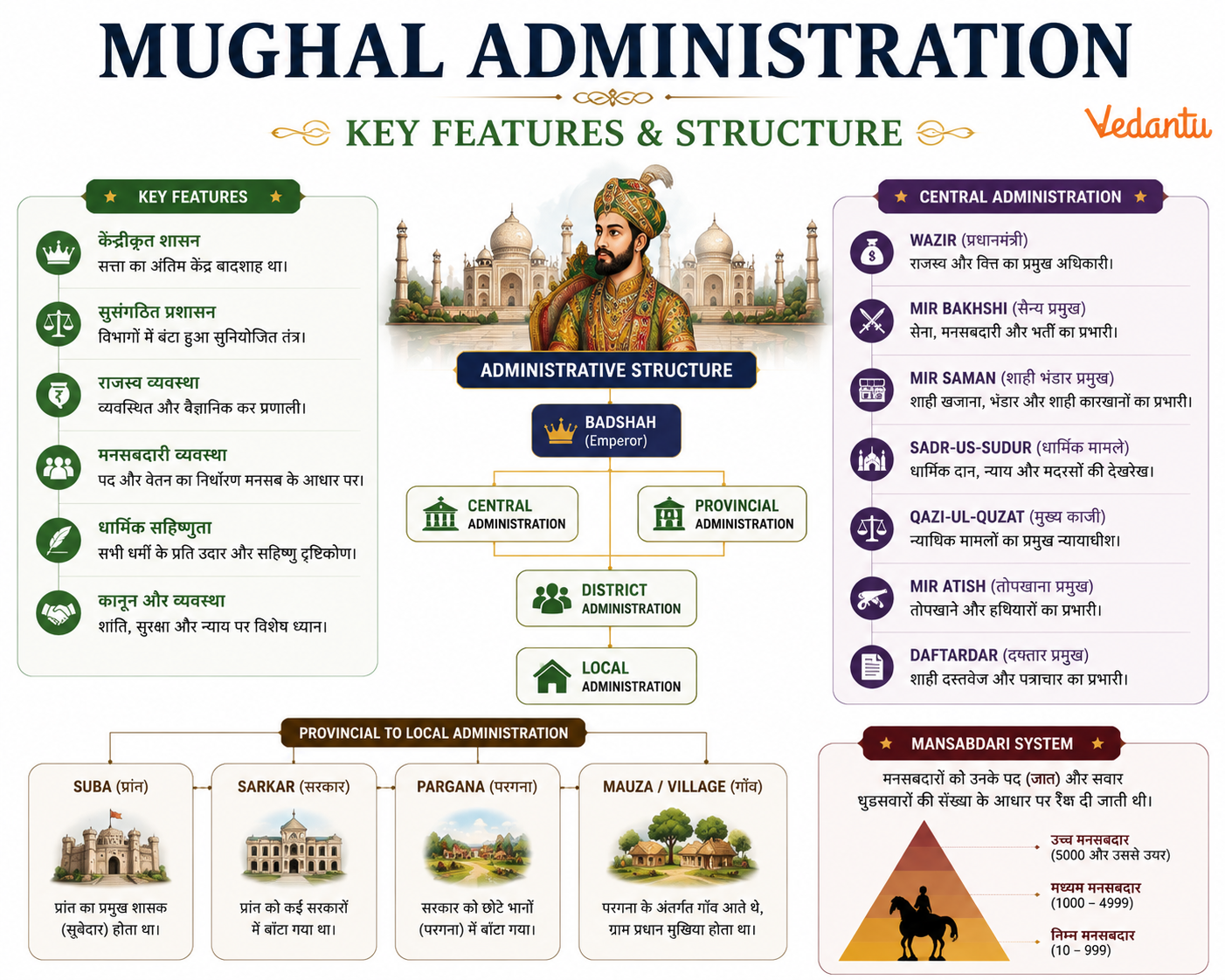
Overview of Mughal Administration
The Mughal administrative system was highly centralized, with the emperor holding supreme authority. The emperor was the head of the state, the chief lawmaker, the supreme commander of the army, and the final authority in judicial matters. The administration was divided into central, provincial, and local levels to ensure effective governance.
- Strong central authority under the emperor
- Well-defined departments and officials
- Efficient revenue collection system
- Organized military structure through the Mansabdari system
Central Administration
The central administration was directly controlled by the emperor. Several high-ranking officials assisted him in running the empire efficiently. These officials were appointed by the emperor and were responsible for specific departments.
Important Central Officials
Key Officials in Mughal Central Administration
| Official | Department | Main Functions |
|---|---|---|
| Wazir or Diwan | Revenue and Finance | Supervised income and expenditure of the empire |
| Mir Bakshi | Military | Managed army, appointments, and Mansabdars |
| Sadr-us-Sudur | Religious Affairs | Looked after religious grants and charities |
Other important officials included the Qazi, who handled judicial matters, and the Khan-i-Saman, who managed the royal household. These officials ensured smooth functioning of different administrative branches.
Provincial Administration
The Mughal Empire was divided into provinces called Subas. Each Suba was governed by a Subedar or governor appointed by the emperor. The provincial administration closely resembled the central structure to maintain uniformity across the empire.
Key Provincial Officers
- Subedar - Head of the province and maintained law and order
- Diwan - In charge of revenue collection in the province
- Bakshi - Managed provincial military affairs
- Qazi - Administered justice at provincial level
Each province was further divided into Sarkars, which were subdivided into Parganas and villages. At the village level, local officials like the village headman and patwari assisted in administration and revenue collection.
Mansabdari System
The Mansabdari system was a unique administrative and military system introduced by Akbar. Under this system, every officer was assigned a rank called Mansab. The rank determined the salary, status, and number of troops the officer had to maintain.
- Mansab means rank or position
- Two components - Zat and Sawar
- Zat indicated personal rank and salary
- Sawar indicated the number of cavalry troops to be maintained
This system helped the emperor maintain control over nobles and ensured a strong centralized military structure.
Revenue Administration
Revenue was the main source of income for the Mughal Empire. Akbar introduced important reforms under the guidance of Raja Todar Mal. The land revenue system was carefully organized to ensure fairness and efficiency.
Zabt System
The Zabt system involved measurement of land and assessment of revenue based on the average produce and prices over a period of ten years. Farmers were required to pay revenue in cash. This system improved financial stability and reduced corruption.
- Systematic land measurement
- Classification of land based on fertility
- Fixed revenue rates
- Reduced exploitation of peasants
Judicial Administration
The emperor was the highest judicial authority in the Mughal Empire. Islamic law or Sharia formed the basis of justice, but local customs were also respected in many cases. Qazis were appointed at various levels to administer justice.
- Emperor as supreme judge
- Qazis at provincial and local levels
- Civil and criminal cases handled separately
- Use of Islamic law along with local traditions
Key Features of Mughal Administration
- Highly centralized administrative structure
- Efficient revenue collection system
- Well-organized military through Mansabdari system
- Clear division of responsibilities among officials
- Uniform system across the empire
Importance of Mughal Administrative System
The Mughal administrative structure laid the foundation for future administrative practices in India. Many features, such as revenue assessment, land measurement, and centralized governance, influenced later systems including British administration. The efficiency and organization of the Mughal system contributed to the stability and prosperity of the empire for nearly two centuries.
In conclusion, the Mughal Administration was a well-structured and systematic form of governance that combined military strength, efficient revenue management, and centralized authority. Its key features and structured hierarchy made it one of the most significant administrative systems in Indian history, making it an important topic for General Knowledge and competitive examinations.
FAQs on Mughal Administration: Structure and Main Features Explained
1. What were the key features of Mughal Administration?
The Mughal Administration was a centralized and efficient system that ensured strong imperial control over the empire. Key features included:
• A highly centralized monarchy under the emperor
• A well-organized mansabdari system for military and civil services
• Efficient revenue administration under Todar Mal
• Division of empire into provinces (Subas)
• Strong judicial and military structure
This system strengthened governance during rulers like Akbar, Jahangir, Shah Jahan, and Aurangzeb.
2. How was the central administration organized under the Mughals?
The Central Administration of the Mughal Empire revolved around the emperor as the supreme authority. It included:
• Wazir (Prime Minister) – Head of revenue and finance
• Mir Bakshi – Head of military and mansabdars
• Diwan – Revenue officer
• Sadr-us-Sudur – Religious affairs head
• Qazi – Chief judge
This structure ensured smooth governance and administrative efficiency.
3. What was the Mansabdari System in Mughal Administration?
The Mansabdari System was a rank-based administrative and military system introduced by Akbar. Its main features were:
• Officers were called Mansabdars
• Rank was divided into Zat (personal rank) and Sawar (cavalry rank)
• Mansabdars were paid through Jagirs (land revenue assignments)
This system helped maintain a strong army and administrative control across the Mughal Empire.
4. What was the revenue system under the Mughals?
The Mughal Revenue System was systematic and scientific, especially under Raja Todar Mal. Important aspects included:
• Introduction of the Zabt system
• Land measurement and classification
• Fixing revenue based on average produce
• Collection mainly in cash
This efficient land revenue system strengthened the empire’s economy.
5. How was the Mughal Empire divided administratively?
The administrative structure of the Mughal Empire was divided into several units for better governance:
• Suba (Province) – Headed by Subedar
• Sarkar (District)
• Pargana
• Village – Smallest unit
This hierarchical system ensured effective provincial administration and law enforcement.
6. Who were the important officials in provincial administration?
The Provincial Administration under the Mughals mirrored the central structure. Key officials included:
• Subedar – Governor of the province
• Diwan – Revenue head
• Bakshi – Military officer
• Qazi – Judicial officer
• Faujdar – Maintained law and order
This system ensured strong control over distant regions.
7. What role did the emperor play in Mughal Administration?
The Mughal Emperor was the supreme authority in political, military, and judicial matters. His powers included:
• Head of the executive, judiciary, and army
• Appointment of all high officials
• Final authority in legal decisions
• Controller of revenue and expansion policies
The emperor’s centralized power was the backbone of Mughal governance.
8. What was the Jagirdari System in Mughal rule?
The Jagirdari System was a land revenue assignment system linked with the mansabdari system. Key points include:
• Jagirs were granted to Mansabdars instead of salaries
• Jagirdars collected revenue from assigned lands
• Jagirs were transferable to prevent rebellion
This system helped maintain administrative loyalty and financial stability.
9. How did Mughal Administration maintain law and order?
The law and order system in the Mughal Empire was strict and organized. It included:
• Faujdar for maintaining peace
• Kotwal for city administration
• Qazi for judicial matters
• Application of Islamic law (Sharia) along with local customs
This ensured stability across vast territories.
10. Why is Mughal Administration important for competitive exams?
The Mughal Administration is important for exams like UPSC, SSC, and State PSC due to its structured governance model. It covers topics such as:
• Mansabdari and Jagirdari systems
• Revenue reforms of Todar Mal
• Central and Provincial administration
• Role of major rulers like Akbar and Aurangzeb
Understanding these concepts helps in answering GK, history, and polity-related questions effectively.
