






Functions of the MPC in Controlling Inflation and Interest Rates
The Monetary Policy Committee (MPC) is a statutory body responsible for formulating monetary policy in a country. In India, the Monetary Policy Committee was established under the Reserve Bank of India Act, 1934, through an amendment in 2016. The main objective of the MPC is to maintain price stability while keeping in mind the goal of economic growth. It plays a crucial role in controlling inflation, managing interest rates, and ensuring financial stability in the economy.
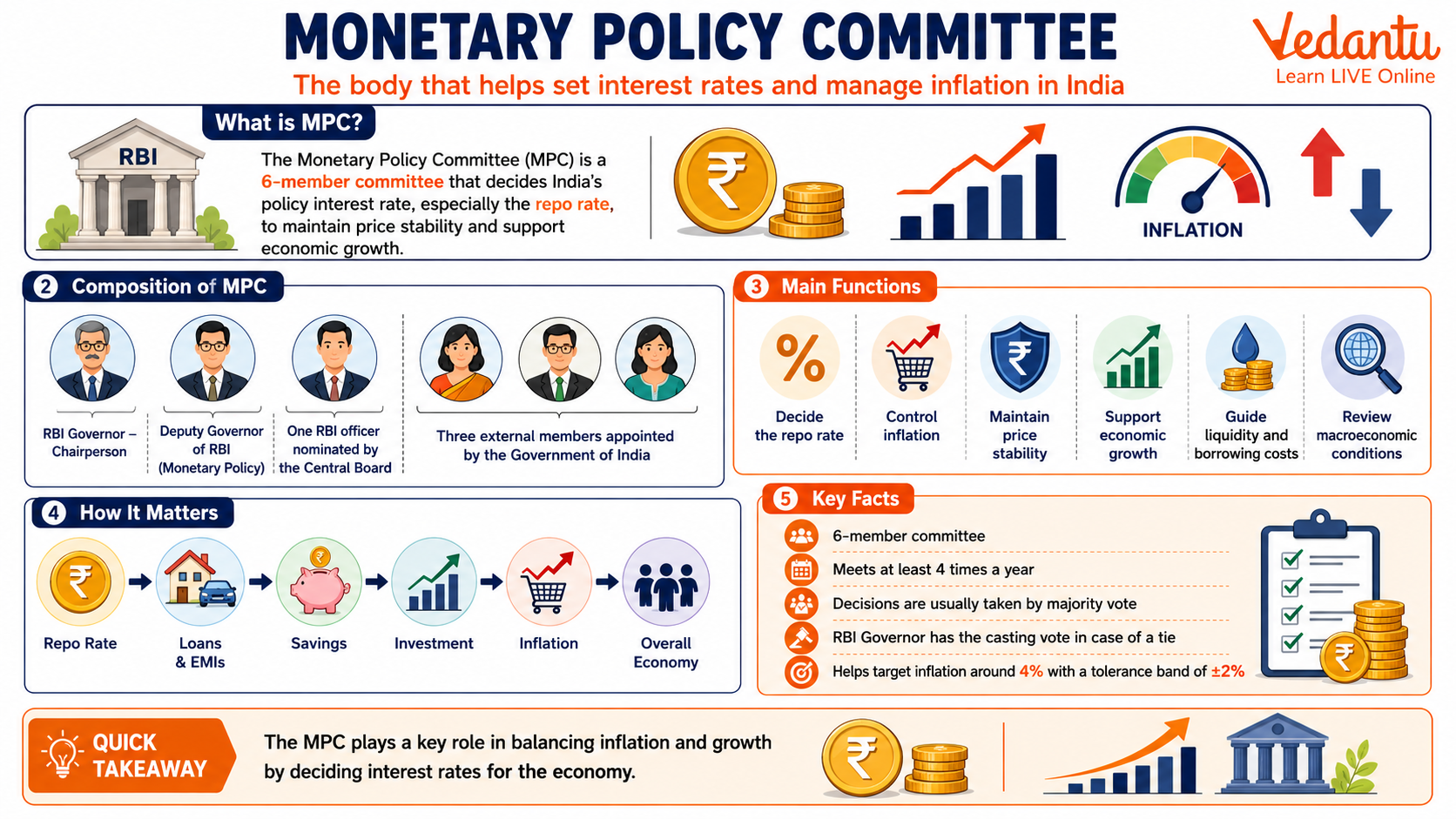
Introduction to Monetary Policy Committee
Monetary policy refers to the actions taken by a central bank to control money supply and credit conditions in an economy. In India, the Reserve Bank of India (RBI) is responsible for monetary policy, and the Monetary Policy Committee assists in decision-making regarding key policy rates such as the repo rate.
The Monetary Policy Committee system ensures transparency, accountability, and collective decision-making in setting interest rates. It aims to achieve the inflation target set by the Government of India.
Establishment and Legal Framework
The Monetary Policy Committee was established in 2016 following the recommendations of the Urjit Patel Committee. It was created through an amendment to the Reserve Bank of India Act, 1934.
- Established in India in 2016
- Constituted under Section 45ZB of the RBI Act, 1934
- Implements Flexible Inflation Targeting framework
- Inflation target set at 4 percent with a tolerance band of +/- 2 percent
Composition of the Monetary Policy Committee
| Member Type | Number of Members | Appointing Authority |
|---|---|---|
| RBI Officials | 3 | Reserve Bank of India |
| External Members | 3 | Government of India |
The MPC consists of six members. Three members are from the RBI including the Governor, who acts as the Chairperson. The other three members are appointed by the Government of India. Each member has one vote, and decisions are taken by majority. In case of a tie, the Governor has a casting vote.
Functions of the Monetary Policy Committee
The primary responsibility of the Monetary Policy Committee is to determine the policy repo rate. However, its functions extend beyond this single task.
- Fixes the benchmark interest rate known as the repo rate
- Controls inflation through monetary tools
- Ensures price stability in the economy
- Supports sustainable economic growth
- Publishes Monetary Policy Report and policy statements
Meetings of the Monetary Policy Committee
The Monetary Policy Committee is required to meet at least four times in a year. In practice, it usually meets six times annually. The decisions of the meeting are published along with the voting pattern of each member to ensure transparency.
Decision Making Process
- Review of economic indicators such as inflation and GDP growth
- Discussion among committee members
- Voting by each member
- Announcement of policy decision
Importance of the Monetary Policy Committee
The Monetary Policy Committee plays a vital role in maintaining macroeconomic stability. By controlling inflation and stabilizing prices, it protects the purchasing power of citizens and promotes economic confidence.
- Enhances transparency in monetary policy decisions
- Reduces arbitrary decision-making
- Improves credibility of the central bank
- Provides stable economic environment for investment
Key Terms Related to Monetary Policy Committee
Repo Rate
The rate at which the RBI lends money to commercial banks. It is the main tool used by the MPC to control inflation.
Inflation Targeting
A monetary policy framework where the central bank aims to keep inflation around a predetermined target level, which in India is 4 percent with a tolerance band of +/- 2 percent.
Cash Reserve Ratio (CRR)
The percentage of total deposits that banks must keep with the RBI as reserves. Although decided by RBI, it supports the broader goals of monetary policy.
Challenges Faced by the Monetary Policy Committee
The Monetary Policy Committee faces several challenges in balancing inflation and growth. External shocks, global oil prices, supply chain disruptions, and fiscal policy measures can impact inflation levels.
- Managing food and fuel price volatility
- Global economic uncertainty
- Balancing growth with inflation control
- Transmission of policy rates to banks
Conclusion
The Monetary Policy Committee is a crucial institution in India financial system. By setting interest rates and targeting inflation, it ensures economic stability and sustainable development. Understanding the structure, functions, and importance of the MPC is essential for students preparing for competitive examinations and for anyone interested in how economic policies shape a nation growth.
FAQs on Monetary Policy Committee: Meaning, Members and Objectives
1. What is the Monetary Policy Committee (MPC)?
The Monetary Policy Committee (MPC) is a statutory body responsible for deciding a country’s monetary policy, especially interest rates to control inflation. • In India, it was established under the RBI Act, 1934 (amended in 2016) • It determines the repo rate and other policy rates • It aims to maintain price stability while supporting economic growth • Common searches include: What is MPC in RBI? Who controls inflation in India? What is repo rate decision body?
2. When was the Monetary Policy Committee formed in India?
The Monetary Policy Committee of India was formed in 2016 after amendments to the Reserve Bank of India Act, 1934. • It replaced the earlier system where the RBI Governor alone decided policy rates • The first MPC meeting was held in October 2016 • It introduced a formal inflation targeting framework • Related queries: When did inflation targeting start in India? Who introduced MPC in India?
3. How many members are there in the Monetary Policy Committee?
The MPC in India consists of six members responsible for monetary policy decisions. • Three members from the RBI (including the RBI Governor) • Three external members appointed by the Central Government • Each member has one vote • The Governor has a casting vote in case of a tie • People also ask: Who appoints MPC members? What is the composition of MPC?
4. What are the main functions of the Monetary Policy Committee?
The main function of the Monetary Policy Committee is to regulate inflation and liquidity in the economy. • Fixes the repo rate and policy interest rates • Maintains the inflation target (4% ± 2%) • Ensures price stability • Supports sustainable economic growth • Related terms: monetary tools, interest rate policy, inflation control mechanism.
5. What is the inflation target set by the MPC in India?
The inflation target set by the Government of India for the MPC is 4% with a tolerance band of ±2%. • This means inflation should remain between 2% and 6% • If inflation exceeds limits for three consecutive quarters, MPC must explain reasons • This framework is called Flexible Inflation Targeting (FIT) • People also search: What is CPI inflation target? What happens if inflation crosses 6%?
6. How often does the Monetary Policy Committee meet?
The Monetary Policy Committee meets at least four times a year, but in practice usually meets six times annually. • Meetings are held bi-monthly • Decisions are announced through Monetary Policy Statements • Each member’s vote is recorded and published • Common queries: How many MPC meetings per year? When is RBI policy announcement?
7. Who is the head of the Monetary Policy Committee?
The Governor of the Reserve Bank of India (RBI) is the ex-officio Chairperson of the MPC. • The Governor presides over meetings • Has a casting vote in case of a tie • Represents the RBI in policy communication • Related searches: Who chairs MPC meetings? Role of RBI Governor in monetary policy?
8. What is the role of the repo rate in MPC decisions?
The repo rate is the key policy rate decided by the MPC to control inflation and money supply. • Increase in repo rate reduces borrowing and controls inflation • Decrease in repo rate boosts investment and growth • It directly impacts EMIs, loans, and bank interest rates • People also ask: How does repo rate affect economy? What is reverse repo rate?
9. Why was the Monetary Policy Committee introduced in India?
The MPC was introduced to ensure transparency, accountability, and collective decision-making in monetary policy. • Earlier, decisions were taken solely by the RBI Governor • It aligns India with global best practices (like Bank of England MPC) • Strengthens inflation targeting framework • Related terms: monetary reforms 2016, policy transparency, economic governance.
10. What is the difference between monetary policy and fiscal policy?
The key difference is that monetary policy is controlled by the central bank (RBI/MPC), while fiscal policy is managed by the government. • Monetary policy deals with interest rates, repo rate, inflation control • Fiscal policy deals with taxation, government spending, budget • Both aim to ensure economic stability and growth • People also search: Monetary vs fiscal policy difference, who controls inflation in India?
