






Key Features of the Mauryan Empire Administrative System
The Mauryan Empire Administration represents one of the earliest and most efficient systems of governance in ancient India. Established by Chandragupta Maurya in 322 BCE, the Mauryan Empire expanded under Bindusara and reached its peak during the reign of Ashoka. The administrative framework of the Mauryan Empire was highly centralized, well-organized, and supported by a strong bureaucracy. Detailed information about its administration is available in sources like Kautilya's Arthashastra, Megasthenes' Indica, and Ashokan inscriptions. Understanding the Mauryan administrative system is important for students and competitive exam aspirants as it reflects the foundation of structured governance in Indian history.
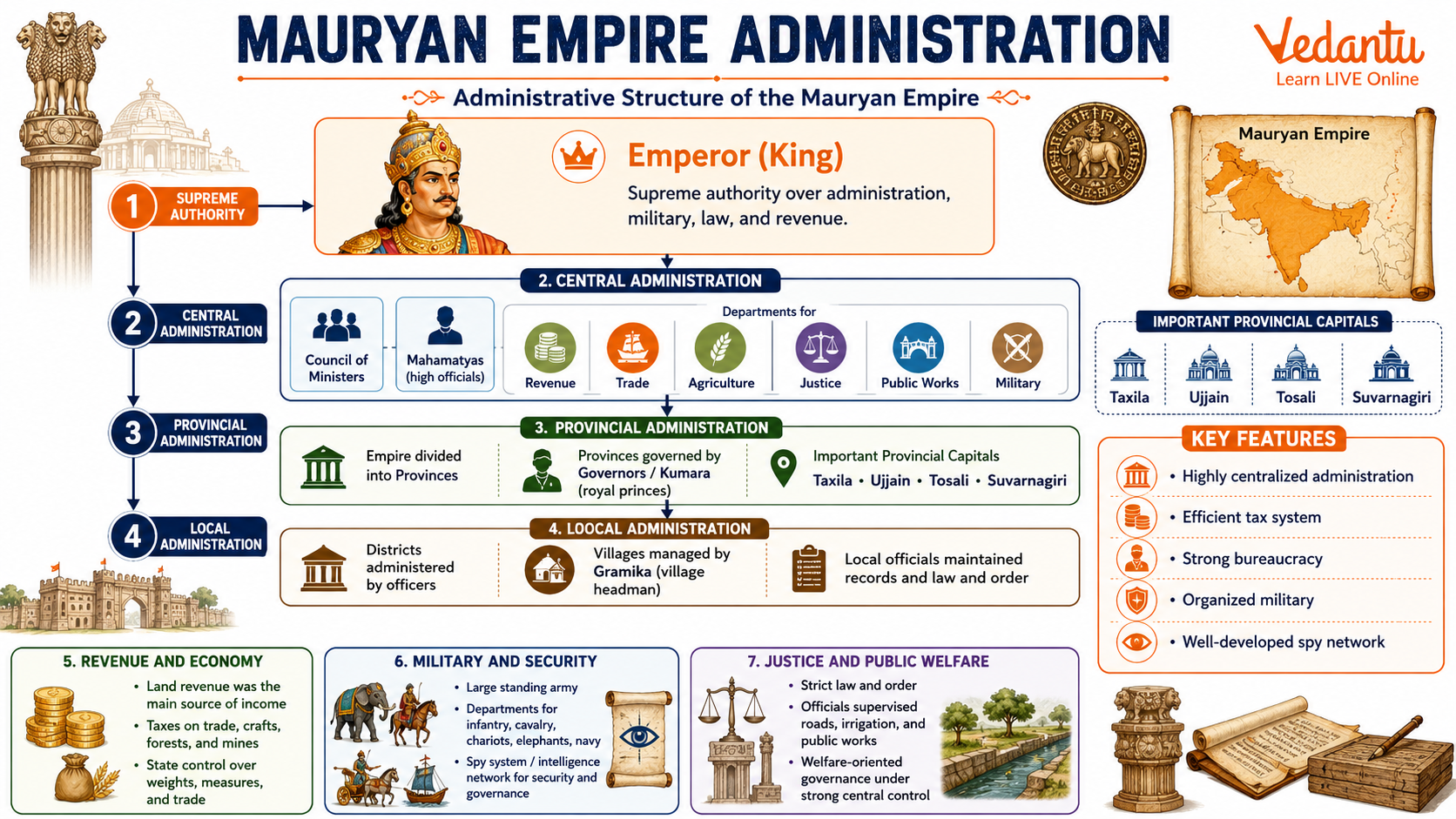
Features of Mauryan Administration
The Mauryan administration was known for its centralized authority, systematic revenue collection, organized military, and efficient communication network. The king was the supreme authority, but he was assisted by a council of ministers and a large number of officials.
- Highly centralized political system.
- Well-defined bureaucracy with appointed officials.
- Efficient tax and revenue system.
- Strong and organized military structure.
- Use of spies for internal security and administration.
Central Administration
The central administration was headed by the king, who held supreme executive, legislative, and judicial powers. The king was assisted by a council of ministers known as the Mantriparishad. Important decisions were taken after consulting this council.
Role of the King
- Supreme head of the state.
- Commander-in-chief of the army.
- Chief law-maker and highest judge.
- Responsible for welfare of subjects.
Council of Ministers
The Mantriparishad consisted of high-ranking officials who advised the king. Important officers included the Prime Minister, Purohita, Senapati, and other departmental heads.
Important Officials in Mauryan Administration
| Official | Position | Function |
|---|---|---|
| Mantri | Prime Minister | Advised the king on administration |
| Senapati | Army Chief | Head of the military forces |
| Samaharta | Revenue Officer | Collected taxes and managed revenue |
Apart from these, there were several other officials who looked after trade, agriculture, mines, forests, and public works. The administration was divided into various departments, each headed by a superintendent.
Provincial Administration
The Mauryan Empire was divided into provinces for better governance. Important provinces included Taxila, Ujjain, Tosali, and Suvarnagiri. Each province was governed by a prince or trusted official known as Kumara or Aryaputra.
- Provinces were subdivided into districts.
- District administration was handled by officials called Rajukas.
- Village was the smallest administrative unit.
- Village headman was known as Gramika.
Municipal Administration
Megasthenes described the municipal administration of Pataliputra. The city was administered by a board of 30 members divided into six committees of five members each. These committees looked after industries, foreigners, birth and death records, trade regulation, public works, and tax collection.
Revenue System
Land revenue was the main source of income for the Mauryan state. The state collected approximately one-sixth of the produce as tax. Other sources of revenue included trade taxes, customs duties, fines, forest produce, and mining.
- Land tax was systematically assessed.
- Irrigation tax was collected where state facilities were used.
- Strict supervision of trade and commerce.
Military Administration
The Mauryan Empire maintained a large standing army. According to Megasthenes, the army consisted of infantry, cavalry, chariots, and elephants. A separate war office managed military affairs through various committees.
- Infantry formed the backbone of the army.
- War elephants played a significant role in battles.
- Navy was also maintained for riverine and coastal security.
Judicial Administration
The king was the highest judicial authority. Courts were established at different levels for civil and criminal cases. Punishments were strict to maintain law and order. Officials such as Rajukas were empowered to administer justice in provinces.
Spy System
One of the most unique features of Mauryan administration was the extensive spy network. Spies were employed to gather information about officials and public opinion. This helped the king maintain control and prevent corruption or rebellion.
Significance of Mauryan Administration
The Mauryan administrative system laid the foundation for future governance in India. Its centralized structure, organized bureaucracy, and efficient revenue system ensured political stability and economic prosperity. The emphasis on welfare during Ashoka's reign further strengthened the moral and ethical dimension of governance.
- First large-scale empire with structured administration in India.
- Systematic documentation through inscriptions.
- Model of centralized governance for later empires.
Conclusion
The Mauryan Empire Administration was a remarkable achievement in ancient Indian history. With its centralized authority, organized departments, efficient revenue collection, and strong military system, it ensured effective governance over a vast territory. The administrative principles described in Arthashastra and evidenced through inscriptions highlight the advanced political thinking of the Mauryan rulers. A clear understanding of this topic is essential for General Knowledge, school examinations, and competitive exams.
FAQs on Mauryan Empire Administration Structure and Governance
1. What was the administrative system of the Mauryan Empire?
The Mauryan Empire administration was a highly centralized and well-organized system under the direct control of the king. • The emperor was the supreme authority in political, military, and judicial matters. • The empire was divided into provinces, districts, and villages for efficient governance. • A network of officials and spies ensured law, order, and revenue collection. • The system is detailed in the Arthashastra by Kautilya, a key source on Mauryan governance.
2. Who were the important officials in Mauryan administration?
The Mauryan administration included several high-ranking officials who assisted the emperor in governance. • The Mantriparishad (Council of Ministers) advised the king. • The Amatyas handled administrative duties. • The Mahamatras supervised provinces and public welfare. • The Senapati led the army, and the Samaharta managed revenue collection. These officials formed the backbone of Mauryan bureaucracy.
3. How was the Mauryan Empire divided for administrative purposes?
The Mauryan Empire was divided into provinces to ensure effective administration and control. • The empire had major provinces like Taxila, Ujjain, Tosali, and Suvarnagiri. • Each province was governed by a prince or trusted official. • Provinces were further divided into districts (Aharas) and villages (Gramas). • Local officers ensured tax collection, law enforcement, and public works management.
4. What was the role of Kautilya in Mauryan administration?
Kautilya played a crucial role in shaping the Mauryan administrative system through his work Arthashastra. • He was the chief advisor of Chandragupta Maurya. • The Arthashastra explains policies on governance, taxation, espionage, and diplomacy. • It emphasized a strong central authority and efficient bureaucracy. • His ideas influenced the structure of Mauryan political administration.
5. How did revenue collection work in the Mauryan Empire?
Revenue collection in the Mauryan Empire was systematic and primarily based on agriculture. • The main source was land revenue (Bhaga), usually one-sixth of the produce. • Taxes were also imposed on trade, crafts, forests, and mining. • The Samaharta supervised revenue administration. • Proper record-keeping ensured financial stability and economic strength.
6. What was the role of spies in Mauryan administration?
Spies played a vital role in maintaining security and stability in the Mauryan Empire. • A well-organized espionage system monitored officials and public activities. • Spies reported directly to the king. • They helped prevent corruption, rebellions, and conspiracies. • The spy system is elaborately described in the Arthashastra.
7. How was justice administered in the Mauryan Empire?
The Mauryan judicial system ensured law and order through strict administration of justice. • The king was the supreme judge. • Courts operated at provincial and local levels. • Punishments were often strict to maintain discipline. • Laws were based on Dharma, royal decrees, and Arthashastra guidelines.
8. What was the role of Ashoka in Mauryan administration?
Emperor Ashoka strengthened administration by focusing on welfare and moral governance. • He appointed Dhamma Mahamatras to spread moral values. • Rock and pillar edicts communicated policies to the public. • He promoted public welfare, roads, hospitals, and rest houses. • His rule emphasized non-violence and ethical governance.
9. What was the importance of the Mantriparishad in Mauryan governance?
The Mantriparishad was the advisory council that supported the emperor in decision-making. • It consisted of experienced ministers and officials. • The council discussed military, financial, and administrative matters. • Though the king had final authority, advice from ministers improved governance efficiency.
10. Why is Mauryan administration considered highly efficient?
Mauryan administration is considered efficient due to its centralized control and systematic organization. • Clear division into provinces and districts. • Strong bureaucracy and revenue system. • Effective spy network and judicial system. • Detailed administrative guidelines in the Arthashastra. This structure made the Mauryan Empire one of ancient India’s most powerful empires.
