






Mahmud of Ghazni’s 17 Invasions of India and Their Effects
Mahmud Ghaznavi, also known as Mahmud of Ghazni, was one of the most prominent rulers of the early medieval period in Indian and Central Asian history. He was the founder of the Ghaznavid Empire and is best known for his repeated invasions of India between 1000 CE and 1027 CE. His campaigns significantly impacted the political, economic, and cultural landscape of the Indian subcontinent. Mahmud Ghaznavi is an important topic in General Knowledge, especially for students preparing for competitive exams like UPSC, SSC, State PSCs, and other government examinations.
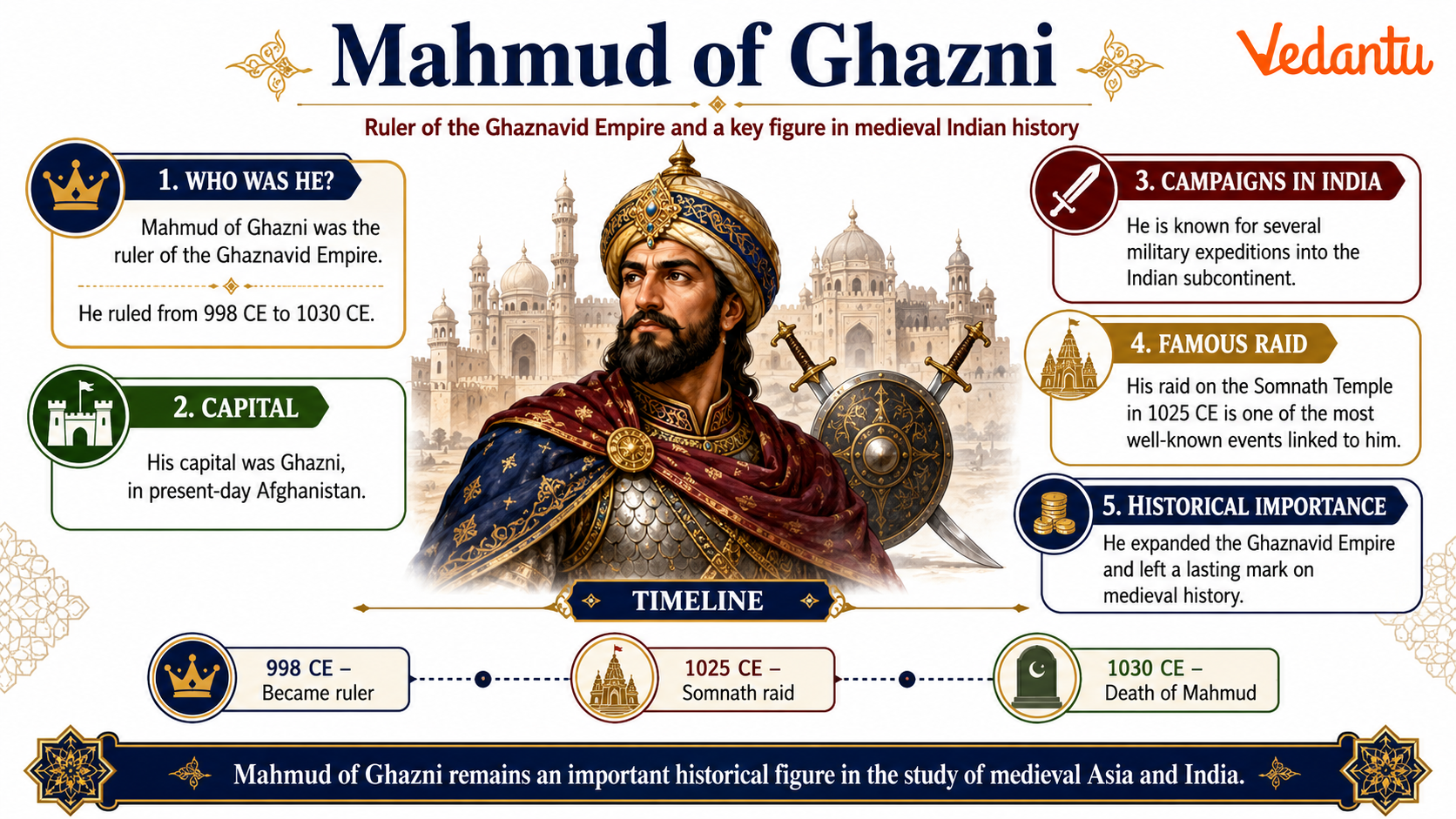
Early Life and Background
Mahmud Ghaznavi was born in 971 CE in Ghazni, which is in present-day Afghanistan. He was the son of Sabuktigin, the founder of the Ghaznavid dynasty. After the death of his father in 997 CE, Mahmud defeated his brother Ismail and ascended the throne of Ghazni.
- Born - 971 CE
- Father - Sabuktigin
- Dynasty - Ghaznavid Dynasty
- Capital - Ghazni
Expansion of the Ghaznavid Empire
Mahmud Ghaznavi expanded his empire extensively in Central Asia, Iran, and the northwestern parts of the Indian subcontinent. He aimed to consolidate his power and accumulate wealth to strengthen his empire.
He conducted around 17 expeditions into India. His invasions were mainly targeted at wealthy temples and prosperous cities.
Major Regions Conquered
- Punjab
- Multan
- Sindh
- Parts of present-day Afghanistan and Iran
Important Invasions of India
Mahmud's invasions into India were primarily motivated by wealth and political dominance. Among his many invasions, the most famous was the attack on the Somnath Temple in Gujarat in 1025 CE.
Attack on Somnath Temple
In 1025 CE, Mahmud attacked the Somnath Temple, which was one of the richest temples in India at that time. He looted immense wealth and returned to Ghazni. This event is frequently mentioned in historical records and competitive exams.
Key Facts About Mahmud Ghaznavi
| Aspect | Details | Year |
|---|---|---|
| Birth | Ghazni | 971 CE |
| Attack on Somnath | Gujarat | 1025 CE |
| Death | Ghazni | 1030 CE |
The table above highlights the most important factual details about Mahmud Ghaznavi that are frequently asked in examinations.
Administration and Cultural Contributions
Although Mahmud is mainly remembered for his invasions, he was also an efficient administrator. He strengthened his army and centralized administration in Ghazni. He patronized scholars, poets, and artists.
Patronage of Scholars
- Al-Biruni - Famous scholar who wrote Kitab al-Hind
- Firdawsi - Author of Shahnameh
Ghazni became an important center of learning and culture under his rule.
Reasons for Indian Invasions
- To acquire wealth from rich temples and cities
- To expand and consolidate his empire
- To establish political dominance in northwestern India
- To gain recognition from the Abbasid Caliph
Death and Legacy
Mahmud Ghaznavi died in 1030 CE in Ghazni. After his death, the Ghaznavid Empire gradually declined. However, his invasions paved the way for future Turkish invasions into India and influenced the political developments in the subcontinent.
He remains a controversial historical figure. While some regard him as a strong military ruler and empire builder, others criticize him for his destructive raids. His role in Indian history is significant and widely studied in medieval history.
Importance for Competitive Exams
Mahmud Ghaznavi is a frequently asked topic in General Knowledge and history sections of competitive exams. Questions are usually based on his invasions, the number of expeditions, the Somnath attack, his dynasty, and scholars in his court.
Exam Preparation Tips
- Remember key dates such as 971 CE, 1025 CE, and 1030 CE
- Focus on the number of invasions - 17 expeditions
- Revise important personalities like Al-Biruni and Firdawsi
- Understand the political impact of his invasions
A clear understanding of Mahmud Ghaznavi helps students grasp the early phase of Turkish invasions in India and the transition of power in medieval Indian history.
FAQs on Mahmud of Ghazni: Life, Rule, and Impact on India
1. Who was Mahmud Ghaznavi?
Mahmud Ghaznavi was a powerful ruler of the Ghaznavid Empire who is best known for his repeated invasions of India in the 11th century.
- Born in 971 CE, he was the son of Sabuktigin.
- Became the ruler of Ghazni (in present-day Afghanistan) in 998 CE.
- Expanded his empire across Central Asia, Iran, and North-Western India.
- Remembered for spreading Islamic rule and accumulating vast wealth through Indian campaigns.
2. How many times did Mahmud Ghaznavi invade India?
Mahmud Ghaznavi invaded India 17 times between 1000 CE and 1027 CE to expand his empire and loot wealth.
- Targeted rich temples and cities such as Mathura, Kanauj, and Somnath.
- Defeated several Rajput rulers.
- His invasions weakened North Indian kingdoms.
- These campaigns are frequently asked in GK and competitive exams.
3. Why did Mahmud Ghaznavi attack the Somnath Temple?
Mahmud Ghaznavi attacked the Somnath Temple in 1025 CE mainly to gain wealth and religious prestige.
- The temple was located in Gujarat and was extremely rich.
- He looted gold, jewels, and valuable offerings.
- The attack enhanced his image as a defender of Islam.
- The Somnath raid remains one of the most discussed events in medieval Indian history.
4. What was the capital of Mahmud Ghaznavi?
The capital of Mahmud Ghaznavi was Ghazni, located in present-day Afghanistan.
- Ghazni became a major center of culture, trade, and Islamic learning.
- He built magnificent palaces and mosques there.
- Scholars like Al-Biruni and Firdausi were associated with his court.
- Ghazni flourished as a powerful political and cultural hub under his rule.
5. Who defeated Mahmud Ghaznavi in India?
Mahmud Ghaznavi was rarely defeated in India, as most of his campaigns were successful.
- He defeated rulers like Jaipal and Anandpal of the Hindu Shahi dynasty.
- Indian kingdoms were politically divided at that time.
- His military strength included a well-trained cavalry and archers.
- No major Indian ruler is recorded to have decisively defeated him.
6. What was the main aim of Mahmud Ghaznavi’s invasions?
The main aim of Mahmud Ghaznavi’s invasions was to acquire wealth and expand his empire.
- Looted temples and prosperous cities for gold and riches.
- Strengthened the Ghaznavid Empire economically.
- Sought religious recognition as a champion of Sunni Islam.
- Funded architectural and cultural developments in Ghazni.
7. Who were the Hindu Shahi rulers defeated by Mahmud Ghaznavi?
Mahmud Ghaznavi defeated the Hindu Shahi rulers Jaipal and Anandpal during his early invasions.
- Battle of Peshawar (1001 CE) against Jaipal.
- Anandpal was defeated near Waihind (1008 CE).
- These victories opened the gateway to North-Western India.
- Marked the decline of the Hindu Shahi dynasty.
8. What was Mahmud Ghaznavi’s contribution to art and culture?
Mahmud Ghaznavi promoted Persian art, literature, and architecture in his empire.
- Patronized scholars like Al-Biruni, who wrote about India.
- Supported poet Firdausi, author of the Shahnameh.
- Built grand mosques and libraries in Ghazni.
- Helped spread Persian culture across Central Asia.
9. When did Mahmud Ghaznavi die?
Mahmud Ghaznavi died in 1030 CE after ruling for over three decades.
- He ruled from 998 CE to 1030 CE.
- Died in his capital city, Ghazni.
- Succeeded by his son Masud I.
- His death marked the gradual decline of the Ghaznavid dynasty.
10. Why is Mahmud Ghaznavi important in Indian history?
Mahmud Ghaznavi is important in Indian history because his invasions significantly impacted medieval North India.
- Weakened several Rajput kingdoms.
- Opened routes for later Muslim invasions, including Muhammad Ghori.
- His raids changed the political and economic landscape of the region.
- Frequently asked topic in General Knowledge (GK), UPSC, SSC, and state exams.
