






State-wise Literacy Rate in India (2011 Census) – Highest and Lowest States
The Literacy Rate Among The Indian States Census 2011 is an important topic in General Knowledge and is frequently asked in competitive examinations. Literacy rate is a key indicator of educational development and socio-economic progress in a country. According to Census 2011, literacy rate refers to the percentage of literate persons aged 7 years and above. Understanding state-wise literacy rates helps students analyze regional disparities, gender gaps, and development patterns across India.
What is Literacy Rate?
Literacy rate is defined as the percentage of people aged 7 years and above who can read and write with understanding in any language. In Census 2011, a person was considered literate if he or she could both read and write with understanding. It is one of the most significant indicators of human development.
Overall Literacy Rate in India - Census 2011
- Total Literacy Rate - 74.04 percent
- Male Literacy Rate - 82.14 percent
- Female Literacy Rate - 65.46 percent
The data shows a significant gender gap in literacy. However, compared to Census 2001, literacy rates improved substantially, indicating progress in educational access and awareness.
State-wise Literacy Rate in India - Census 2011
| State | Literacy Rate Percent | Rank |
|---|---|---|
| Kerala | 93.91 | 1 |
| Mizoram | 91.33 | 2 |
| Tripura | 87.22 | 3 |
| Goa | 88.70 | 4 |
| Himachal Pradesh | 82.80 | 5 |
| Bihar | 61.80 | Lowest |
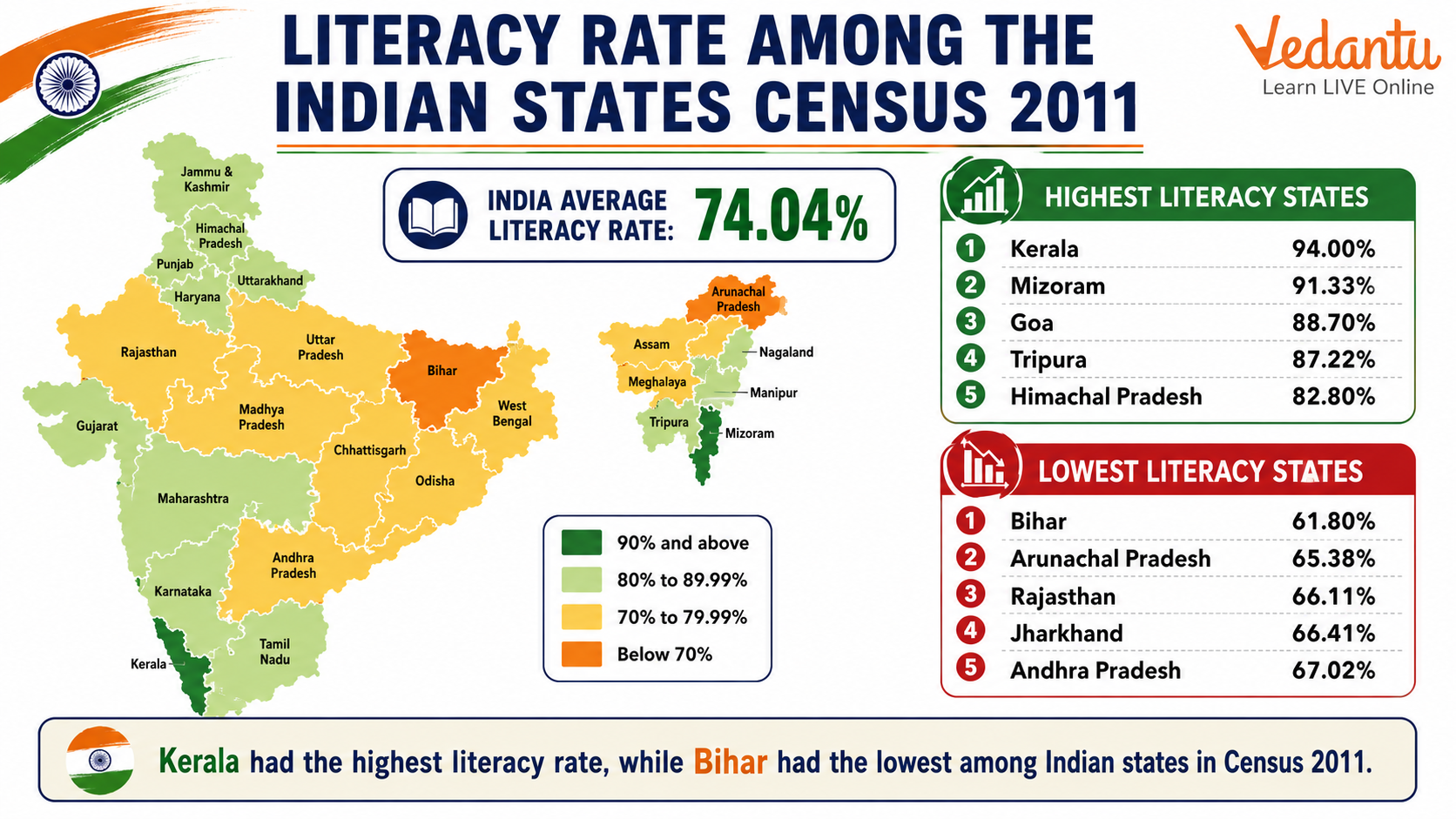
Kerala recorded the highest literacy rate in Census 2011, while Bihar had the lowest literacy rate among Indian states. Northeastern states such as Mizoram and Tripura also performed exceptionally well.
Highest Literacy Rate States - Census 2011
- Kerala - 93.91 percent
- Mizoram - 91.33 percent
- Tripura - 87.22 percent
- Goa - 88.70 percent
- Himachal Pradesh - 82.80 percent
These states invested heavily in education infrastructure, awareness programs, and gender equality, which contributed to higher literacy levels.
Lowest Literacy Rate States - Census 2011
- Bihar - 61.80 percent
- Arunachal Pradesh - 65.38 percent
- Rajasthan - 66.11 percent
- Jharkhand - 66.41 percent
- Uttar Pradesh - 67.68 percent
These states faced challenges such as poverty, rural backwardness, gender disparity, and lack of educational infrastructure, which affected literacy growth.
Gender Gap in Literacy - Census 2011
The gender gap in literacy is calculated as the difference between male and female literacy rates. In Census 2011, the gap was around 16.68 percentage points. Although female literacy improved compared to previous censuses, disparities still exist, especially in rural areas.
States with High Female Literacy
- Kerala
- Mizoram
- Goa
Importance of Literacy Rate
- Reflects socio-economic development
- Indicates access to education
- Helps in policy planning and resource allocation
- Promotes employment opportunities and economic growth
Key Points for Competitive Exams
- Census 2011 overall literacy rate - 74.04 percent
- Highest literacy state - Kerala
- Lowest literacy state - Bihar
- Male literacy is higher than female literacy
- Literacy is measured for population aged 7 years and above
Conclusion
The Literacy Rate Among The Indian States Census 2011 highlights the educational progress and regional disparities within India. While states like Kerala and Mizoram have achieved high literacy levels, others continue to face challenges. Understanding these statistics is crucial for students preparing for competitive examinations and for anyone interested in India's socio-economic development. The literacy rate remains a fundamental measure of national progress and human development.
FAQs on Literacy Rate Among Indian States: Census 2011 Overview
1. What was the overall literacy rate of India according to Census 2011?
The overall literacy rate of India in Census 2011 was 74.04%, showing significant improvement from 2001.
• Male literacy rate: 82.14%
• Female literacy rate: 65.46%
• Increase of nearly 9% from Census 2001
• Highlights progress in education, awareness, and literacy programs
This data is crucial for understanding India’s education development, state-wise literacy trends, and gender gap in literacy.
2. Which Indian state had the highest literacy rate in Census 2011?
The state with the highest literacy rate in Census 2011 was Kerala with 93.91%.
• Known for strong education policies and social reforms
• High female literacy rate
• Consistently ranks first in education and human development index
Kerala is often cited in exams for its leadership in literacy rate among Indian states.
3. Which Indian state had the lowest literacy rate in Census 2011?
The lowest literacy rate in Census 2011 was recorded in Bihar at 63.82%.
• Lower female literacy compared to national average
• Challenges in educational infrastructure and rural education
• Improvement seen compared to Census 2001
This highlights regional disparities in education levels and literacy growth across India.
4. What is the definition of literacy according to Census 2011?
According to Census 2011, a person aged 7 years or above who can read and write with understanding in any language is considered literate.
• Applies to both men and women
• Does not require formal schooling
• Includes ability to understand written content
This definition is important for understanding literacy statistics and census data in India.
5. What was the male and female literacy rate in India in 2011?
The male literacy rate in 2011 was 82.14%, while the female literacy rate was 65.46%.
• Gender gap of around 16.68%
• Improvement in women’s education compared to 2001
• Reflects need for stronger female literacy programs
Gender-based literacy data is important for competitive exams and social development analysis.
6. Which Union Territory had the highest literacy rate in Census 2011?
Among Union Territories, Lakshadweep had the highest literacy rate at 92.28% in Census 2011.
• Strong focus on basic education and schooling
• High male and female literacy levels
• Small population aiding better implementation of policies
This is frequently asked in GK and government exams.
7. How did literacy rate improve from Census 2001 to Census 2011?
The literacy rate increased from 64.83% in 2001 to 74.04% in 2011, marking significant growth.
• Increase of about 9.21%
• Rise in female literacy rate
• Impact of schemes like Sarva Shiksha Abhiyan
This improvement shows progress in India’s educational reforms and literacy campaigns.
8. Why is Kerala’s literacy rate highest in India?
Kerala has the highest literacy rate due to its long-standing focus on education, social reform movements, and public awareness.
• Early investment in primary education
• Emphasis on women’s education
• Strong public schooling system
Kerala’s model is often discussed in relation to human development and literacy success in India.
9. What are the top five most literate states in India as per Census 2011?
The top five most literate states in Census 2011 were:
• Kerala – 93.91%
• Mizoram – 91.58%
• Goa – 88.70%
• Tripura – 87.75%
• Himachal Pradesh – 82.80%
These states show strong performance in education standards and literacy development.
10. Why is literacy rate important for a country’s development?
The literacy rate is a key indicator of a country’s social and economic development.
• Improves employment opportunities
• Reduces poverty and inequality
• Promotes gender equality and awareness
• Strengthens democracy and civic participation
In India, literacy data from Census 2011 helps measure progress in education policy and human resource development.
