






Updated BSE Sensex 30 Companies List with Sector-Wise Details
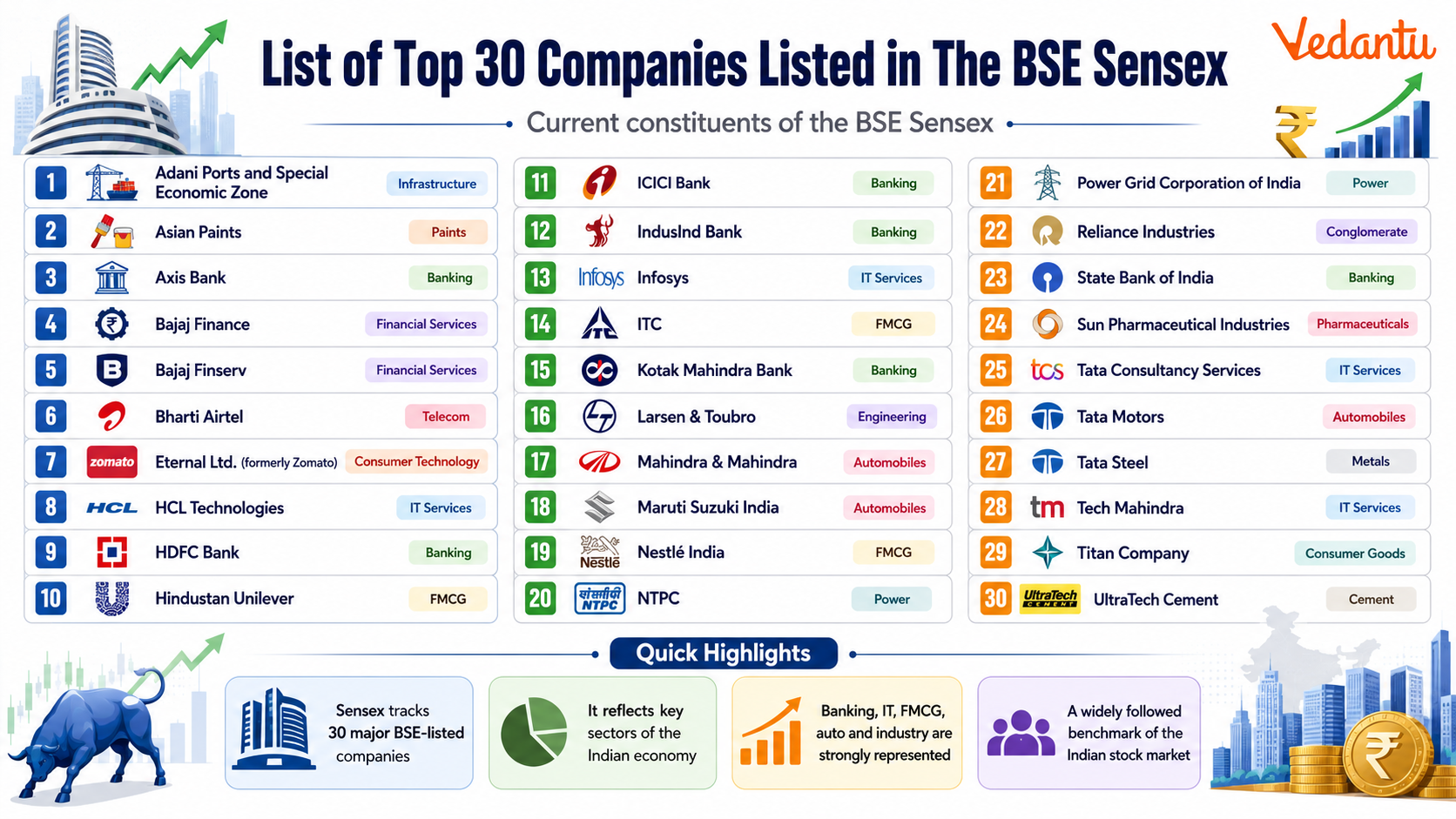
The List Of Top 30 Companies Listed In The BSE Sensex represents the most prominent and financially strong companies traded on the Bombay Stock Exchange in India. The BSE Sensex, also known as the S&P BSE Sensex, is a benchmark stock market index that tracks the performance of 30 well-established and financially sound companies across key sectors of the Indian economy. These companies reflect the overall health and direction of the Indian stock market and economy. For students, competitive exam aspirants, and general readers, understanding the Sensex companies is essential for General Knowledge, Economics, and current affairs preparation.
What Is BSE Sensex?
The BSE Sensex is the flagship index of the Bombay Stock Exchange. It was introduced in 1986 and is one of the oldest stock market indices in India. The term "Sensex" is derived from the words Sensitive and Index. It measures the price movements of 30 large, actively traded companies listed on the BSE.
- Base Year - 1978 to 1979
- Base Value - 100
- Exchange - Bombay Stock Exchange
- Number of Companies - 30
List Of Top 30 Companies Listed In The BSE Sensex
| S.No | Company Name | Sector |
|---|---|---|
| 1 | Reliance Industries Ltd | Oil and Gas |
| 2 | Tata Consultancy Services | Information Technology |
| 3 | HDFC Bank | Banking |
| 4 | ICICI Bank | Banking |
| 5 | Infosys Ltd | Information Technology |
| 6 | Hindustan Unilever Ltd | FMCG |
| 7 | ITC Ltd | FMCG |
| 8 | State Bank of India | Banking |
| 9 | Bharti Airtel | Telecommunications |
| 10 | Larsen and Toubro | Engineering and Construction |
| 11 | Asian Paints | Paints |
| 12 | Maruti Suzuki India | Automobile |
| 13 | Sun Pharmaceutical Industries | Pharmaceuticals |
| 14 | Tata Motors | Automobile |
| 15 | Mahindra and Mahindra | Automobile |
| 16 | UltraTech Cement | Cement |
| 17 | Axis Bank | Banking |
| 18 | Kotak Mahindra Bank | Banking |
| 19 | NTPC Ltd | Power |
| 20 | Power Grid Corporation of India | Power Transmission |
| 21 | Titan Company | Consumer Goods |
| 22 | Bajaj Finance | Financial Services |
| 23 | HCL Technologies | Information Technology |
| 24 | Wipro Ltd | Information Technology |
| 25 | Tech Mahindra | Information Technology |
| 26 | Nestle India | FMCG |
| 27 | IndusInd Bank | Banking |
| 28 | Dr Reddys Laboratories | Pharmaceuticals |
| 29 | JSW Steel | Steel |
| 30 | Tata Steel | Steel |
The composition of the Sensex is reviewed periodically by the BSE based on market capitalization, liquidity, and sector representation. Companies may be added or removed depending on their performance and relevance in the market.
Key Features Of Sensex Companies
The companies listed in the Sensex share certain common characteristics that make them leaders in their respective industries.
- Large market capitalization
- High liquidity and active trading
- Strong financial performance
- Representation from diverse sectors
- Significant impact on the Indian economy
Importance Of The Top 30 Sensex Companies
The top 30 companies listed in the BSE Sensex play a crucial role in shaping India’s financial landscape. Their performance influences investor confidence and reflects economic trends.
Economic Indicator
The Sensex acts as a barometer of the Indian economy. When the Sensex rises, it indicates economic growth and investor optimism. A fall suggests economic slowdown or market uncertainty.
Investment Benchmark
Mutual funds, portfolio managers, and investors use the Sensex as a benchmark to compare returns and measure market performance.
Competitive Exam Relevance
Questions about Sensex, its full form, number of companies, base year, and major companies frequently appear in exams such as UPSC, SSC, Banking, and other government examinations.
How Companies Are Selected For Sensex
The selection of companies in the Sensex is based on specific criteria to ensure that only top-performing and representative companies are included.
- Company must be listed on the Bombay Stock Exchange.
- High free-float market capitalization.
- High liquidity and regular trading activity.
- Financially sound track record.
- Sectoral representation to reflect the Indian economy.
Conclusion
The List Of Top 30 Companies Listed In The BSE Sensex provides valuable insight into India’s leading corporate entities and the overall economic environment. These companies represent major sectors such as banking, information technology, FMCG, pharmaceuticals, automobiles, energy, and infrastructure. Understanding the structure and significance of the Sensex helps students and aspirants strengthen their General Knowledge and stay updated with financial awareness. Regular revision of these companies and their sectors is beneficial for academic learning and competitive examinations.
FAQs on List of Top 30 Companies in the BSE Sensex Index
1. What is the List of Top 30 Companies Listed in the BSE Sensex?
The List of Top 30 Companies in the BSE Sensex represents the largest and most actively traded companies on the Bombay Stock Exchange (BSE). These companies are selected based on market capitalization, liquidity, and sector representation. Key examples include:
• Reliance Industries
• Tata Consultancy Services (TCS)
• HDFC Bank
• Infosys
• ICICI Bank
• State Bank of India (SBI)
• Larsen & Toubro (L&T)
• ITC Limited
• Hindustan Unilever (HUL)
• Bharti Airtel
These companies form the benchmark index known as the S&P BSE Sensex, reflecting the overall performance of the Indian stock market.
2. What is the BSE Sensex?
The BSE Sensex is India’s oldest and most tracked stock market index, representing 30 financially strong companies listed on the BSE. Key facts include:
• Established in 1986
• Managed by S&P Dow Jones Indices
• Based on free-float market capitalization
• Considered the barometer of the Indian stock market
It is often searched as “What is Sensex?” or “How does Sensex work?” and is crucial for investors and competitive exam aspirants.
3. How are companies selected for the BSE Sensex?
Companies are selected for the BSE Sensex based on strict eligibility criteria to ensure market representation. The selection is done considering:
• Free-float market capitalization
• High trading liquidity
• Financial stability and revenue track record
• Listing history on the Bombay Stock Exchange
The index committee reviews the list periodically to maintain relevance and sector balance in the Indian equity market.
4. Why are the top 30 companies in the Sensex important?
The Top 30 Sensex companies are important because they reflect India’s economic strength and corporate performance. Their significance includes:
• Represent major sectors like banking, IT, FMCG, energy, and infrastructure
• Influence stock market trends and investor sentiment
• Serve as benchmarks for mutual funds and ETFs
• Indicate overall economic growth in India
These companies are widely tracked in financial news and competitive exams.
5. Which sectors are represented in the BSE Sensex companies list?
The BSE Sensex companies list covers diverse sectors of the Indian economy. Major sectors include:
• Banking & Financial Services (HDFC Bank, ICICI Bank, SBI)
• Information Technology (IT) (TCS, Infosys)
• Energy & Oil (Reliance Industries)
• FMCG (HUL, ITC)
• Telecommunications (Bharti Airtel)
• Infrastructure & Engineering (L&T)
This sectoral diversification makes the Sensex a comprehensive market index.
6. How often is the BSE Sensex list updated?
The BSE Sensex list is reviewed periodically to ensure it reflects current market conditions. Key details include:
• Reviewed semi-annually by the index committee
• Companies may be added or removed based on performance
• Changes are based on market capitalization and liquidity
• Announcements are made by S&P BSE
This ensures the index remains relevant and representative of the Indian stock market.
7. What is free-float market capitalization in Sensex?
Free-float market capitalization refers to the value of shares available for public trading in a company listed on the Sensex. It excludes:
• Promoter holdings
• Government stakes
• Locked-in shares
The formula considers only publicly traded shares, making the S&P BSE Sensex a more accurate reflection of real market movements.
8. How does the BSE Sensex affect investors?
The BSE Sensex affects investors by indicating overall stock market performance and economic trends. Its impact includes:
• Influencing buying and selling decisions
• Affecting mutual funds and ETFs linked to Sensex
• Reflecting investor confidence in India
• Guiding long-term investment strategies
Investors often track daily Sensex movements to assess market volatility and returns.
9. What is the difference between BSE Sensex and NSE Nifty?
The BSE Sensex and NSE Nifty are benchmark indices of two different stock exchanges in India. Key differences include:
• Sensex tracks 30 companies, while Nifty tracks 50 companies
• Sensex is based on the Bombay Stock Exchange (BSE)
• Nifty is based on the National Stock Exchange (NSE)
• Both use free-float market capitalization methodology
They are commonly searched as “Sensex vs Nifty” in competitive exams and finance studies.
10. Where can students find the updated list of top 30 Sensex companies?
Students can find the updated Top 30 BSE Sensex companies list on official and financial platforms. Reliable sources include:
• Official BSE India website
• Financial news portals
• Stock market apps and trading platforms
• Annual reports of listed companies
Checking updated data is important for GK preparation, UPSC, SSC, banking exams, and investment research.
