






Major Political Associations in India Before Congress Was Established
The List Of Political Organizations Before The Establishment Of Congress is an important topic in modern Indian history. Before the formation of the Indian National Congress in 1885, several political associations were formed across different regions of India. These organizations played a crucial role in creating political awareness, promoting unity among Indians, and laying the foundation for the national movement. They helped in voicing public grievances against British policies and preparing the ground for a structured national struggle.
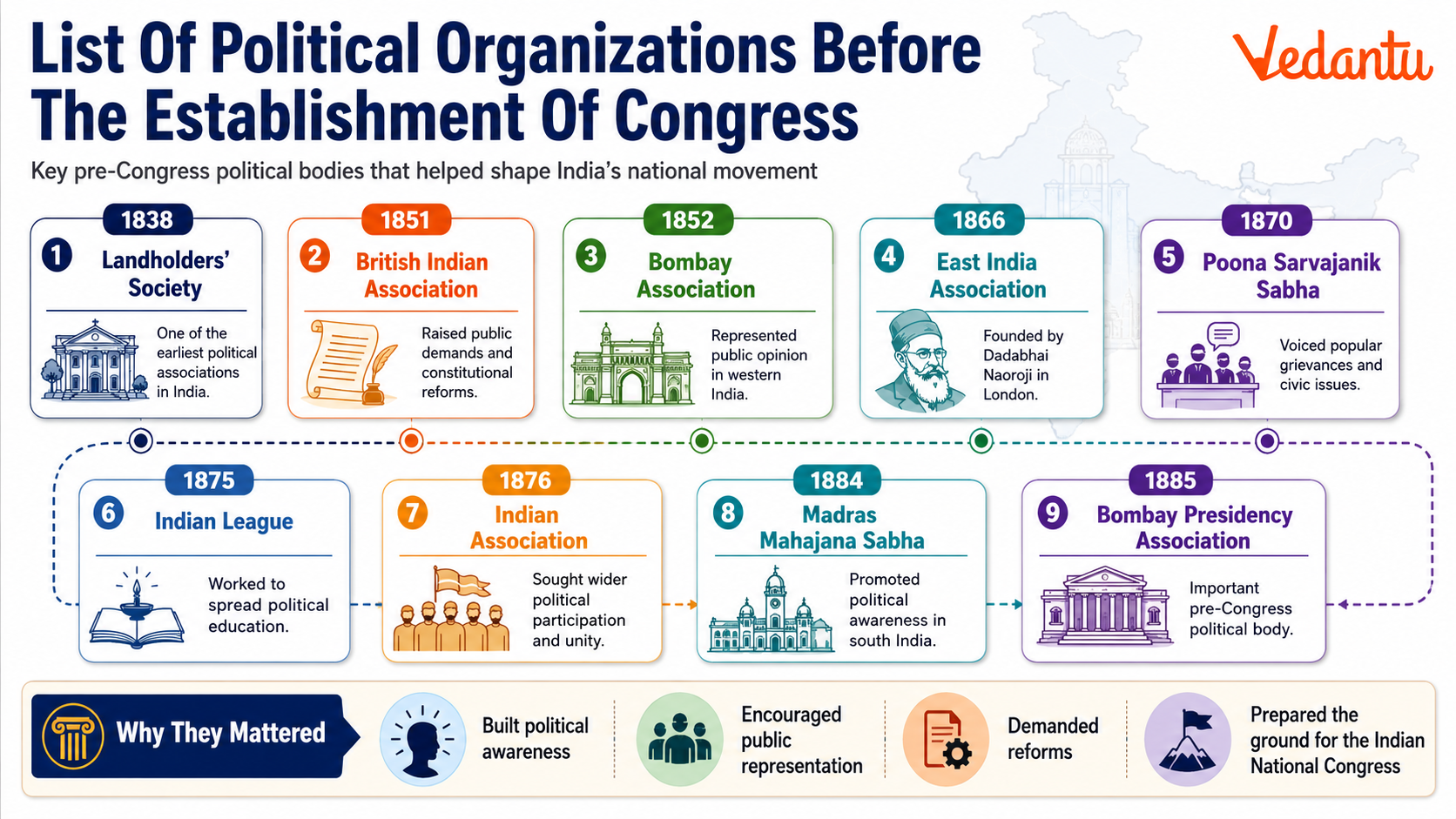
Background Of Political Associations In India
During the early 19th century, English education, the spread of print media, and socio-religious reform movements led to the emergence of a politically conscious middle class. Educated Indians began organizing themselves to express their concerns regarding administrative reforms, civil rights, and representation in government services.
These early political organizations were mostly regional in nature and were dominated by educated elites. Although limited in reach, they were significant in shaping the future course of Indian nationalism.
Major Political Organizations Before 1885
1. Landholders' Society - 1838
- Founded in Calcutta.
- Established by Dwarkanath Tagore and other zamindars.
- Worked to safeguard the interests of landlords.
- One of the earliest political associations in India.
2. British Indian Association - 1851
- Formed by merging the Landholders' Society and Bengal British India Society.
- Demanded legislative reforms and inclusion of Indians in higher services.
- Represented educated elites of Bengal.
3. Bombay Association - 1852
- Established by Jagannath Shankarsheth and others.
- Submitted petitions to the British Parliament.
- Focused on administrative reforms.
4. Madras Native Association - 1852
- Founded by Gazulu Lakshminarasu Chetty.
- Raised public issues through petitions.
- One of the earliest political bodies in South India.
5. Poona Sarvajanik Sabha - 1870
- Founded by M G Ranade and others.
- Acted as a bridge between the government and the people.
- Demanded representation of Indians in legislative councils.
6. Indian Association - 1876
- Founded by Surendranath Banerjee and Anand Mohan Bose.
- Aimed to unite Indians on political issues.
- Organized the All India National Conference in 1883.
- Played a significant role in preparing ground for Congress.
Summary Table Of Political Organizations Before Congress
| Organization | Year | Founder or Key Leader |
|---|---|---|
| Landholders' Society | 1838 | Dwarkanath Tagore |
| British Indian Association | 1851 | Radhakanta Deb |
| Bombay Association | 1852 | Jagannath Shankarsheth |
| Madras Native Association | 1852 | G L Chetty |
| Poona Sarvajanik Sabha | 1870 | M G Ranade |
| Indian Association | 1876 | Surendranath Banerjee |
These organizations gradually expanded political participation in India. Although their demands were moderate and constitutional in nature, they helped develop a political platform for collective action. They also trained future leaders who later became part of the Indian National Congress.
Common Objectives Of Early Political Organizations
- Expansion of legislative councils.
- Greater representation of Indians in civil services.
- Reduction of military expenditure.
- Protection of civil rights and freedom of speech.
- Administrative and constitutional reforms.
Limitations Of These Organizations
- Limited membership mainly from educated elite class.
- Regional in character rather than national.
- Relied mostly on petitions and memorials.
- Did not mobilize masses extensively.
Significance In Indian National Movement
Despite their limitations, these early political organizations were significant because they introduced modern political methods such as drafting petitions, organizing meetings, and forming public opinion. They encouraged political unity among different regions and communities. Most importantly, they laid the intellectual and organizational foundation for the formation of the Indian National Congress in 1885.
Understanding the List Of Political Organizations Before The Establishment Of Congress helps students grasp how Indian nationalism evolved gradually. These associations marked the beginning of organized political activity in India and played a pioneering role in shaping the freedom struggle.
FAQs on List of Political Organizations Before Congress Formation in India
1. What were the major political organizations formed in India before the establishment of the Indian National Congress?
Several early political associations were formed before 1885 to promote political awareness and represent Indian interests.
• Landholders’ Society (1838) – Founded in Bengal by Dwarkanath Tagore
• British Indian Association (1851) – Formed by merging Landholders’ Society and Bengal British India Society
• Madras Native Association (1852)
• Bombay Association (1852)
• Poona Sarvajanik Sabha (1870) – Led by Mahadev Govind Ranade
• Indian Association (1876) – Founded by Surendranath Banerjee
• Madras Mahajana Sabha (1884)
These early political organizations laid the foundation for the formation of the Indian National Congress (1885) and the Indian freedom movement.
2. Why were political organizations formed in India before 1885?
Political organizations before 1885 were formed to voice Indian grievances and demand administrative reforms under British rule.
• To demand greater Indian representation in government
• To protest against discriminatory laws and policies
• To promote political awareness and national unity
• To seek reforms in civil services and legislative councils
These associations marked the beginning of organized political activity in India and paved the way for the national movement.
3. What was the role of the Indian Association (1876) in Indian politics?
The Indian Association played a key role in uniting educated Indians and demanding political reforms.
• Founded by Surendranath Banerjee and Anand Mohan Bose
• Opposed the reduction of the ICS age limit
• Promoted political education among Indians
• Organized the National Conference (1883)
This association directly influenced the creation of the Indian National Congress.
4. How did the Poona Sarvajanik Sabha contribute to political development?
The Poona Sarvajanik Sabha acted as a representative body to present public grievances to the British government.
• Established in 1870 in Maharashtra
• Led by M.G. Ranade and others
• Submitted petitions on famine relief and taxation
• Promoted local self-government and constitutional reforms
It became an important regional political organization before the Congress era.
5. What was the significance of the British Indian Association (1851)?
The British Indian Association was one of the earliest political bodies representing Indian landholders.
• Formed in Calcutta in 1851
• Merged earlier associations in Bengal
• Demanded legislative reforms and Indian representation
• Submitted petitions to the British Parliament
It marked the early phase of constitutional agitation in India.
6. Which was the first political organization in India?
The Landholders’ Society (1838) is considered the first political organization in India.
• Founded in Calcutta
• Led by Dwarkanath Tagore
• Represented the interests of zamindars (landowners)
• Focused on constitutional methods like petitions
This society initiated the tradition of organized political representation in British India.
7. What was the objective of the Madras Mahajana Sabha (1884)?
The Madras Mahajana Sabha aimed to promote political awareness and represent public opinion in South India.
• Founded in 1884 in Madras
• Demanded expansion of legislative councils
• Encouraged political participation of educated Indians
• Later supported the Indian National Congress
It was an important regional body in the early nationalist movement.
8. How did early political organizations influence the formation of the Indian National Congress?
Early political associations created a foundation for all-India political unity and constitutional agitation.
• Developed political consciousness among Indians
• Trained leaders like Dadabhai Naoroji and Surendranath Banerjee
• Highlighted common national issues
• Demonstrated the need for a unified national platform
These efforts directly led to the establishment of the Indian National Congress in 1885.
9. What methods did political organizations before Congress use to express their demands?
Pre-Congress political bodies mainly used constitutional and peaceful methods to express demands.
• Submitting petitions and memoranda
• Sending delegations to Britain
• Passing resolutions in meetings
• Publishing political articles and pamphlets
These moderate methods characterized the early phase of the Indian nationalist movement.
10. What are the key differences between early political organizations and the Indian National Congress?
Early political organizations were regional and limited, while the Indian National Congress became a national movement.
• Early bodies were mostly regional associations
• Membership was limited to educated elites
• Focused on specific local issues
• Congress united leaders from across India on a national platform
The transition marked the beginning of organized Indian nationalism and freedom struggle.
