






Country-Wise Breakdown of Nobel Prize Winners and Top Nations
The Nobel Prize is one of the most prestigious international awards given annually in recognition of outstanding contributions to humanity in the fields of Physics, Chemistry, Physiology or Medicine, Literature, Peace, and Economic Sciences. Established by the will of Alfred Nobel in 1895, the prizes have been awarded since 1901. Over the years, individuals and organizations from various countries have received this honor, reflecting global excellence in science, literature, and peace efforts. Understanding the List of Nobel Laureates by Country is important for general knowledge, competitive exams, and academic awareness.
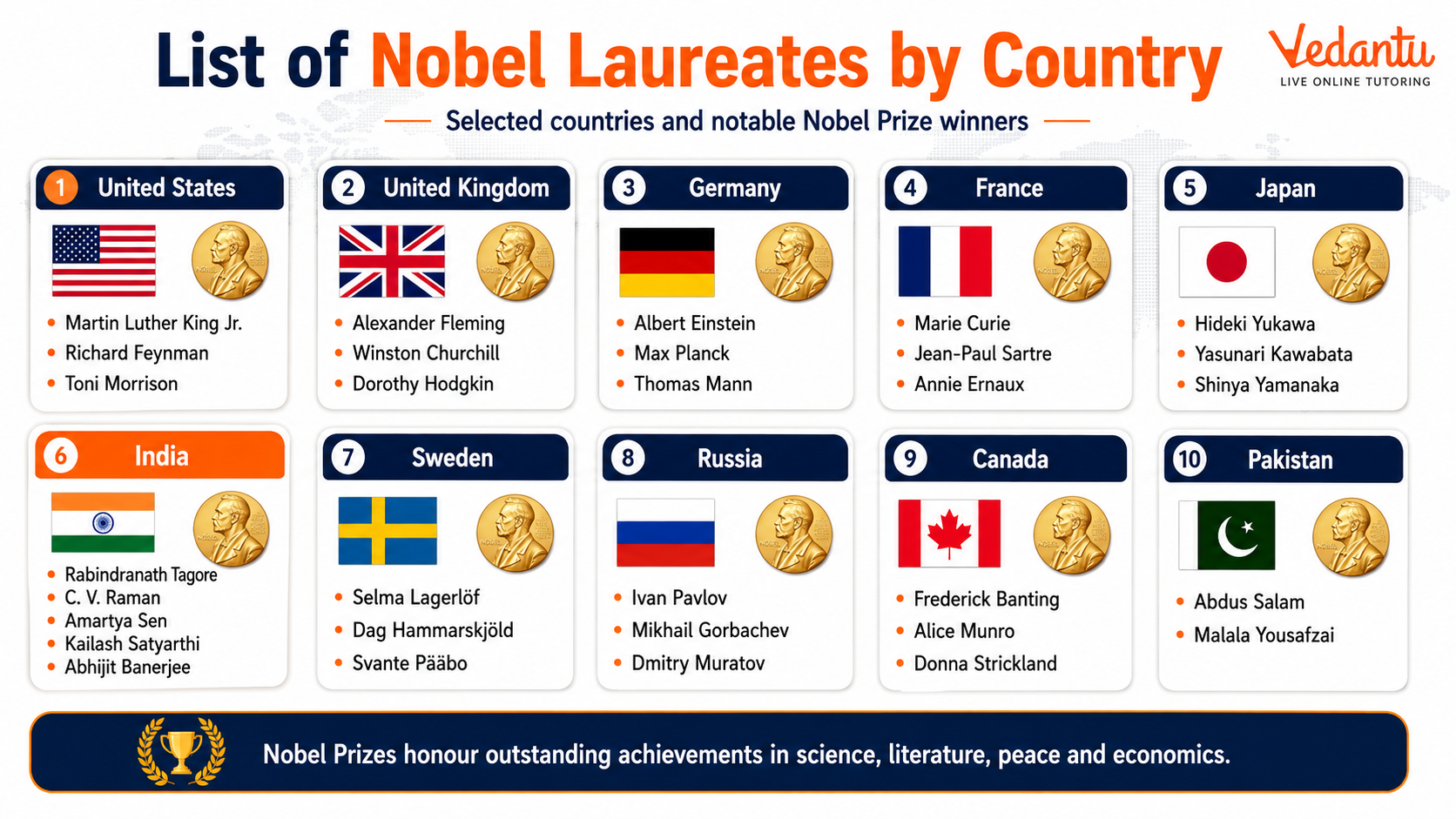
Overview of the Nobel Prize
The Nobel Prizes are awarded by different institutions in Sweden and Norway. The Royal Swedish Academy of Sciences awards the prizes in Physics, Chemistry, and Economic Sciences. The Karolinska Institute awards the prize in Physiology or Medicine. The Swedish Academy selects the Literature laureates, while the Norwegian Nobel Committee awards the Peace Prize.
- Established in 1901 as per Alfred Nobel’s will.
- Awarded annually in six categories.
- Includes a medal, diploma, and monetary prize.
- Peace Prize is awarded in Oslo, Norway.
Nobel Prize Categories
- Physics
- Chemistry
- Physiology or Medicine
- Literature
- Peace
- Economic Sciences
Top Countries by Number of Nobel Laureates
Some countries have produced a large number of Nobel Laureates due to strong educational systems, research institutions, and historical academic excellence. Below is a table showing countries with the highest number of Nobel Prize winners.
Countries with Highest Number of Nobel Laureates
| Country | Approximate Number of Laureates | Major Fields of Achievement |
|---|---|---|
| United States | 400+ | Physics, Medicine, Chemistry, Economics |
| United Kingdom | 130+ | Physics, Literature, Medicine |
| Germany | 110+ | Physics, Chemistry, Medicine |
| France | 70+ | Literature, Physics, Peace |
| Sweden | 30+ | Literature, Peace, Sciences |
The United States leads by a significant margin, particularly in scientific and economic categories. European nations such as the United Kingdom, Germany, and France have also historically dominated the Nobel Prize landscape.
Nobel Laureates from India
India has also made notable contributions to the Nobel Prize list. Indian citizens and people of Indian origin have won Nobel Prizes in different categories.
Nobel Laureates from India
| Name | Year | Category |
|---|---|---|
| Rabindranath Tagore | 1913 | Literature |
| C. V. Raman | 1930 | Physics |
| Mother Teresa | 1979 | Peace |
| Amartya Sen | 1998 | Economic Sciences |
| Kailash Satyarthi | 2014 | Peace |
These laureates have contributed significantly to literature, science, economics, and humanitarian efforts, enhancing India's global reputation in intellectual and social fields.
Distribution by Continent
The majority of Nobel Laureates belong to Europe and North America. However, Asia, Africa, South America, and Oceania have also produced notable winners, especially in recent decades.
- Europe - Historically dominant in all categories.
- North America - Leading in scientific research and economics.
- Asia - Growing presence in Physics, Chemistry, and Peace.
- Africa - Recognized mainly in Peace and Literature.
- South America - Notable achievements in Literature and Peace.
Why the Country-wise List is Important for Exams
Questions about Nobel Laureates by country are frequently asked in competitive exams, quizzes, and interviews. Students should focus on major countries with the highest number of winners and important laureates from their own country.
- Memorize top 5 countries by number of laureates.
- Remember first Nobel winner from your country.
- Note important recent winners.
- Understand major fields in which each country excels.
Conclusion
The List of Nobel Laureates by Country reflects global intellectual and humanitarian achievements across more than a century. Countries like the United States, United Kingdom, and Germany lead in total awards, while many other nations have made remarkable contributions in specific fields. Studying this topic enhances general awareness, improves exam preparation, and provides insight into the global distribution of excellence in science, literature, economics, and peace efforts.
FAQs on List Of Nobel Laureates By Country: Complete Country-Wise Nobel Prize Winners
1. Which country has the highest number of Nobel Laureates?
The United States has the highest number of Nobel Laureates by country.
• The USA has won over 400 Nobel Prizes across categories.
• Major fields include Physics, Chemistry, Medicine, Literature, Peace, and Economics.
• Top institutions like Harvard University and MIT contribute significantly.
This makes the USA the leading nation in global Nobel Prize rankings.
2. Which European country has produced the most Nobel Prize winners?
Among European nations, Germany has produced the highest number of Nobel Laureates.
• Germany has over 100 Nobel Prize winners.
• Strong achievements in Physics, Chemistry, and Literature.
• Famous laureates include Albert Einstein and Max Planck.
Germany remains a key country in Nobel Prize history and scientific research.
3. Which country has won the most Nobel Peace Prizes?
The United States has won the highest number of Nobel Peace Prizes among countries.
• Winners include Martin Luther King Jr. and Barack Obama.
• Organizations like the United Nations (based in the USA) have also been awarded.
• The prize recognizes efforts in peacebuilding, diplomacy, and human rights.
This highlights America’s influence in global peace initiatives.
4. Which Asian country has the most Nobel Laureates?
In Asia, Japan has the highest number of Nobel Prize winners.
• Japan has won over 25 Nobel Prizes.
• Strongest categories include Physics, Chemistry, and Medicine.
• Notable laureates include Hideki Yukawa and Yoshinori Ohsumi.
Japan leads Asia in scientific innovation and Nobel achievements.
5. How many countries have won at least one Nobel Prize?
More than 80 countries have produced at least one Nobel Laureate.
• Nobel Prizes are awarded in six categories.
• Countries from every continent have winners.
• Both individuals and organizations are recognized.
This shows the global impact and international diversity of the Nobel Prize awards.
6. Which country has the most Nobel Laureates in Literature?
The United States and France are among the top countries with Nobel Laureates in Literature.
• Famous American winners include Ernest Hemingway and Toni Morrison.
• French laureates include Albert Camus and Jean-Paul Sartre.
• The award honors excellence in world literature and writing.
These nations have made major contributions to global literary heritage.
7. Which country has the highest number of Nobel Laureates in Science?
The United States leads in Nobel Prizes in Physics, Chemistry, and Medicine.
• Strong research universities and funding systems.
• Collaboration with global scientists.
• Major discoveries in quantum mechanics, genetics, and space science.
The USA dominates scientific Nobel Prize categories worldwide.
8. Which country has the most Nobel Laureates per capita?
When measured per capita, countries like Switzerland and Sweden rank very high.
• Smaller populations with a high number of winners.
• Strong education and research systems.
• Home to Nobel institutions like the Swedish Academy.
Per capita rankings show research excellence relative to population size.
9. Which country was the first to win a Nobel Prize?
The first Nobel Prizes in 1901 were awarded to laureates from countries like Germany, France, and Switzerland.
• Wilhelm Conrad Röntgen (Germany) won the first Physics Prize.
• The awards were established by Alfred Nobel.
• The ceremony takes place in Stockholm, Sweden.
These early winners marked the beginning of Nobel Prize history.
10. Why do some countries have more Nobel Laureates than others?
Countries with more Nobel Laureates usually have stronger education systems and research funding.
• Investment in science, technology, and innovation.
• Presence of world-class universities.
• Political stability and academic freedom.
• International collaboration in research.
These factors explain why nations like the USA, Germany, and Japan dominate Nobel Prize statistics.
