






Major Global Organizations List with Roles and Headquarters
International organisations play a crucial role in maintaining global peace, promoting economic development, protecting human rights, and fostering cooperation among nations. These organisations are formed by multiple countries to address issues that go beyond national boundaries such as climate change, health crises, trade, security, and education. Understanding the List of International Organisations is important for students, competitive exam aspirants, and general readers as it forms a key part of General Knowledge and current affairs.
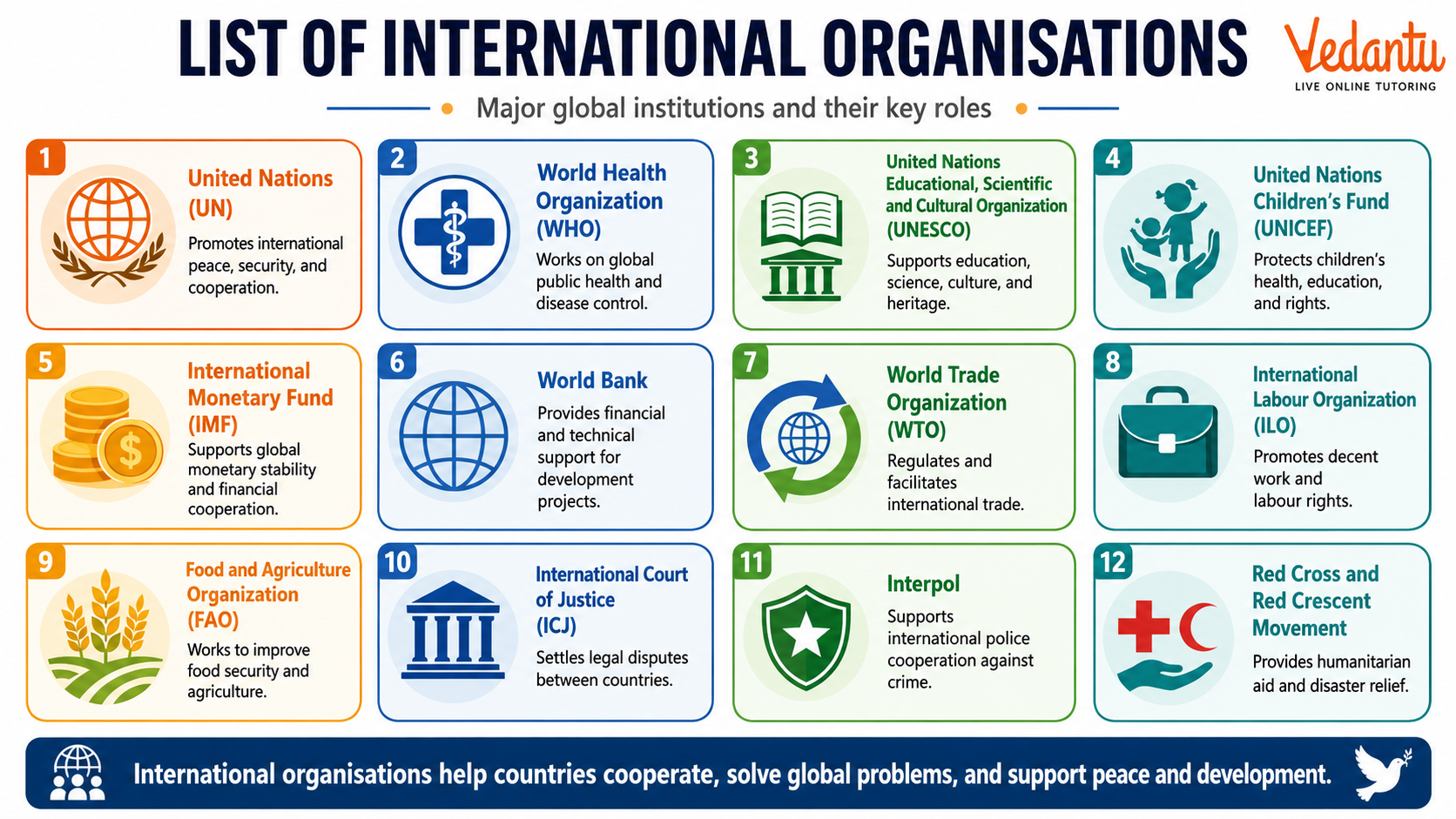
What Are International Organisations?
International organisations are institutions formed by agreements between two or more countries to work on common objectives. They function based on treaties or charters and operate at global or regional levels. These organisations help in decision-making, policy formulation, dispute resolution, and development planning among member countries.
Main Objectives
- Promote international peace and security
- Encourage economic growth and trade cooperation
- Protect human rights and social justice
- Support health, education, and environmental sustainability
- Facilitate diplomatic dialogue among nations
Major International Organisations and Their Details
| Organisation | Established | Headquarters |
|---|---|---|
| United Nations - UN | 1945 | New York, USA |
| World Health Organization - WHO | 1948 | Geneva, Switzerland |
| International Monetary Fund - IMF | 1944 | Washington DC, USA |
| World Bank | 1944 | Washington DC, USA |
| World Trade Organization - WTO | 1995 | Geneva, Switzerland |
| UNESCO | 1945 | Paris, France |
| UNICEF | 1946 | New York, USA |
| NATO | 1949 | Brussels, Belgium |
| SAARC | 1985 | Kathmandu, Nepal |
| ASEAN | 1967 | Jakarta, Indonesia |
These organisations differ in their structure and functions, but all aim to promote cooperation among member states. Some operate globally like the UN and WHO, while others focus on specific regions such as SAARC and ASEAN.
Classification of International Organisations
1. Global Organisations
These organisations have worldwide membership and deal with global issues affecting multiple countries.
- United Nations - UN
- World Health Organization - WHO
- International Monetary Fund - IMF
- World Trade Organization - WTO
2. Regional Organisations
Regional organisations focus on cooperation within a specific geographical area.
- SAARC - South Asian Association for Regional Cooperation
- ASEAN - Association of Southeast Asian Nations
- European Union - EU
- African Union - AU
Importance of International Organisations
International organisations help maintain international order and stability. They provide platforms for dialogue, resolve conflicts peacefully, offer financial assistance to developing countries, and coordinate responses to global emergencies such as pandemics and climate change. Their policies and decisions significantly influence global governance and development.
Key Facts for Competitive Exams
- The United Nations was formed after World War II in 1945.
- WHO is the specialized agency of the UN for global health.
- IMF and World Bank were established at the Bretton Woods Conference in 1944.
- WTO replaced the General Agreement on Tariffs and Trade - GATT in 1995.
- SAARC Secretariat is located in Kathmandu, Nepal.
Conclusion
The List of International Organisations is an essential part of General Knowledge. These organisations shape global policies, promote peace, and support development across nations. For students and competitive exam aspirants, remembering their establishment years, headquarters, and primary objectives is highly important. A clear understanding of international organisations not only strengthens exam preparation but also enhances awareness of global affairs.
FAQs on List of International Organisations and Their Functions
1. What are International Organisations?
International Organisations are global or regional institutions formed by multiple countries to promote cooperation, peace, security, trade, and development. They work collectively to address international issues.
• Examples include United Nations (UN), World Bank, and World Health Organization (WHO)
• Focus areas: global governance, economic growth, humanitarian aid, and conflict resolution
• Commonly asked in GK, UPSC, SSC, and other competitive exams
2. What is the role of the United Nations (UN)?
The United Nations (UN) is an international organization established in 1945 to maintain global peace and security. Its key roles include:
• Promoting international peace and security
• Protecting human rights
• Supporting sustainable development goals (SDGs)
• Providing humanitarian assistance during crises
The UN is headquartered in New York, USA and is one of the most important global bodies.
3. What is the function of the World Health Organization (WHO)?
The World Health Organization (WHO) is a specialized agency of the UN responsible for international public health. Its major functions include:
• Controlling global diseases and pandemics (e.g., COVID-19)
• Setting health standards and guidelines
• Supporting vaccination and immunization programs
• Promoting universal health coverage
WHO was founded in 1948 and is headquartered in Geneva, Switzerland.
4. What is the World Bank and what does it do?
The World Bank is an international financial institution that provides loans and grants to developing countries for development projects. Its main objectives are:
• Reducing poverty
• Supporting infrastructure development
• Improving education and healthcare systems
• Promoting economic growth
It was established in 1944 and is headquartered in Washington, D.C.
5. What is the International Monetary Fund (IMF)?
The International Monetary Fund (IMF) is a global financial organization that ensures international monetary stability. Its primary functions include:
• Providing financial assistance to countries facing economic crises
• Monitoring global financial systems
• Offering policy advice on fiscal and monetary matters
• Promoting international trade and economic cooperation
The IMF was founded in 1944 and works closely with the World Bank.
6. What is NATO and why was it formed?
The North Atlantic Treaty Organization (NATO) is a military alliance formed in 1949 for collective defense. It was created to:
• Ensure mutual military protection among member countries
• Counter security threats, originally from the Soviet Union
• Promote political and military cooperation
NATO headquarters is in Brussels, Belgium, and it plays a key role in global security affairs.
7. What is the difference between IMF and World Bank?
The main difference between IMF and World Bank lies in their functions and objectives.
• IMF: Maintains global monetary stability and provides short-term financial assistance
• World Bank: Provides long-term loans for development and poverty reduction projects
• IMF focuses on economic stabilization, while the World Bank focuses on development and infrastructure
Both were established in 1944 under the Bretton Woods Agreement.
8. What is the European Union (EU)?
The European Union (EU) is a political and economic union of European countries that promotes regional integration. Its key features include:
• A single market allowing free movement of goods, services, capital, and people
• A common currency called the Euro (used by many member states)
• Common policies on trade, agriculture, and regional development
The EU plays a major role in global trade and diplomacy.
9. What is ASEAN and what are its objectives?
The Association of Southeast Asian Nations (ASEAN) is a regional organization formed in 1967 to promote cooperation among Southeast Asian countries. Its objectives include:
• Enhancing economic growth and trade
• Promoting regional peace and stability
• Encouraging cultural and social collaboration
ASEAN strengthens regional integration and is important for Asia-Pacific geopolitics.
10. Why are International Organisations important for competitive exams?
International Organisations are important for competitive exams because they are frequently asked in General Knowledge (GK), UPSC, SSC, banking, and state-level exams. Key reasons include:
• Questions on headquarters, founders, and objectives
• Current affairs related to global summits and reports
• Understanding global governance and international relations
Knowledge of major organizations like UN, IMF, World Bank, WHO, NATO, EU, and ASEAN is essential for scoring well.
