






Key Figures of the 1857 Uprising and Their Contributions Across India
The Revolt of 1857, also known as the First War of Indian Independence, was a major uprising against the rule of the British East India Company. It began in May 1857 and soon spread across northern and central India. The revolt saw the participation of soldiers, kings, queens, zamindars, and common people. Several important leaders played a key role in organizing and leading the rebellion in different regions. Understanding these leaders and their contributions is essential for students preparing for competitive exams and for building strong General Knowledge about modern Indian history.
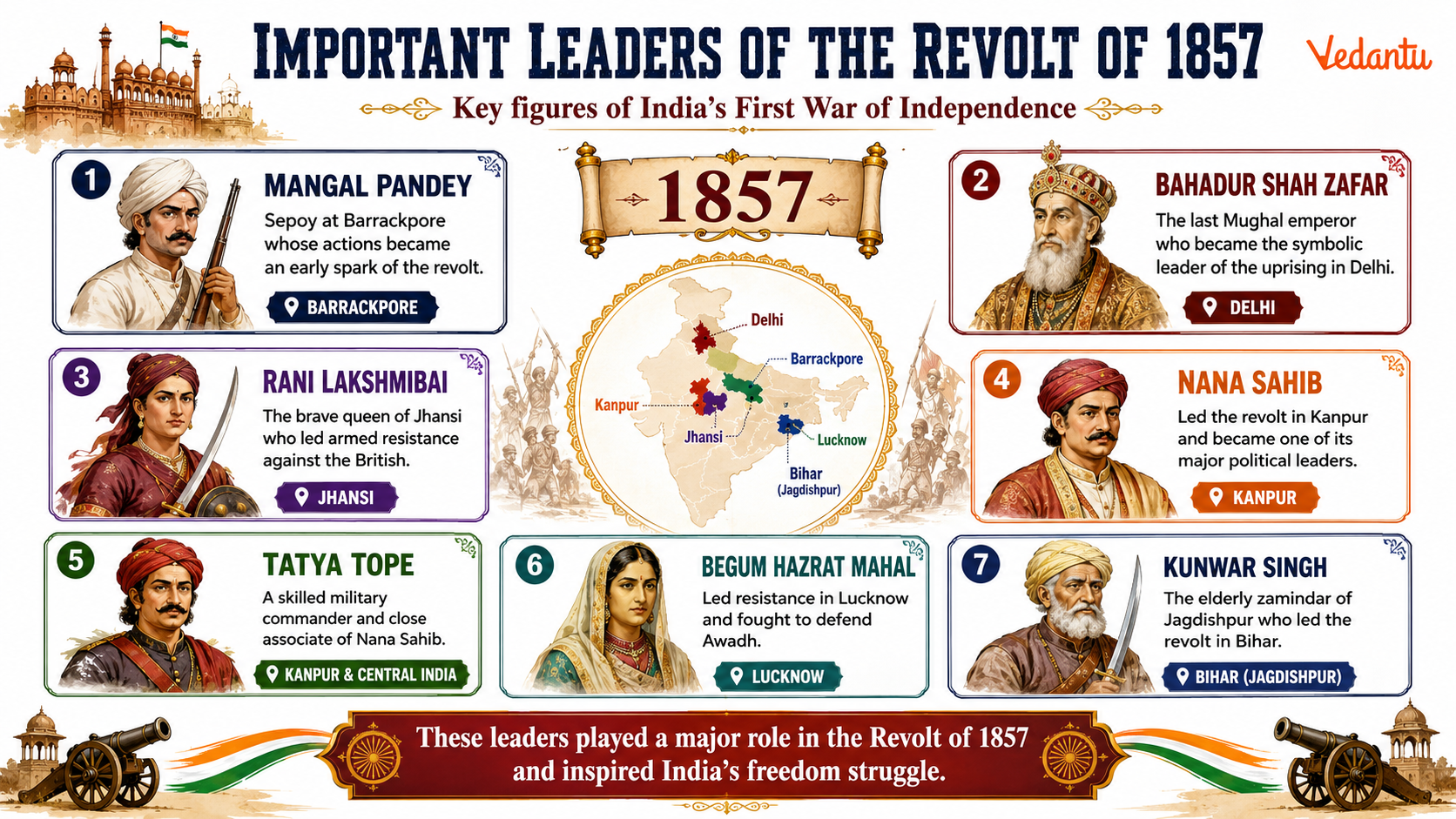
Major Leaders of the Revolt of 1857
1. Bahadur Shah Zafar
Bahadur Shah Zafar was the last Mughal Emperor of India. Although he was old and had limited power, he was declared the symbolic leader of the revolt by the rebels in Delhi. His leadership gave the revolt a sense of unity and legitimacy. After the failure of the revolt, he was captured by the British and exiled to Rangoon.
2. Rani Lakshmibai of Jhansi
Rani Lakshmibai was one of the bravest leaders of the revolt. She opposed the British policy of Doctrine of Lapse, under which her kingdom of Jhansi was annexed. She led her army with courage and fought against British forces. She died fighting in 1858 and became a symbol of resistance and patriotism.
3. Nana Sahib
Nana Sahib was the adopted son of Peshwa Baji Rao II. The British refused to grant him his father's pension, which angered him. He led the revolt in Kanpur. Though he initially gained control, the British later recaptured Kanpur. Nana Sahib disappeared after the revolt and his fate remains unknown.
4. Tatya Tope
Tatya Tope was a close associate of Nana Sahib and one of the most skilled military commanders of the revolt. He led guerrilla warfare against the British and fought bravely even after major centers were recaptured. He was eventually captured and executed by the British in 1859.
5. Begum Hazrat Mahal
Begum Hazrat Mahal was the wife of Nawab Wajid Ali Shah of Awadh. After the annexation of Awadh, she led the revolt in Lucknow. She declared her son as the ruler and actively organized resistance against British forces. She later sought refuge in Nepal.
6. Kunwar Singh
Kunwar Singh was a zamindar of Jagdishpur in Bihar. Despite being around 80 years old, he led the revolt in Bihar with great determination. He successfully fought several battles against the British before he died in 1858.
7. Mangal Pandey
Mangal Pandey was a soldier in the British East India Company army. His attack on British officers at Barrackpore in March 1857 is considered one of the immediate causes of the revolt. He was arrested and executed, but his actions inspired many others to join the rebellion.
List of Important Leaders and Their Areas of Activity
| Leader | Region | Role in the Revolt |
|---|---|---|
| Bahadur Shah Zafar | Delhi | Symbolic head of the revolt |
| Rani Lakshmibai | Jhansi | Led armed resistance against British |
| Nana Sahib | Kanpur | Organized revolt and challenged British authority |
| Tatya Tope | Central India | Military commander and guerrilla warfare expert |
| Begum Hazrat Mahal | Lucknow | Led rebellion in Awadh |
| Kunwar Singh | Bihar | Led revolt in Jagdishpur |
| Mangal Pandey | Barrackpore | Early revolutionary and inspiration for uprising |
These leaders represented different regions and social backgrounds, but they were united in their opposition to British rule. Their combined efforts made the Revolt of 1857 one of the most significant events in Indian history.
Other Notable Leaders of the Revolt
- Maulvi Ahmadullah Shah - Played a key role in Faizabad and Awadh, inspiring people with his speeches.
- Khan Bahadur Khan - Led the revolt in Bareilly and declared himself the ruler.
- Rao Tula Ram - Organized resistance in Haryana and supported rebel forces.
- Azimullah Khan - Political advisor to Nana Sahib and strategist during the revolt.
Importance of These Leaders in Indian History
The leaders of the Revolt of 1857 showed unity, courage, and determination against foreign rule. Though the revolt was eventually suppressed, it exposed the weaknesses of British administration and led to significant changes. In 1858, the British Crown took direct control of India from the East India Company. The revolt also planted the seeds of organized national movement in later years.
Key Points for Competitive Exams
- The revolt started on 10 May 1857 in Meerut.
- Bahadur Shah Zafar was declared the Emperor of India during the revolt.
- Doctrine of Lapse was a major cause for Rani Lakshmibai's participation.
- Mangal Pandey's action in March 1857 acted as an immediate trigger.
- The revolt ended in 1858 with the Government of India Act.
A clear understanding of the important leaders associated with the Revolt of 1857 helps students answer direct factual questions as well as analytical questions in exams. Their contributions remain a significant chapter in India's struggle for independence and continue to inspire generations.
FAQs on Important Leaders of the Revolt of 1857 and Their Roles
1. Who were the most important leaders of the Revolt of 1857?
The most important leaders of the Revolt of 1857 were prominent rulers, soldiers, and freedom fighters who led regional uprisings against the British East India Company.
• Bahadur Shah Zafar – Symbolic Mughal Emperor and leader in Delhi
• Rani Lakshmibai – Queen of Jhansi and key military commander
• Nana Sahib – Leader of Kanpur revolt
• Tantia Tope – Military general and close associate of Nana Sahib
• Begum Hazrat Mahal – Led the revolt in Lucknow
• Kunwar Singh – Leader from Bihar
These leaders played a central role in what is also called the First War of Indian Independence or Sepoy Mutiny.
2. What role did Bahadur Shah Zafar play in the Revolt of 1857?
Bahadur Shah Zafar served as the symbolic head of the Revolt of 1857 and was declared the Emperor of Hindustan by the rebels.
• Last Mughal Emperor of India
• Provided political legitimacy to the uprising
• Became the face of resistance in Delhi
• Exiled to Rangoon after British suppression
His involvement united various rebel leaders under the Mughal banner during the Indian Rebellion of 1857.
3. Why is Rani Lakshmibai considered a key leader of the Revolt of 1857?
Rani Lakshmibai of Jhansi is considered a key leader due to her bravery and military leadership against British forces.
• Opposed the Doctrine of Lapse policy
• Led armed resistance in Jhansi
• Fought alongside Tantia Tope
• Became a symbol of women’s courage in Indian history
Her leadership made her one of the most iconic figures of the 1857 uprising.
4. Who was Nana Sahib and what was his contribution to the Revolt of 1857?
Nana Sahib was a prominent rebel leader who led the uprising in Kanpur during the Revolt of 1857.
• Adopted son of Peshwa Baji Rao II
• Opposed British refusal of pension
• Led attacks against British troops in Kanpur
• Worked closely with Tantia Tope
He was one of the main political and military figures of the First War of Independence.
5. What was the role of Tantia Tope in the Revolt of 1857?
Tantia Tope was the chief military commander of the Revolt of 1857 known for his guerrilla warfare tactics.
• Close associate of Nana Sahib
• Led battles in Kanpur and Central India
• Supported Rani Lakshmibai in Jhansi
• Continued resistance even after major defeats
His strategic warfare made him one of the most skilled generals of the Indian Mutiny of 1857.
6. Who led the Revolt of 1857 in Lucknow?
Begum Hazrat Mahal led the Revolt of 1857 in Lucknow and Awadh against British annexation.
• Wife of Nawab Wajid Ali Shah
• Declared her son as ruler of Awadh
• Organized resistance forces in Lucknow
• Played a major role in defending the region
She was one of the few female leaders of the Indian Rebellion of 1857.
7. Who was Kunwar Singh in the Revolt of 1857?
Kunwar Singh was a prominent leader from Bihar who fought bravely in the Revolt of 1857 despite his old age.
• Zamindar of Jagdishpur
• Led armed rebellion against British forces
• Fought several battles in Bihar and Uttar Pradesh
• Remembered for his determination and patriotism
He remains a respected hero of the 1857 freedom struggle.
8. Who was the first martyr of the Revolt of 1857?
Mangal Pandey is regarded as the first martyr of the Revolt of 1857 for initiating resistance against British officers.
• Sepoy in the 34th Bengal Native Infantry
• Attacked British officers at Barrackpore
• Opposed the use of greased cartridges
• Executed in April 1857
His actions triggered the larger uprising known as the Sepoy Mutiny.
9. What was the role of the Doctrine of Lapse in the Revolt of 1857?
The Doctrine of Lapse was a British annexation policy that became a major cause of the Revolt of 1857.
• Introduced by Lord Dalhousie
• Allowed annexation of states without a natural heir
• Affected Jhansi, Satara, and other kingdoms
• Created resentment among Indian rulers
This policy directly influenced leaders like Rani Lakshmibai to join the uprising.
10. Why is the Revolt of 1857 called the First War of Indian Independence?
The Revolt of 1857 is called the First War of Indian Independence because it was the first large-scale, united uprising against British rule.
• Involved soldiers, rulers, peasants, and civilians
• Spread across North and Central India
• Led by figures like Bahadur Shah Zafar and Rani Lakshmibai
• Marked the beginning of organized resistance
Though unsuccessful, it laid the foundation for the later Indian freedom movement.
