






Main Types in the List of Collar Workers with Examples
The term Collar Workers refers to categories of workers classified based on the type of job they perform, their working environment, and the nature of their duties. This classification helps in understanding the structure of the workforce in different sectors of the economy. The concept is widely used in General Knowledge, competitive exams, and sociology to describe employment patterns and economic roles. Different collar colors symbolize different types of professions, such as office-based jobs, skilled labor, service roles, and environmental occupations.
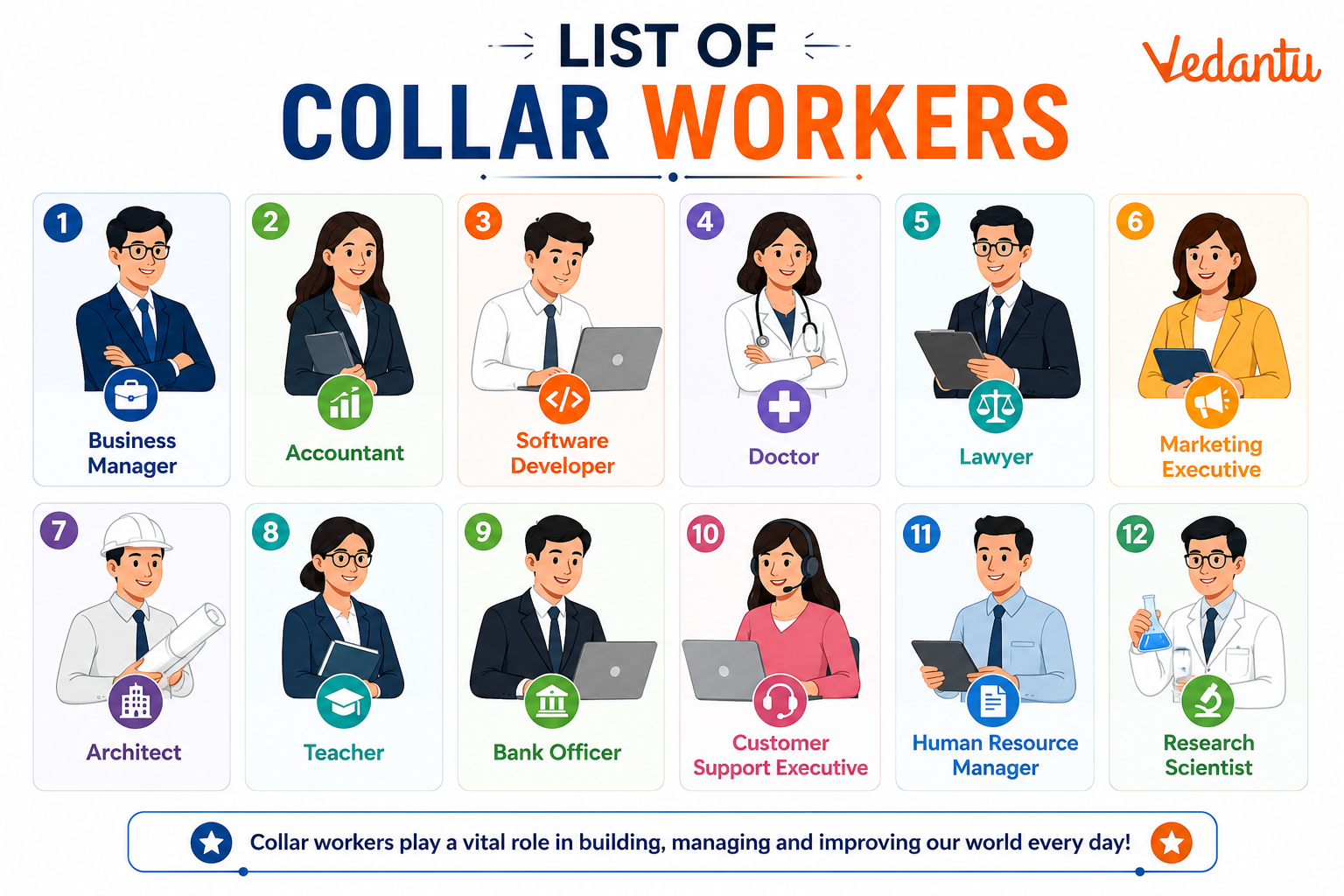
What Are Collar Workers?
Collar workers are groups of employees categorized according to their job roles and the type of work they perform. The term originally began with "White Collar" and "Blue Collar" workers, but over time, more categories were added to reflect modern economic and professional diversity.
These classifications help in:
- Understanding labor market trends
- Identifying skill levels and job environments
- Studying economic development patterns
- Preparing for competitive exams and interviews
List of Collar Workers
| Type of Collar Worker | Nature of Work | Examples of Professions |
|---|---|---|
| White Collar Workers | Office-based, managerial or administrative work | Doctors, Engineers, Teachers, Managers |
| Blue Collar Workers | Manual labor or skilled trade work | Electricians, Plumbers, Factory Workers |
| Pink Collar Workers | Service-oriented jobs, often in care or hospitality sectors | Nurses, Receptionists, Waiters |
| Green Collar Workers | Environmental and sustainability related work | Environmentalists, Solar Panel Technicians |
| Grey Collar Workers | Technically skilled jobs combining manual and professional work | Technicians, IT Support Staff |
| Gold Collar Workers | Highly skilled professionals with specialized knowledge | Scientists, Surgeons, Corporate Lawyers |
The above classifications represent different segments of the workforce. As economies evolve, new collar categories may emerge to reflect changing job roles and industries.
Detailed Explanation of Major Collar Types
White Collar Workers
White collar workers are professionals who perform administrative, managerial, or clerical duties. They usually work in offices and rely more on mental skills than physical labor. These jobs often require formal education and specialized training.
Blue Collar Workers
Blue collar workers are involved in manual labor. They may work in factories, construction sites, or workshops. These jobs may require physical strength, technical skills, and vocational training.
Pink Collar Workers
Pink collar workers are generally employed in the service sector. These roles often involve customer interaction, caregiving, or support services. Historically, many of these jobs were associated with women, but today they are open to all genders.
Green Collar Workers
Green collar workers are associated with environmental protection and sustainable development. Their work contributes to conserving natural resources and promoting eco-friendly practices.
Grey and Gold Collar Workers
Grey collar workers perform jobs that combine technical knowledge with hands-on work. Gold collar workers are highly educated and skilled professionals who command high salaries due to their expertise and specialization.
Importance of Collar Worker Classification
The classification of collar workers is important for understanding economic structure and workforce distribution. It also helps governments and organizations design employment policies and training programs.
- Helps in analyzing employment trends
- Assists in career guidance and planning
- Supports economic and labor studies
- Commonly asked in competitive exams
Key Points to Remember
- White collar refers to office and professional work.
- Blue collar refers to manual labor and skilled trades.
- Pink collar represents service-oriented jobs.
- Green collar focuses on environmental occupations.
- Gold collar indicates highly specialized professionals.
Conclusion
The list of collar workers reflects the diversity of modern employment sectors. From office professionals and manual laborers to environmental specialists and highly skilled experts, each category plays an important role in economic development. Understanding these classifications enhances general knowledge and helps students prepare effectively for competitive examinations and interviews.
FAQs on List of Collar Workers and Their Job Categories
1. What are collar workers?
Collar workers are employees categorized based on the type of job they perform and the nature of their work environment.
• The term comes from the color of workers’ traditional uniforms or attire.
• It classifies jobs into types like blue-collar, white-collar, pink-collar, and others.
• This classification helps in understanding employment sectors, labor division, and workforce structure.
• Common in General Knowledge (GK), competitive exams, and career awareness topics.
2. Who are blue-collar workers?
Blue-collar workers are individuals engaged in manual or physical labor jobs.
• Typically work in industries like manufacturing, construction, mining, and mechanics.
• Often require technical skills or vocational training.
• Examples: electricians, plumbers, factory workers, drivers.
• Associated with hourly wages and industrial or trade sectors.
3. Who are white-collar workers?
White-collar workers are professionals who perform office-based or managerial work.
• Usually employed in corporate offices, banks, educational institutions, and IT companies.
• Jobs require higher education or specialized qualifications.
• Examples: teachers, managers, engineers, doctors, accountants.
• Connected with administrative, clerical, and knowledge-based roles.
4. What are pink-collar jobs?
Pink-collar jobs refer to service-oriented professions traditionally associated with women.
• Common in sectors like healthcare, hospitality, and caregiving.
• Examples: nurses, receptionists, teachers, flight attendants.
• The term highlights gender roles in the workforce.
• Frequently asked in GK under labor classification and employment types.
5. Who are green-collar workers?
Green-collar workers are employees working in environmental and sustainable sectors.
• Focus on environmental protection and renewable energy.
• Examples: solar panel technicians, environmental engineers, conservation workers.
• Associated with sustainable development and eco-friendly industries.
• Important in discussions about climate change and green economy jobs.
6. What are gold-collar jobs?
Gold-collar jobs refer to highly skilled and highly paid professional occupations.
• Require advanced education and specialized expertise.
• Examples: doctors, lawyers, scientists, airline pilots.
• Often linked with high-income careers and intellectual skills.
• Represent top-tier positions in the professional workforce.
7. Who are grey-collar workers?
Grey-collar workers perform jobs that combine elements of both blue-collar and white-collar work.
• Involve technical and supervisory responsibilities.
• Examples: technicians, police officers, paramedics.
• Require both practical skills and formal education.
• Often seen in modern industrial and service sectors.
8. What are new-collar jobs?
New-collar jobs are modern careers that focus on skills rather than formal degrees.
• Common in technology and digital industries.
• Examples: data analysts, cybersecurity experts, cloud computing specialists.
• Emphasize certifications, training programs, and technical skills.
• Frequently searched under future careers and IT workforce trends.
9. Why is the classification of collar workers important?
The classification of collar workers helps in understanding the structure and diversity of the labor market.
• Distinguishes between manual, professional, and service occupations.
• Useful for career guidance and workforce planning.
• Important in economics, sociology, and employment studies.
• Common topic in competitive exams and General Knowledge sections.
10. What is the difference between blue-collar and white-collar workers?
The main difference between blue-collar and white-collar workers lies in the type of work they perform.
• Blue-collar workers: Manual labor, physical tasks, industrial settings.
• White-collar workers: Office-based work, administrative or professional roles.
• Blue-collar jobs often require vocational skills, while white-collar jobs need higher education.
• This distinction is widely asked in GK, interviews, and competitive examinations.
