






British Governors-General in India from 1773 to 1947: Key Events and Reforms
The List of British Governors General in India is an important topic in Indian History and General Knowledge. The Governor General was the head of British administration in India before the title of Viceroy was introduced in 1858. These officials played a major role in shaping the political, administrative, legal, and economic structure of colonial India. Understanding their tenure, major reforms, and historical contributions is essential for students and competitive exam aspirants preparing for exams like UPSC, SSC, State PSC, and other government examinations.
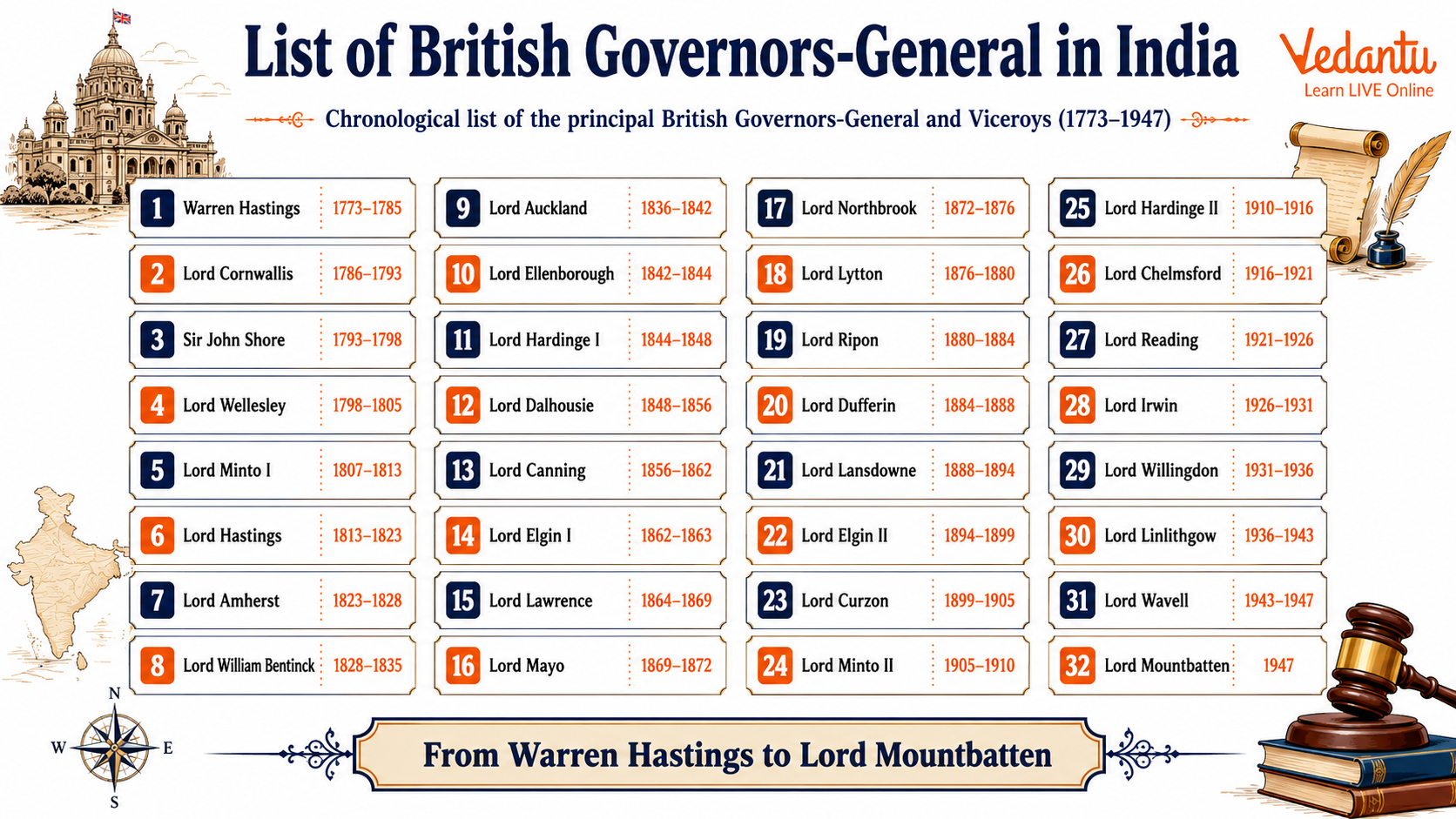
Who Was the Governor General of India?
The post of Governor General of India was created in 1773 under the Regulating Act of 1773. The Governor General was the head of the British East India Company's administration in India. Initially, the title was Governor General of Bengal, but later it became Governor General of India under the Charter Act of 1833.
After the Revolt of 1857, the Government of India Act 1858 transferred power from the East India Company to the British Crown. From that point, the Governor General also held the title of Viceroy of India.
List of British Governors General in India (1773 - 1858)
| Name | Tenure | Major Contributions |
|---|---|---|
| Warren Hastings | 1773 - 1785 | Regulating Act implementation, Judicial reforms, First Rohilla War |
| Lord Cornwallis | 1786 - 1793 | Permanent Settlement 1793, Civil Services reforms |
| Sir John Shore | 1793 - 1798 | Policy of Non Intervention |
| Lord Wellesley | 1798 - 1805 | Subsidiary Alliance system |
| Lord Minto I | 1807 - 1813 | Treaty of Amritsar 1809 |
| Lord Hastings | 1813 - 1823 | Anglo Nepal War, End of Maratha power |
| Lord Amherst | 1823 - 1828 | First Anglo Burmese War |
| Lord William Bentinck | 1828 - 1835 | Abolition of Sati 1829, English Education Act 1835 |
| Lord Metcalfe | 1835 - 1836 | Freedom of Press Act 1835 |
| Lord Auckland | 1836 - 1842 | First Anglo Afghan War |
| Lord Ellenborough | 1842 - 1844 | Annexation of Sindh |
| Lord Hardinge I | 1844 - 1848 | First Anglo Sikh War |
| Lord Dalhousie | 1848 - 1856 | Doctrine of Lapse, Railways, Telegraph, Postal reforms |
| Lord Canning | 1856 - 1858 | Revolt of 1857, First Viceroy of India |
The above table highlights the major British Governors General in India and their significant contributions. Their policies had long lasting effects on Indian society, economy, and administration.
Major Reforms and Policies Introduced
Administrative Reforms
- Introduction of Civil Services reforms by Lord Cornwallis.
- Centralization of administration under the Regulating Act.
- Expansion of British territories through wars and alliances.
Economic Policies
- Permanent Settlement introduced by Lord Cornwallis in Bengal.
- Expansion of trade and revenue collection systems.
- Development of railways and telegraph under Lord Dalhousie.
Social and Educational Reforms
- Abolition of Sati by Lord William Bentinck in 1829.
- Promotion of English education through Macaulay Minute and English Education Act 1835.
- Freedom of Press Act by Lord Metcalfe.
Difference Between Governor General and Viceroy
The Governor General governed India on behalf of the British East India Company from 1773 to 1858. After the Revolt of 1857, the British Crown assumed direct control. From 1858 onwards, the head of administration was called the Viceroy of India. Lord Canning became the first Viceroy in 1858.
Importance for Competitive Exams
Questions about the British Governors General in India are frequently asked in competitive exams. Students should focus on:
- Matching Governors General with their reforms.
- Chronological order of tenure.
- Important Acts passed during their period.
- Major wars and annexations.
Conclusion
The List of British Governors General in India provides deep insight into the colonial administrative system and the transformation of India under British rule. Each Governor General introduced policies that significantly influenced Indian political, economic, and social structures. A clear understanding of their tenure and contributions is essential for building a strong foundation in modern Indian history and performing well in competitive examinations.
FAQs on List of British Governors-General in India: Complete Chronological Overview
1. Who was the first Governor-General of India?
The first Governor-General of India was Lord William Bentinck in 1833 under the Charter Act of 1833.
- Before him, Warren Hastings was the first Governor-General of Bengal (1773).
- The title “Governor-General of India” was officially introduced in 1833.
- Bentinck is known for abolishing Sati (1829) and promoting English education.
- Important for UPSC, SSC, and other competitive exams under British rule in India.
2. Who was the last Governor-General of India?
The last Governor-General of independent India was C. Rajagopalachari (1948–1950).
- He was the only Indian Governor-General.
- Before him, Lord Mountbatten was the last British Governor-General (1947–1948).
- The post ended when India became a Republic on 26 January 1950.
- Frequently asked in GK questions on modern Indian history.
3. Who was the first Governor-General of Bengal?
The first Governor-General of Bengal was Warren Hastings in 1773 under the Regulating Act of 1773.
- He strengthened the East India Company administration.
- Introduced reforms in the judicial and revenue system.
- Faced impeachment in Britain.
- A key personality in the expansion of British power in India.
4. Who introduced the Doctrine of Lapse?
The Doctrine of Lapse was introduced by Lord Dalhousie (1848–1856).
- States without a natural heir were annexed by the British.
- Annexed territories included Satara, Jhansi, Nagpur, and Awadh.
- It became a major cause of the Revolt of 1857.
- Important topic in British annexation policies and Indian national movement.
5. Who was the Governor-General during the Revolt of 1857?
The Governor-General during the Revolt of 1857 was Lord Canning.
- He became the first Viceroy of India after 1858.
- The revolt led to the end of East India Company rule.
- Power was transferred to the British Crown under the Government of India Act 1858.
- Frequently asked in questions about the First War of Independence.
6. What is the difference between Governor-General and Viceroy?
The main difference is that a Governor-General represented the East India Company, while a Viceroy represented the British Crown.
- Governor-General (1773–1858): Head of Company administration.
- Viceroy (1858–1947): Direct representative of the British monarch.
- Lord Canning was the first Viceroy.
- Key concept in understanding British constitutional changes in India.
7. Who introduced the Permanent Settlement in India?
The Permanent Settlement of Bengal (1793) was introduced by Lord Cornwallis.
- It fixed land revenue permanently with Zamindars.
- Applied mainly in Bengal, Bihar, and Orissa.
- Known as the Zamindari System.
- Important in topics related to land revenue systems under British rule.
8. Who partitioned Bengal in 1905?
The Partition of Bengal (1905) was carried out by Lord Curzon.
- Divided Bengal into East Bengal and West Bengal.
- Sparked the Swadeshi Movement.
- Aimed at administrative efficiency but seen as “Divide and Rule”.
- Major event in the Indian National Movement.
9. Who introduced Subsidiary Alliance in India?
The Subsidiary Alliance System was introduced by Lord Wellesley.
- Indian rulers had to accept British troops in their states.
- They paid for the maintenance of these forces.
- Lost control over foreign affairs.
- Strengthened British expansion and control in Indian princely states.
10. How many Governor-Generals were there in India?
There were 21 Governor-Generals of India from 1773 to 1950, including Company and Crown representatives.
- 1773–1858: Governors-General under the East India Company.
- 1858–1947: Also held the title of Viceroy of India.
- 1947–1950: Governor-General of independent India.
- Important factual data for General Knowledge (GK) and competitive exams.
