






Why Would the United States Recognize Tibet’s Independence and What Would Happen?
The topic "US Recognize Tibet As Independent Nation" relates to international relations, geopolitics, and the long-standing Tibet issue involving China, the United States, and the Tibetan government-in-exile. Tibet, a region on the Tibetan Plateau in Asia, has been at the center of political debates since the mid-20th century. The question of whether the United States recognizes Tibet as an independent nation has important diplomatic implications for global politics, especially US-China relations. This topic is significant for students preparing for competitive exams, as it covers international organizations, sovereignty, foreign policy, and human rights issues.
Background of Tibet Issue
Tibet is a high-altitude region located in the Himalayas. Historically, Tibet functioned with varying degrees of autonomy. In 1950, the People’s Republic of China took control of Tibet. In 1959, following an uprising against Chinese rule, the 14th Dalai Lama fled to India and established the Tibetan Government-in-Exile in Dharamshala.
Since then, the political status of Tibet has remained a sensitive global issue. China considers Tibet an integral part of its territory, while some groups advocate for greater autonomy or full independence for Tibet.
Does the US Recognize Tibet as an Independent Nation?
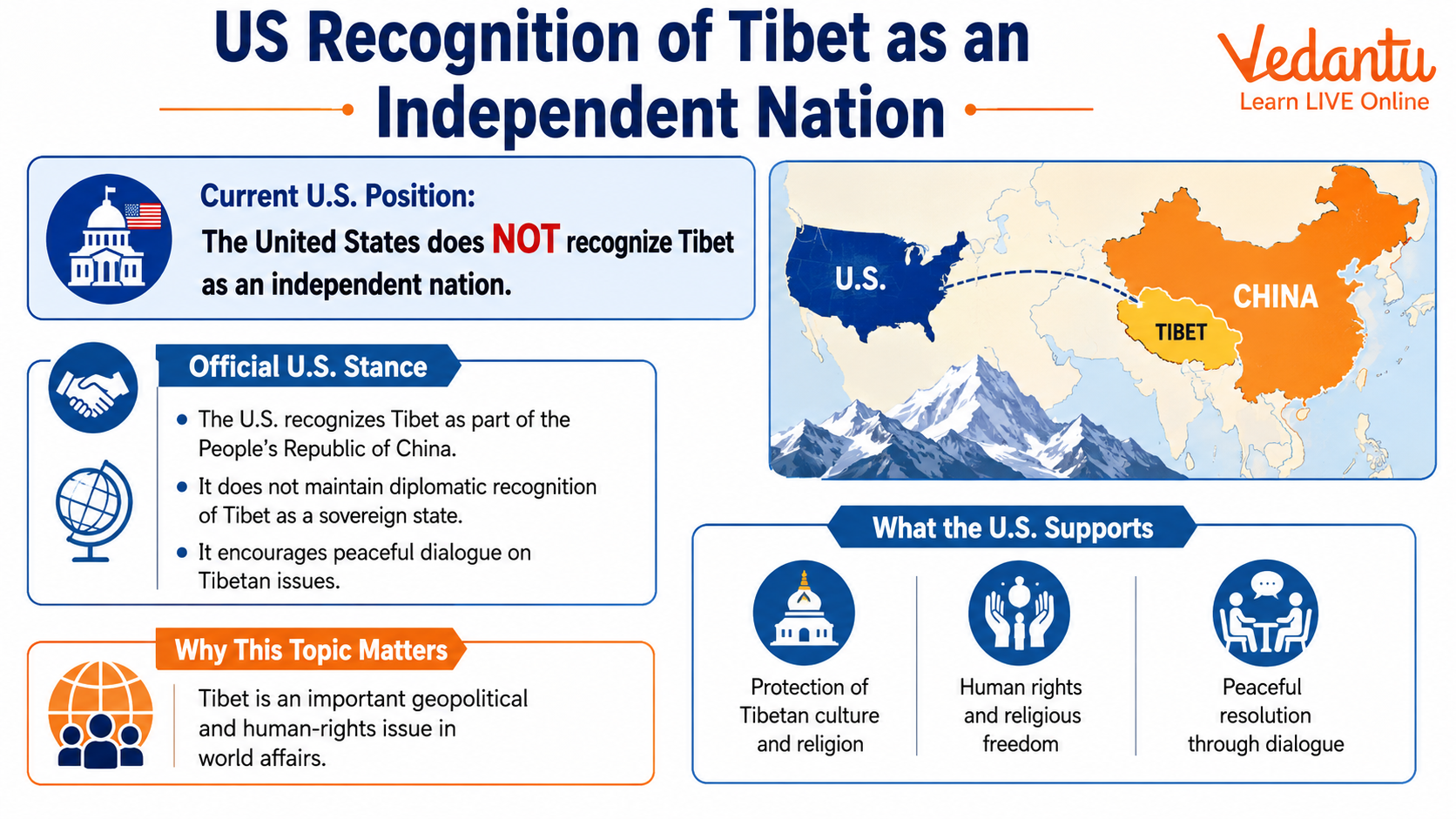
As of present official policy, the United States does not recognize Tibet as an independent nation. The US officially acknowledges Tibet as part of the People’s Republic of China. However, the United States has expressed concerns about human rights, religious freedom, and cultural preservation in Tibet.
While supporting dialogue between Chinese authorities and Tibetan representatives, the US policy does not support Tibetan independence. Instead, it promotes meaningful autonomy within China.
Key Points of US Policy on Tibet
- The US recognizes the Tibet Autonomous Region as part of China.
- The US supports the protection of Tibetan cultural and religious rights.
- The US encourages dialogue between China and the Dalai Lama or his representatives.
- The US Congress has passed laws addressing human rights in Tibet.
Important US Laws Related to Tibet
Major US Acts Concerning Tibet
| Act Name | Year | Purpose |
|---|---|---|
| Tibetan Policy Act | 2002 | Promotes dialogue and supports Tibetan rights |
| Tibetan Policy and Support Act | 2020 | Strengthens US support for Tibetan autonomy and religious freedom |
These laws show that while the US does not recognize Tibet as independent, it actively supports human rights and religious freedom for Tibetans.
Why This Issue Is Important Globally
The Tibet issue affects international diplomacy, especially relations between the US and China. China strongly opposes any foreign interference in what it considers internal matters. Any move toward recognizing Tibet as independent would significantly impact diplomatic, economic, and security relations.
Global Implications
- Impacts US-China trade and diplomatic relations.
- Influences global human rights discussions.
- Affects regional stability in Asia.
- Shapes international debate on sovereignty and self-determination.
Tibet Autonomous Region - Key Facts
Basic Information About Tibet
| Feature | Details | Remarks |
|---|---|---|
| Capital | Lhasa | Administrative center |
| Status | Autonomous Region of China | Under PRC administration |
Tibet is officially known as the Tibet Autonomous Region under Chinese governance. It holds strategic and cultural importance due to its geography, water resources, and religious heritage.
Difference Between Independence and Autonomy
Understanding the difference between independence and autonomy is crucial in this context.
- Independence means complete political separation and formation of a sovereign state.
- Autonomy means self-governance in certain areas while remaining under a larger sovereign state.
The US supports meaningful autonomy for Tibet but does not advocate full independence.
Exam Relevance and Preparation Tips
This topic is relevant for General Knowledge, Current Affairs, Political Science, and International Relations sections of competitive exams. Students should focus on understanding official US policy, the historical background, and global implications.
Preparation Strategy
- Remember that the US does not officially recognize Tibet as an independent country.
- Learn key years such as 1950, 1959, 2002, and 2020.
- Understand the difference between autonomy and independence.
- Stay updated with recent diplomatic developments.
Conclusion
In conclusion, the United States does not recognize Tibet as an independent nation. It officially considers Tibet part of China while advocating for human rights, religious freedom, and meaningful autonomy for the Tibetan people. The issue remains sensitive and closely tied to US-China relations. Understanding this topic helps students grasp broader themes of sovereignty, international diplomacy, and global politics.
FAQs on US Recognition of Tibet as an Independent Nation: Background and Meaning
1. Did the United States officially recognize Tibet as an independent nation?
No, the United States has not officially recognized Tibet as an independent nation.
• The U.S. government has historically recognized Tibet as part of China.
• However, the U.S. has expressed concerns over human rights in Tibet.
• Laws like the Tibetan Policy Act (2002) and Tibetan Policy and Support Act (2020) focus on autonomy and religious freedom, not independence.
People also ask: Is Tibet a country? Does the US support Tibetan independence?
2. What is the current status of Tibet in international politics?
Tibet is internationally recognized as an autonomous region of China.
• Official name: Tibet Autonomous Region (TAR).
• Administered by the People’s Republic of China (PRC) since 1951.
• No major country formally recognizes Tibet as an independent state.
People also search: Tibet political status, Tibet autonomy vs independence.
3. What was the U.S. position on Tibet before 1950?
Before 1950, the U.S. maintained a cautious and unclear stance on Tibet’s sovereignty.
• The U.S. did not formally recognize Tibet as a separate country.
• It acknowledged China’s claim but supported limited Tibetan autonomy.
• After China’s takeover in 1950–1951, the U.S. expressed political concerns.
People also ask: Was Tibet independent before China? What happened in 1950 in Tibet?
4. What is the Tibetan Policy and Support Act of 2020?
The Tibetan Policy and Support Act (TPSA) of 2020 is a U.S. law supporting Tibetan human rights and religious freedom.
• Supports the Dalai Lama’s succession process without Chinese interference.
• Promotes access to Tibet for diplomats and journalists.
• Encourages environmental protection of the Tibetan Plateau.
People also search: US Tibet law 2020, Dalai Lama succession issue.
5. Who is the Dalai Lama and what is his role in the Tibet issue?
The Dalai Lama is the spiritual leader of Tibetan Buddhism and a global advocate for Tibetan autonomy.
• The current leader is the 14th Dalai Lama, Tenzin Gyatso.
• He fled to India in 1959 after a failed uprising.
• Advocates the Middle Way Approach (genuine autonomy, not full independence).
People also ask: Where does the Dalai Lama live? What is the Middle Way policy?
6. Why is Tibet strategically important?
Tibet is strategically important due to its geography, resources, and political significance.
• Known as the “Roof of the World” due to its high altitude.
• Source of major Asian rivers like the Brahmaputra and Yangtze.
• Holds geopolitical value between China and India.
People also search: Tibet geography importance, Tibet water resources.
7. Has any country recognized Tibet as an independent country?
No major country currently recognizes Tibet as an independent nation.
• Most countries officially recognize Tibet as part of China.
• Some governments support human rights and cultural preservation in Tibet.
• Tibetan exile groups operate from Dharamshala, India.
People also ask: Is Tibet recognized by the UN? Which countries support Tibet?
8. What happened during the 1959 Tibetan Uprising?
The 1959 Tibetan Uprising was a major revolt against Chinese rule in Lhasa.
• Occurred in March 1959.
• Led to the exile of the Dalai Lama to India.
• Resulted in tighter Chinese control over Tibet.
People also search: Lhasa uprising 1959, Dalai Lama escape to India.
9. What is the difference between Tibetan autonomy and independence?
Tibetan autonomy means self-governance within China, while independence means complete separation.
• Autonomy: Cultural, religious, and administrative freedom under Chinese sovereignty.
• Independence: Full sovereign state status separate from China.
• The Dalai Lama supports greater autonomy, not full independence.
People also ask: What is genuine autonomy? Does Tibet want independence?
10. Why does the Tibet issue remain controversial?
The Tibet issue remains controversial due to historical disputes, human rights concerns, and geopolitical tensions.
• China considers Tibet an internal matter.
• Activists raise concerns about religious freedom and cultural preservation.
• The issue affects US–China relations and regional diplomacy.
People also search: Tibet China dispute, US China Tibet tensions.
