






How Left-Wing and Right-Wing Political Ideologies Shape Government and Society
Left and Right Wing Politics are two major ideological positions in political science that describe different views about government, economy, society, and individual rights. These terms are widely used across the world to classify political parties, movements, and leaders. Understanding the difference between Left and Right Wing politics is important for students, competitive exam aspirants, and general readers because it helps in analyzing policies, governance models, and political debates in a structured way.
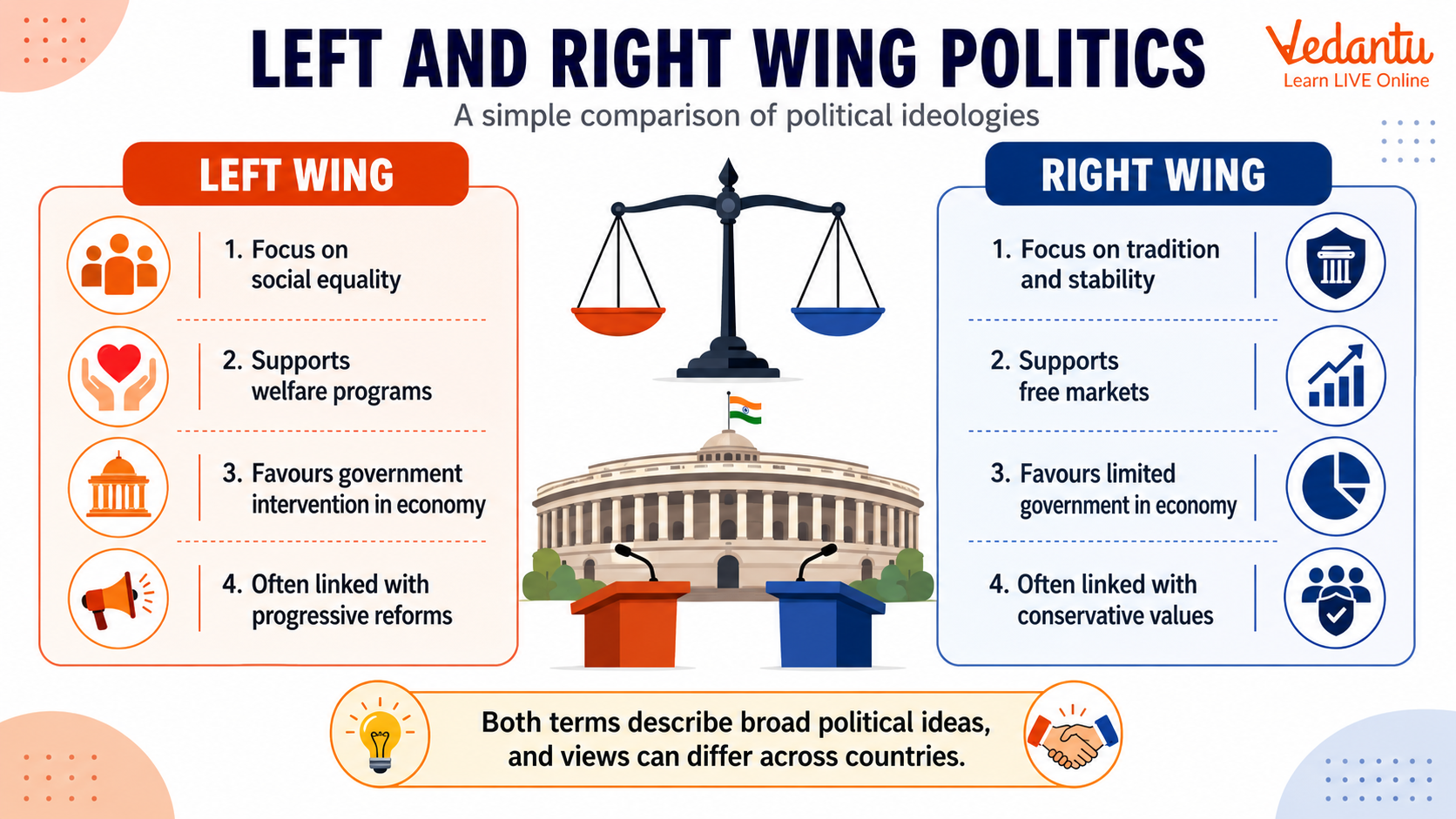
Origin of Left and Right Wing Politics
The terms Left and Right originated during the French Revolution in 1789. Members of the National Assembly were seated according to their political views. Those who supported the monarchy and traditional institutions sat on the right side of the president, while those who supported revolution and social change sat on the left side. Over time, these seating positions evolved into broad political ideologies known as Left Wing and Right Wing politics.
Meaning of Left Wing Politics
Left Wing politics generally supports social equality, government intervention in the economy, and welfare policies for the upliftment of weaker sections of society. Left Wing ideologies believe that the state should play a major role in reducing inequality and ensuring social justice.
Key Features of Left Wing Politics
- Support for social and economic equality
- Government control or regulation of major industries
- Progressive taxation and wealth redistribution
- Strong welfare programs such as public healthcare and education
- Support for labor unions and workers' rights
Examples of Left Wing Ideologies
- Socialism
- Communism
- Democratic Socialism
- Social Democracy
Meaning of Right Wing Politics
Right Wing politics generally supports free market capitalism, private property, limited government intervention, and traditional social values. Right Wing ideologies emphasize individual responsibility, economic freedom, and national identity.
Key Features of Right Wing Politics
- Support for free market economy
- Limited government intervention in business
- Emphasis on private property and entrepreneurship
- Focus on traditional cultural and social values
- Strong national security and defense policies
Examples of Right Wing Ideologies
- Conservatism
- Liberal Conservatism
- Libertarianism
- Nationalism
Difference Between Left Wing and Right Wing Politics
| Basis of Comparison | Left Wing | Right Wing |
|---|---|---|
| Economic Policy | Government control and welfare focus | Free market and private ownership |
| View on Equality | Promotes social and economic equality | Accepts natural social hierarchy |
| Role of Government | Active and interventionist | Limited and minimal |
| Social Values | Progressive and reform-oriented | Traditional and conservative |
The table above highlights the fundamental differences between Left Wing and Right Wing politics. However, in real-world politics, many political parties combine elements of both ideologies, leading to moderate or centrist positions.
Centrist and Mixed Ideologies
Not all political groups strictly follow Left or Right ideologies. Some adopt centrist positions, combining policies from both sides. For example, a party may support free market policies while also promoting certain welfare programs. This blending of ideas reflects practical governance needs and changing social demands.
Importance of Understanding Left and Right Wing Politics
- Helps in analyzing election manifestos and public policies
- Improves understanding of global political systems
- Useful for competitive exams and interviews
- Enhances critical thinking and informed citizenship
Common Misconceptions
Left Wing Does Not Always Mean Extreme
Left Wing politics ranges from moderate social democracy to extreme communism. It is incorrect to assume that all Left Wing ideologies support radical change.
Right Wing Does Not Always Mean Authoritarian
Right Wing politics can range from moderate conservatism to extreme authoritarianism. Many Right Wing parties function within democratic frameworks and support constitutional governance.
Conclusion
Left and Right Wing Politics represent two broad ideological approaches to governance, economy, and society. While the Left Wing emphasizes equality, welfare, and state intervention, the Right Wing focuses on free markets, limited government, and traditional values. In modern democracies, political systems often reflect a combination of both ideologies. Understanding these concepts enables students and readers to interpret political developments more clearly and participate meaningfully in democratic processes.
FAQs on Left & Right-Wing Politics Explained for Students
1. What is the meaning of Left-wing and Right-wing politics?
Left-wing and Right-wing politics refer to two major ideological positions in a political spectrum.
- Left-wing politics supports social equality, welfare policies, and government intervention in the economy.
- Right-wing politics emphasizes individual freedom, free markets, private property, and limited government control.
- The terms originated during the French Revolution (1789).
- Commonly searched as: political ideologies, liberal vs conservative, political spectrum.
2. What is the origin of the terms Left and Right in politics?
The terms Left and Right originated from seating arrangements in the French National Assembly.
- Supporters of the French Revolution sat on the left side.
- Supporters of the monarchy and traditional institutions sat on the right.
- Over time, Left became associated with reform and equality, while Right became linked to tradition and authority.
- Related searches: history of political spectrum, origin of left and right ideology.
3. What are the main principles of Left-wing politics?
Left-wing politics primarily focuses on equality and social justice.
- Supports socialism, social democracy, and communism.
- Advocates wealth redistribution and progressive taxation.
- Promotes government welfare schemes like healthcare and education.
- Encourages labor rights and minority protection.
- Keywords: leftist ideology, progressive politics, welfare state.
4. What are the core beliefs of Right-wing politics?
Right-wing politics emphasizes tradition, authority, and economic freedom.
- Supports capitalism and free-market economy.
- Favors limited government intervention.
- Promotes nationalism and cultural traditions.
- Often associated with conservative values and strong defense policies.
- Related terms: conservatism, rightist ideology, economic liberalism.
5. What is the difference between Left-wing and Right-wing ideologies?
The key difference lies in their views on equality, economy, and government role.
- Left-wing: Supports equality, welfare state, government regulation.
- Right-wing: Supports free market, private ownership, limited state control.
- Left favors social reforms; Right supports traditional institutions.
- Common comparison: liberal vs conservative, socialism vs capitalism.
6. What is centrism in politics?
Centrism is a political ideology that combines elements of both Left and Right.
- Supports balanced economic policies.
- Encourages moderate reforms rather than extreme changes.
- Often called the middle path in the political spectrum.
- Associated with pragmatic governance and compromise-based politics.
- Related searches: political center, moderate ideology, middle ground politics.
7. Is socialism considered Left-wing or Right-wing?
Socialism is considered a Left-wing ideology.
- Advocates collective ownership of resources.
- Promotes economic equality and reduction of income gaps.
- Supports strong government role in welfare programs.
- Examples include Marxism and democratic socialism.
- Keywords: socialist ideology, leftist economic system, public ownership.
8. Is capitalism associated with Left-wing or Right-wing politics?
Capitalism is generally associated with Right-wing politics.
- Supports private ownership of property and businesses.
- Encourages free market competition.
- Limits government interference in economic activities.
- Often linked with conservative and liberal economic policies.
- Related terms: free market economy, economic liberalism, rightist policies.
9. What are examples of Left-wing and Right-wing political parties?
Different countries have parties representing Left and Right ideologies.
- Left-wing parties: Labour Party (UK), Democratic Socialists, Communist Parties.
- Right-wing parties: Republican Party (USA), Conservative Party (UK), Bharatiya Janata Party (India).
- Many parties fall in between as centrist or mixed ideology.
- Keywords: political parties, conservative vs liberal parties.
10. Why is understanding Left and Right politics important for students?
Understanding Left and Right politics helps students analyze political systems and current affairs.
- Important for competitive exams and General Knowledge (GK).
- Helps in understanding global politics and governance models.
- Encourages critical thinking about public policies and democracy.
- Frequently asked in UPSC, SSC, and other civil service exams.
- Related searches: political awareness, civic education, political science basics.
