






How Karewa sedimentary terraces were formed and why they are important
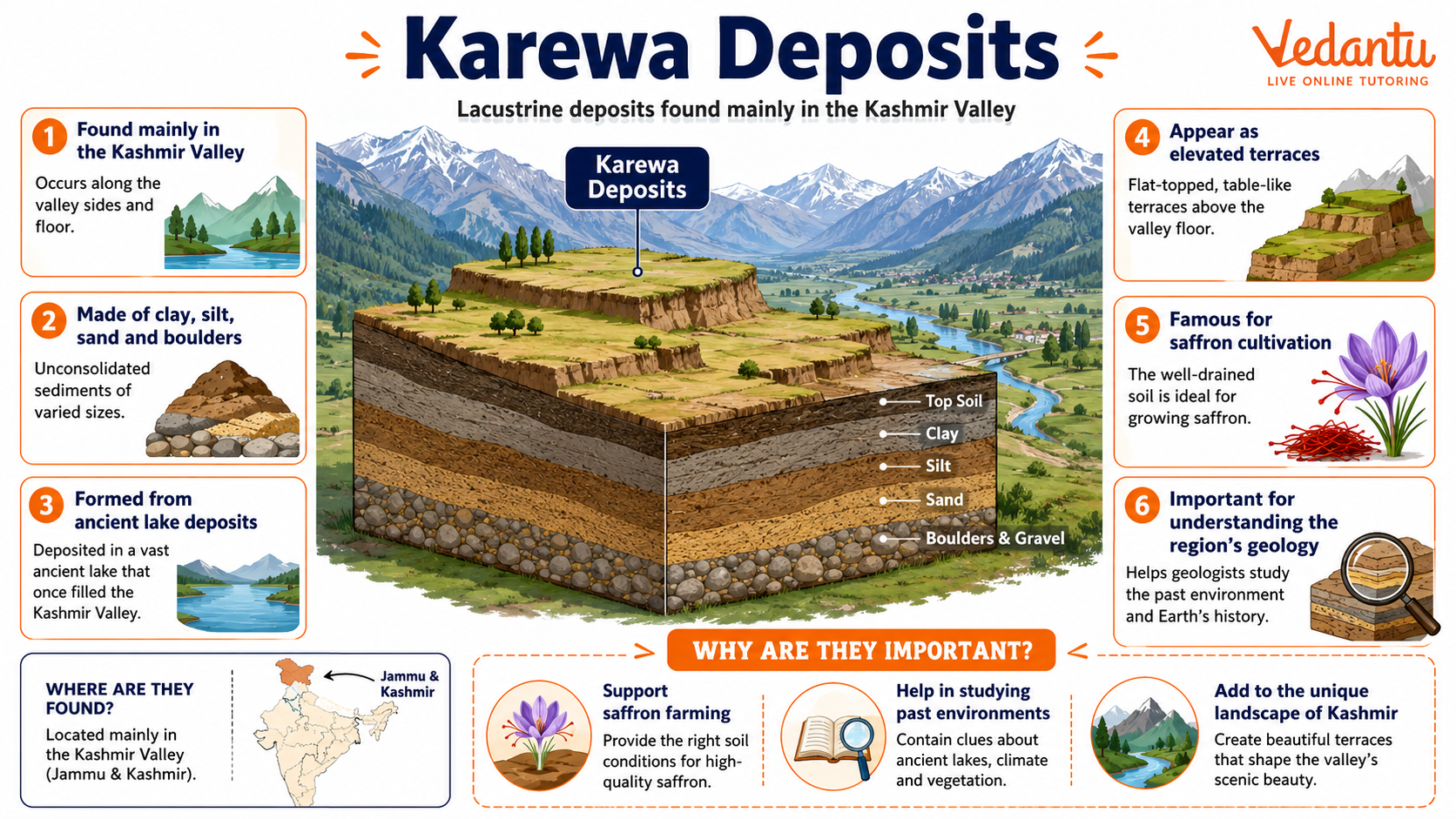
Karewa Deposits are unique geological formations found mainly in the Kashmir Valley of India. These deposits consist of thick layers of lacustrine - lake formed - sediments that were laid down during the Pleistocene epoch. Karewas are significant from geological, agricultural, and economic perspectives because they provide fertile soil for crops like saffron and almonds. Understanding Karewa Deposits is important in Geography and General Knowledge, especially for students preparing for competitive examinations.
What are Karewa Deposits?
Karewa Deposits are flat topped terrace like formations composed of fine clay, silt, sand, and gravel. They were formed due to the deposition of sediments in an ancient lake that once covered the Kashmir Valley. When the lake dried up due to tectonic uplift and drainage changes, these sediments remained behind as elevated plateaus.
- Primarily found in the Kashmir Valley
- Composed of clay, silt, sand, and gravel
- Formed during the Pleistocene epoch
- Appear as elevated table lands or terraces
Formation of Karewa Deposits
The formation of Karewa Deposits is closely linked with the geological history of the Himalayas. During the Pleistocene period, tectonic activities led to the formation of a large lake in the Kashmir Valley. Rivers flowing into the lake deposited fine sediments over thousands of years.
Later, due to uplift of the region and the draining of the lake through the Jhelum River, the water receded. The accumulated sediments were exposed as flat topped terraces, which are now known as Karewas.
- Tectonic uplift formed a closed basin in the Kashmir Valley
- A large lake developed in the basin
- Sediments accumulated at the bottom of the lake
- Drainage of the lake exposed the sediment layers
Types of Karewa Deposits
Karewa Deposits are broadly classified into two types based on their composition and mode of deposition.
1. Lacustrine Karewas
These are formed by fine sediments deposited in the ancient lake. They mainly consist of clay and silt and are very fertile.
2. Fluviatile Karewas
These are formed by river action and contain more sand and gravel compared to lacustrine Karewas.
Distribution of Karewa Deposits
Karewa Deposits are mainly found in the Kashmir Valley, particularly in areas such as Pampore, Pulwama, and Budgam. Pampore Karewas are especially famous for saffron cultivation.
Key Features of Karewa Deposits
| Feature | Description | Significance |
|---|---|---|
| Age | Pleistocene epoch | Helps in understanding geological history |
| Composition | Clay, silt, sand, gravel | Supports agriculture |
| Location | Kashmir Valley | Region specific landform |
The above features make Karewa Deposits important not only in physical geography but also in economic activities like farming and horticulture.
Economic Importance
Karewa soils are highly fertile and well drained, making them ideal for certain crops. The most famous crop grown on Karewas is saffron, particularly in Pampore. Apart from saffron, almonds and walnuts are also cultivated.
- Saffron cultivation in Pampore
- Almond and walnut orchards
- Source of clay for brick making
Importance in Examinations
Karewa Deposits are frequently asked in Geography sections of competitive exams. Questions may focus on their formation, location, or economic significance. Students should remember that Karewas are lake deposits found in the Kashmir Valley and are associated with saffron cultivation.
- Associated with the Kashmir Valley
- Formed during the Pleistocene epoch
- Important for saffron farming
Conclusion
Karewa Deposits are significant geological formations of the Kashmir Valley formed from ancient lake sediments during the Pleistocene period. They are important for understanding regional geology and for their economic value, especially in saffron cultivation. A clear understanding of their formation, characteristics, and importance helps students strengthen their General Knowledge and Geography preparation.
FAQs on Karewa Deposits in the Kashmir Valley Explained Simply
1. What are Karewa Deposits?
Karewa Deposits are thick layers of lacustrine (lake) sediments found in the Kashmir Valley formed during the Pleistocene epoch.
• Composed of clay, silt, sand, and gravel
• Deposited in an ancient lake called the Karewa Lake
• Known for preserving fossils and pollen grains
• Economically important for saffron cultivation
These deposits are frequently asked about in GK, geography, and competitive exams under topics like Himalayan geology and Quaternary sediments.
2. Where are Karewa Deposits located?
Karewa Deposits are mainly found in the Kashmir Valley of Jammu and Kashmir, India.
• Spread across Pampore, Pulwama, and Budgam
• Located between the Pir Panjal and Zanskar ranges
• Form elevated plateaus above river plains
They are an important geographical feature of the northwestern Himalayas and are commonly searched under “location of Karewa deposits” and “Kashmir plateau soils.”
3. How were Karewa Deposits formed?
Karewa Deposits were formed by the sedimentation of materials in an ancient lake during the Pleistocene period.
• Result of tectonic activity in the Himalayas
• Formation of a large lake in the Kashmir basin
• Gradual deposition of fine sediments over thousands of years
• Uplift and drainage of the lake left behind plateau-like deposits
This process relates to glacial periods, tectonic uplift, and lake sedimentation, key topics in physical geography.
4. Why are Karewa Deposits important for agriculture?
Karewa Deposits are highly fertile and especially famous for saffron cultivation.
• Ideal soil for growing saffron (Kesar) in Pampore
• Supports cultivation of almonds and walnuts
• Well-drained and rich in minerals
• Contributes to the regional economy of Kashmir
They are often mentioned in GK under “saffron producing regions of India” and “Kashmir agriculture.”
5. What type of fossils are found in Karewa Deposits?
Karewa Deposits contain plant and animal fossils that help scientists study past climates.
• Fossilized pollen grains
• Remains of mammals
• Evidence of prehistoric vegetation
• Indicators of ancient climatic conditions
These fossils provide insights into paleoclimatology and the environmental history of the Himalayan region.
6. What is the age of Karewa Deposits?
Karewa Deposits date back to the Pleistocene epoch of the Quaternary period.
• Formed around 2.6 million to 11,700 years ago
• Associated with Ice Age conditions
• Linked to glacial and interglacial cycles
They are commonly discussed in geography under Quaternary geology and “Ice Age landforms in India.”
7. What are the two types of Karewa Deposits?
Karewa Deposits are classified into Lower Karewas and Upper Karewas based on composition and formation period.
• Lower Karewas: Fine clay and silt deposits, rich in fossils
• Upper Karewas: Coarser materials like sand and gravel
• Differ in texture and stratigraphic layers
This classification is important in understanding sedimentary layers and stratigraphy in the Kashmir basin.
8. How do Karewa Deposits differ from alluvial deposits?
Karewa Deposits are lake-formed sediments, whereas alluvial deposits are river-formed sediments.
• Karewas: Formed in an ancient lake basin
• Alluvium: Deposited by rivers and floods
• Karewas form elevated plateaus
• Alluvial soils form flat floodplains
This distinction is important in physical geography topics like sedimentation processes and river vs. lacustrine deposits.
9. Why are Karewa Deposits important for competitive exams?
Karewa Deposits are frequently asked in UPSC, SSC, and state-level exams under Indian geography.
• Related to Himalayan geomorphology
• Important for questions on saffron cultivation
• Linked to Pleistocene epoch and Quaternary geology
• Often appear in map-based questions
Understanding Karewas helps in topics like Indian physiography and “geographical features of Jammu and Kashmir.”
10. What is the economic significance of Karewa Deposits?
Karewa Deposits play a vital role in the economy of Kashmir due to agriculture and mineral resources.
• Support high-quality saffron production
• Provide land for horticulture
• Contain useful clay and building materials
• Boost regional trade and employment
They are widely searched under “economic importance of Karewa deposits” and “Kashmir natural resources.”
