






IUCN Red Data Book Categories and Conservation Status Explained
The IUCN Red Data Book, also known as the IUCN Red List of Threatened Species, is a comprehensive global inventory of the conservation status of plant and animal species. It is published by the International Union for Conservation of Nature - IUCN. The Red Data Book plays a crucial role in identifying species at risk of extinction and helps governments, researchers, and conservationists take necessary protective measures. For students and competitive exam aspirants such as NEET candidates, understanding the IUCN Red Data Book is important as it forms a key part of biodiversity and conservation studies.
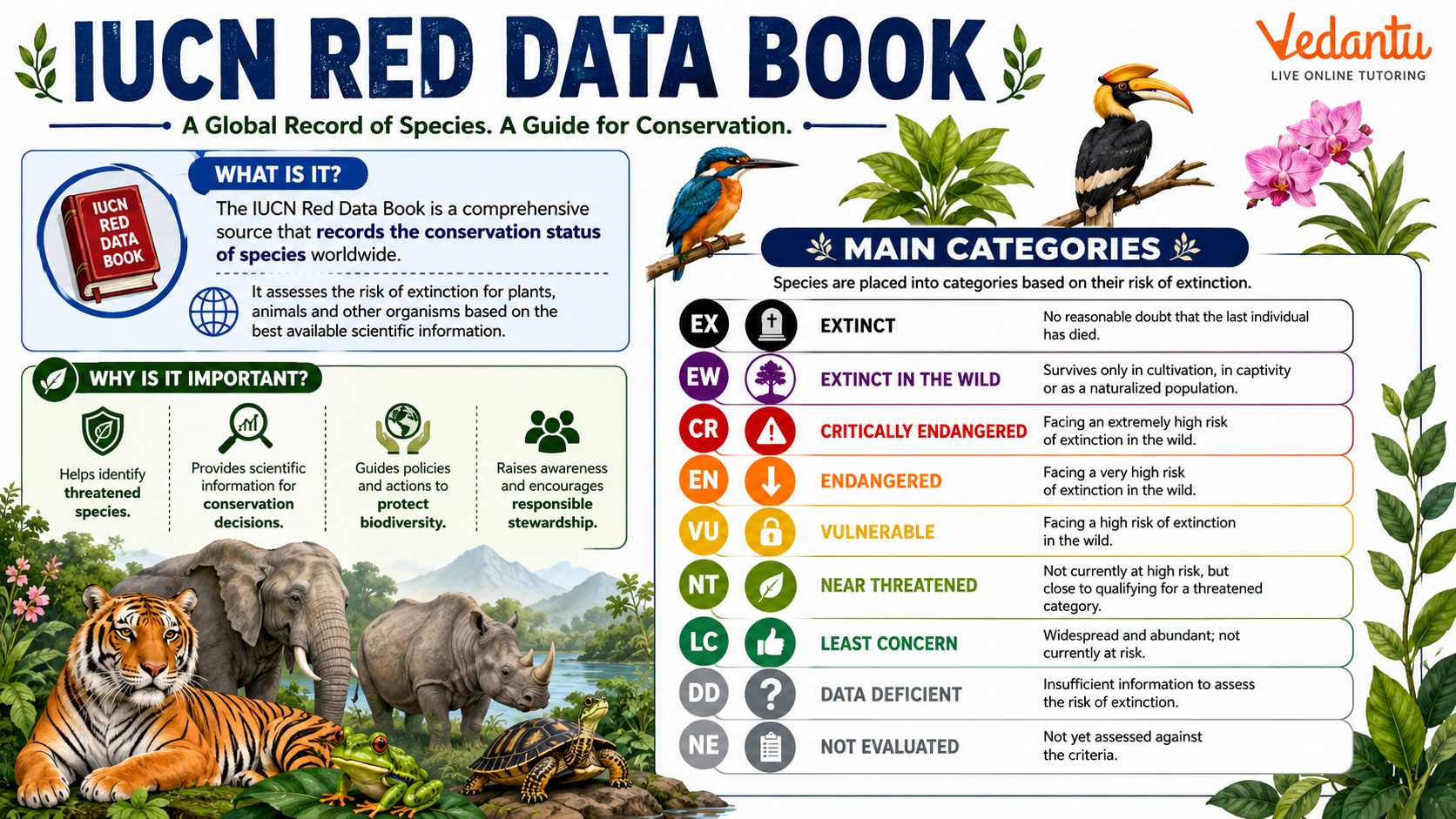
What is the IUCN?
The International Union for Conservation of Nature - IUCN was founded in 1948. It is a global organization that works in the field of nature conservation and sustainable use of natural resources. The headquarters of IUCN is located in Gland, Switzerland.
- Established in 1948
- Headquarters - Gland, Switzerland
- Works on biodiversity conservation and sustainable development
- Maintains the Red Data Book or Red List
What is the IUCN Red Data Book?
The IUCN Red Data Book is a detailed record of the conservation status of various species across the world. It classifies species based on their risk of extinction. The main aim of the Red Data Book is to provide scientifically based information to guide conservation actions and policy decisions.
It includes information about:
- Population size and trends
- Geographic distribution
- Habitat requirements
- Major threats
- Conservation measures in place
IUCN Red List Categories
Species listed in the IUCN Red Data Book are grouped into different categories depending on their level of risk. These categories help in understanding how close a species is to extinction.
Major IUCN Red List Categories
| Category | Abbreviation | Description |
|---|---|---|
| Extinct | EX | No known individuals remaining |
| Extinct in the Wild | EW | Survives only in captivity |
| Critically Endangered | CR | Extremely high risk of extinction |
| Endangered | EN | Very high risk of extinction |
| Vulnerable | VU | High risk of extinction |
| Near Threatened | NT | Likely to become endangered |
| Least Concern | LC | Lowest risk category |
In addition to these categories, there are Data Deficient - DD and Not Evaluated - NE categories for species that lack sufficient data or have not yet been assessed.
Criteria for Classification
The IUCN uses specific scientific criteria to determine the conservation status of a species. These criteria ensure that the assessment is objective and globally consistent.
- Rate of population decline
- Geographic range size
- Total population size
- Degree of population and habitat fragmentation
- Probability of extinction in the wild
Importance of the IUCN Red Data Book
The IUCN Red Data Book is one of the most important tools for global conservation efforts. It provides reliable scientific data that helps in planning and implementing conservation strategies.
- Guides conservation planning and policy making
- Helps identify priority species for protection
- Raises public awareness about threatened species
- Supports environmental impact assessments
- Provides data for academic research and competitive exams
IUCN Red Data Book and India
India, being one of the mega diverse countries, has many species listed in different categories of the IUCN Red List. Examples include the Bengal Tiger - Endangered, Great Indian Bustard - Critically Endangered, and Asiatic Lion - Endangered. The Red Data Book helps Indian authorities design wildlife protection programs and biodiversity conservation policies.
Relevance for NEET and Competitive Exams
For NEET aspirants, the IUCN Red Data Book is an important topic under biodiversity and conservation in Biology. Questions are often asked about Red List categories, examples of species in different categories, and the role of IUCN in conservation.
Preparation Tips
- Memorize the correct order of Red List categories from Extinct to Least Concern.
- Learn examples of Indian species in Critically Endangered, Endangered, and Vulnerable categories.
- Understand the criteria used for classification.
- Revise NCERT content related to biodiversity and conservation.
Conclusion
The IUCN Red Data Book is a vital global document that assesses the conservation status of species and highlights those at risk of extinction. It serves as a scientific foundation for biodiversity conservation efforts worldwide. For students, especially NEET aspirants, a clear understanding of its categories, criteria, and significance is essential for both exams and general environmental awareness.
FAQs on IUCN Red Data Book: Meaning, Purpose and Uses
1. What is the IUCN Red Data Book?
IUCN Red Data Book is a global record that lists threatened and endangered species of plants and animals. It is published by the International Union for Conservation of Nature (IUCN) to assess the conservation status of species worldwide.
• Also known as the IUCN Red List of Threatened Species
• Provides data on extinction risk
• Used by governments, researchers, and environmentalists
• Covers animals, plants, fungi, and other organisms
This book is an important tool for biodiversity conservation and environmental protection.
2. What is the main purpose of the IUCN Red Data Book?
The main purpose of the IUCN Red Data Book is to identify and categorize species based on their risk of extinction. It helps in global conservation planning and policy-making.
• Evaluates species survival status
• Guides wildlife protection laws
• Promotes sustainable development
• Raises awareness about endangered species
It plays a key role in preventing species extinction and protecting global biodiversity.
3. Who publishes the IUCN Red Data Book?
The IUCN Red Data Book is published by the International Union for Conservation of Nature (IUCN), founded in 1948.
• Headquarters: Gland, Switzerland
• An international environmental organization
• Works with governments and NGOs
• Focuses on nature conservation and sustainable resource use
The IUCN is one of the world’s leading authorities on environmental conservation.
4. What are the different categories in the IUCN Red Data Book?
The IUCN Red List categories classify species based on their extinction risk. These categories help scientists understand conservation priorities.
• Extinct (EX)
• Extinct in the Wild (EW)
• Critically Endangered (CR)
• Endangered (EN)
• Vulnerable (VU)
• Near Threatened (NT)
• Least Concern (LC)
• Data Deficient (DD)
These classifications are widely used in GK exams and environmental studies.
5. What does ‘Critically Endangered’ mean in the IUCN Red Data Book?
A species listed as Critically Endangered (CR) faces an extremely high risk of extinction in the wild. It is one step away from being extinct.
• Severe population decline
• Very limited geographic range
• Facing serious threats like habitat loss or poaching
This category highlights urgent need for wildlife conservation efforts.
6. Why is the IUCN Red Data Book important for students and competitive exams?
The IUCN Red Data Book is important for students because it is frequently asked in GK, UPSC, SSC, and state PSC exams.
• Questions on Red List categories
• Facts about endangered species
• Environmental agreements and conservation policies
• Biodiversity and ecology topics
Understanding it strengthens knowledge of environmental studies and current affairs.
7. What is the difference between Extinct and Extinct in the Wild?
The difference between Extinct (EX) and Extinct in the Wild (EW) lies in species survival status.
• Extinct (EX): No living individuals remain anywhere on Earth
• Extinct in the Wild (EW): Survives only in captivity or protected environments
This distinction is crucial in understanding biodiversity loss and conservation strategies.
8. How does a species get listed in the IUCN Red Data Book?
A species is listed in the IUCN Red Data Book after scientific assessment based on strict criteria. Experts evaluate population trends and threats.
• Rate of population decline
• Geographic distribution
• Habitat condition
• Reproductive capacity
• Threat levels like climate change or hunting
The process ensures reliable data for global conservation planning.
9. Is the IUCN Red Data Book legally binding?
The IUCN Red Data Book itself is not legally binding, but it strongly influences environmental laws and policies worldwide.
• Guides national wildlife protection acts
• Supports international treaties like CITES
• Helps in creating protected areas
• Influences conservation funding decisions
It acts as a scientific reference for environmental legislation.
10. What is the difference between the IUCN Red Data Book and CITES?
The IUCN Red Data Book assesses extinction risk, while CITES (Convention on International Trade in Endangered Species) regulates international trade of endangered species.
• IUCN: Scientific assessment and classification
• CITES: Legal framework controlling trade
• IUCN categories guide CITES decisions
Both play a vital role in protecting endangered wildlife and biodiversity.
