






How the Pamban Vertical Lift Railway Sea Bridge Works and Why It Matters
The India’s 1st Vertical Lift Railway Sea Bridge - Pamban is a landmark infrastructure project that connects Rameswaram Island with mainland India in Tamil Nadu. It replaces the old Pamban Railway Bridge, which was India’s first sea bridge built during British rule in 1914. The new bridge is designed with advanced vertical lift technology that allows ships to pass underneath by lifting a central span vertically. This engineering achievement represents India’s growing expertise in modern railway infrastructure and maritime connectivity. The bridge is highly important from geographical, economic, religious, and strategic perspectives, making it a significant topic for General Knowledge and competitive examinations.
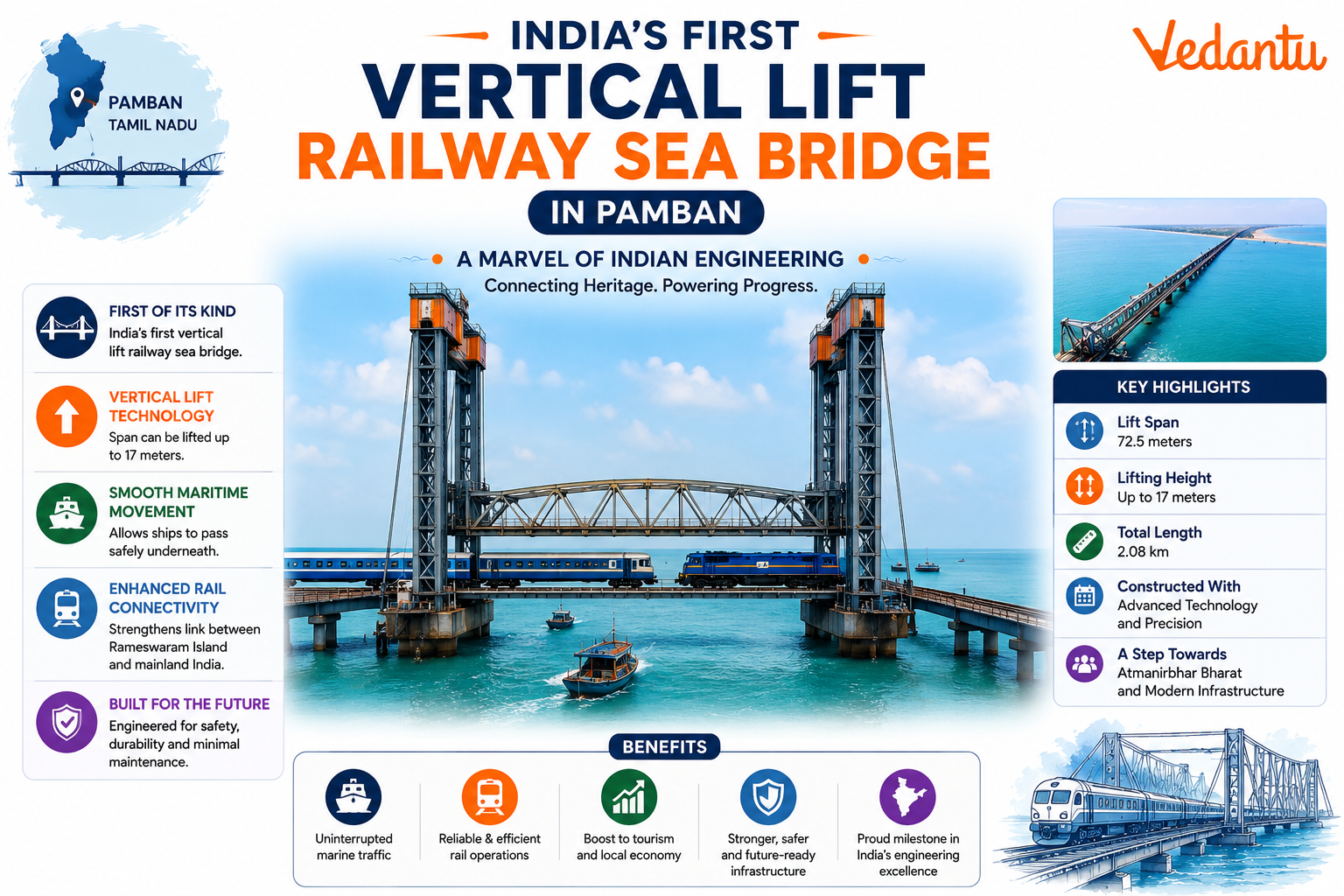
Overview of Pamban Vertical Lift Railway Bridge
The new Pamban Railway Bridge is constructed parallel to the old bridge across the Palk Strait in Tamil Nadu. It connects Mandapam on the mainland to Rameswaram Island. The bridge is designed to improve rail connectivity and ensure smoother and safer movement of trains while allowing uninterrupted maritime traffic.
Key Facts About India’s 1st Vertical Lift Railway Sea Bridge - Pamban
| Feature | Details | Significance |
|---|---|---|
| Location | Tamil Nadu - Between Mandapam and Rameswaram | Connects mainland to island |
| Total Length | Approx. 2.07 km | Long sea railway bridge |
| Vertical Lift Span | 63 meters | Allows ships to pass |
| Constructed By | Rail Vikas Nigam Limited - RVNL | Modern railway engineering |
| Type | Vertical Lift Railway Bridge | First of its kind in India |
The bridge is a technologically advanced structure designed to withstand harsh marine conditions, high wind speeds, and corrosion due to saltwater exposure.
What is a Vertical Lift Bridge?
A vertical lift bridge is a type of movable bridge in which a central span can be lifted vertically using a system of counterweights and motors. This mechanism allows large ships and vessels to pass beneath without disturbing rail or road alignment permanently.
Working Mechanism
- The central span remains at normal track level for train movement.
- When a ship approaches, railway traffic is halted temporarily.
- The span is lifted vertically up to a required height.
- After the ship passes, the span is lowered back to its original position.
Historical Background
The original Pamban Railway Bridge was inaugurated in 1914 and served for more than a century. It was India’s first sea bridge and used a manually operated double leaf bascule section to allow ships to pass. Due to aging structure and safety concerns, Indian Railways decided to construct a modern replacement with advanced technology.
- Old bridge operational since 1914
- Suffered damage during cyclones, including the 1964 Rameswaram cyclone
- Replaced to enhance safety and durability
Engineering Features of the New Bridge
The new Pamban Bridge incorporates modern construction techniques and materials to improve durability and efficiency.
- Stainless steel reinforcement to prevent corrosion
- Automated vertical lifting system
- Electrified railway track support
- Designed to withstand high wind speeds and seismic forces
- Higher navigation clearance for larger vessels
Importance of Pamban Vertical Lift Bridge
1. Economic Importance
The bridge improves connectivity to Rameswaram, a major pilgrimage and tourist destination. It supports local businesses, fishing activities, and regional trade.
2. Religious and Cultural Importance
Rameswaram is one of the Char Dham pilgrimage sites in Hinduism. Better railway connectivity ensures easier access for millions of devotees every year.
3. Strategic Importance
The bridge lies close to India’s southern coastline near Sri Lanka. Improved infrastructure enhances coastal connectivity and strategic movement capability.
4. Technological Advancement
It showcases India’s capability in designing and executing complex marine infrastructure projects with modern automation systems.
Comparison - Old vs New Pamban Bridge
Old and New Pamban Bridge Comparison
| Feature | Old Bridge - 1914 | New Bridge - Vertical Lift |
|---|---|---|
| Technology | Manual Bascule | Automated Vertical Lift |
| Durability | Century old structure | Modern corrosion resistant design |
| Navigation Clearance | Limited | Higher clearance |
The new bridge offers better safety, improved operational efficiency, and reduced maintenance compared to the old structure.
Why This Topic is Important for GK and Competitive Exams
- Frequently asked in current affairs and infrastructure related questions
- Important for exams like UPSC, SSC, Railways, Banking, and State PSC
- Relevant under topics such as Indian Geography and Infrastructure Development
- Highlights India’s technological progress in marine engineering
Conclusion
India’s 1st Vertical Lift Railway Sea Bridge - Pamban is a remarkable example of modern engineering combined with strategic planning. Replacing the historic 1914 bridge, the new structure enhances safety, efficiency, and connectivity while preserving the legacy of the original Pamban Bridge. It strengthens economic activity, supports religious tourism, and showcases India’s capability in advanced infrastructure development. For students and competitive exam aspirants, understanding its features, significance, and technological aspects is essential for strong General Knowledge preparation.
FAQs on India’s First Vertical Lift Railway Sea Bridge in Pamban: Complete Guide for Students
1. What is India’s 1st Vertical Lift Railway Sea Bridge – Pamban Bridge?
India’s 1st Vertical Lift Railway Sea Bridge is the new Pamban Bridge built across the Palk Strait in Tamil Nadu. It connects Rameswaram Island to mainland India and replaces the old 1914 bridge.
- Features a vertical lift span that moves upward to allow ships to pass
- Located between Mandapam and Rameswaram
- Developed by Indian Railways
- A major example of modern railway sea bridge engineering in India
2. Where is the new Pamban Bridge located?
The new Pamban Railway Bridge is located in Tamil Nadu, connecting Rameswaram Island to the mainland at Mandapam across the Palk Strait.
- Situated near the holy town of Rameswaram
- Part of the Southern Railway zone
- Important for pilgrimage and tourism
- Frequently asked in competitive exams under Indian geography and infrastructure topics
3. What is special about the vertical lift technology used in the Pamban Bridge?
The bridge uses vertical lift technology, allowing its central span to rise vertically for ship movement.
- The lift span can move upward to provide navigation clearance
- Operated using an electro-mechanical system
- Stronger and more durable than the old cantilever structure
- Represents modern movable bridge engineering in India
4. When was the original Pamban Bridge built?
The original Pamban Bridge was inaugurated in 1914 during British rule.
- India’s first sea bridge at that time
- Featured a Scherzer rolling lift span
- Served for over 100 years
- Played a key role in rail connectivity to Rameswaram
5. Why was the new Pamban Bridge constructed?
The new bridge was constructed to replace the aging 1914 structure and improve safety and capacity.
- Old bridge suffered corrosion due to sea conditions
- Needed higher speed and heavier train capacity
- Enhanced maritime navigation clearance
- Strengthens coastal infrastructure development in India
6. What is the length of the new Pamban Railway Bridge?
The new Pamban Bridge is approximately 2.07 kilometers long.
- Includes multiple spans across the sea
- Central vertical lift span is about 72.5 meters
- Designed for long-term durability in marine conditions
- Important fact for GK and railway engineering exams
7. How does the Pamban Bridge benefit tourism and pilgrims?
The bridge improves access to Rameswaram, a major Hindu pilgrimage site.
- Facilitates travel to Ramanathaswamy Temple
- Boosts tourism and local economy
- Provides safer and faster railway connectivity
- Enhances regional development in Tamil Nadu
8. Who developed and constructed the new Pamban Bridge?
The new bridge was developed by Indian Railways with support from modern engineering agencies.
- Executed under the Ministry of Railways
- Built using advanced corrosion-resistant materials
- Showcases India’s growing expertise in marine infrastructure
- Often asked in current affairs and infrastructure-related GK questions
9. What are the key features of India’s first vertical lift sea bridge?
The new Pamban Bridge includes several modern engineering features.
- Vertical lift span for ship passage
- High-strength stainless steel reinforcement
- Automated control systems
- Designed for higher train speeds compared to the old bridge
- Improved resilience against cyclones and harsh sea weather
10. Why is the Pamban Bridge important for competitive exams and GK?
The Pamban Vertical Lift Railway Sea Bridge is important for exams due to its engineering and historical significance.
- India’s first vertical lift railway sea bridge
- Located in Tamil Nadu across the Palk Strait
- Replaced the 1914 colonial-era bridge
- Frequently asked in UPSC, SSC, Railways, and State PSC exams under current affairs and infrastructure topics
