






How Per Capita Income Varies Across Indian States and Why It Matters
Per Capita Income of Indian States is an important economic indicator that shows the average income earned per person in a particular state during a specific year. It helps in comparing the economic performance, living standards, and development levels across different states and Union Territories of India. For students, competitive exam aspirants, and general readers, understanding per capita income is essential for topics related to Indian Economy, Economic Development, and regional disparities.
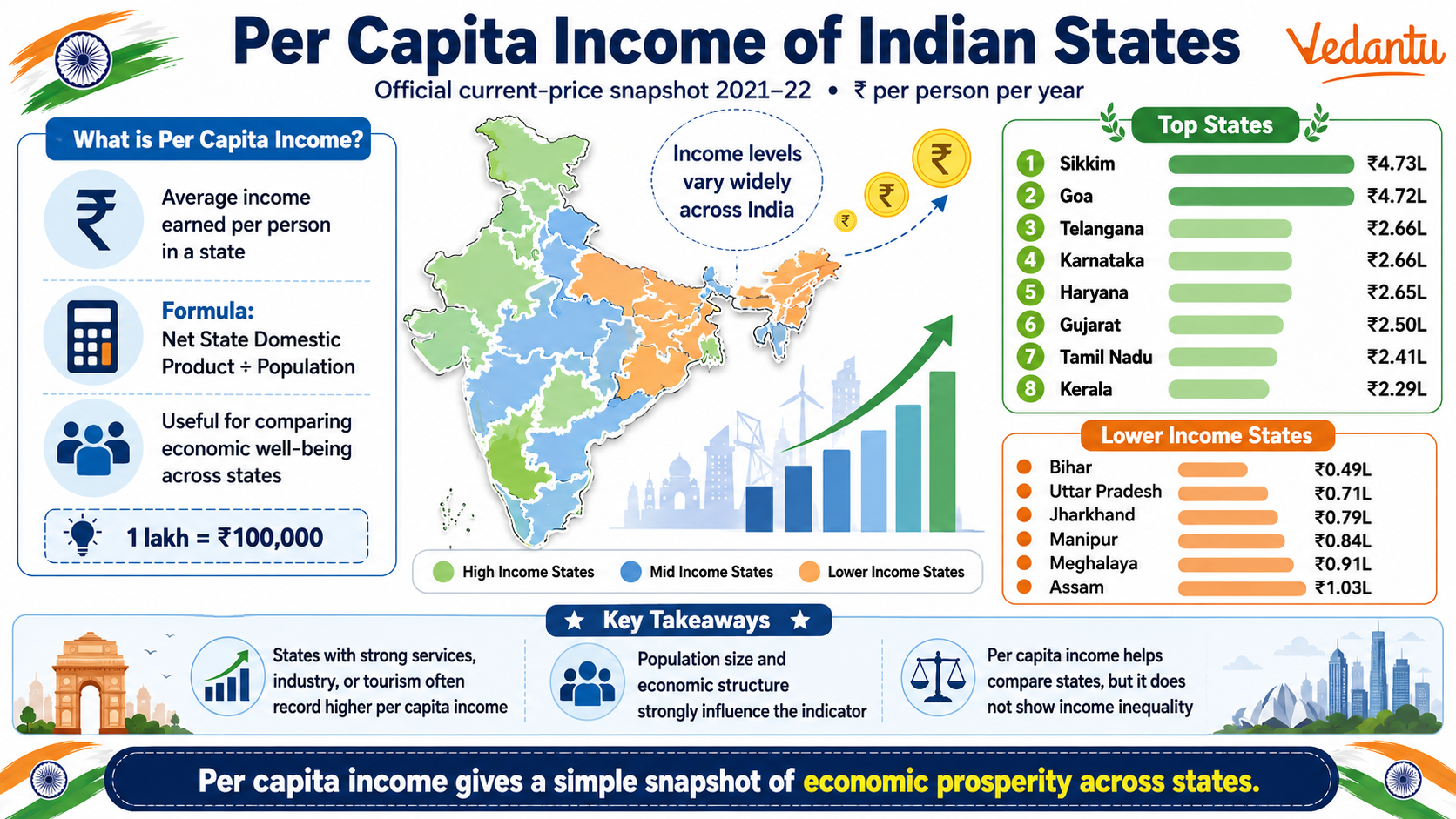
What is Per Capita Income?
Per Capita Income refers to the average income earned per person in a region in a given financial year. It is calculated by dividing the Net State Domestic Product (NSDP) of a state by its total population. It is usually expressed at current prices and constant prices.
Formula for Per Capita Income
Per Capita Income = Net State Domestic Product of the State ÷ Total Population of the State
- Net State Domestic Product represents the total value of goods and services produced in a state.
- Population refers to the total number of people residing in that state.
- It is measured annually by the Ministry of Statistics and Programme Implementation.
Importance of Per Capita Income of Indian States
Per capita income is widely used to measure economic development and compare the standard of living among states. It also helps policymakers design welfare schemes and allocate resources effectively.
- Helps compare economic performance between states.
- Indicates standard of living of people in a state.
- Assists in identifying economically backward regions.
- Useful for competitive exams like UPSC, SSC, State PSC, and other GK tests.
Per Capita Income of Major Indian States
Top and Bottom States by Per Capita Income (Approximate Recent Data)
| State | Per Capita Income (Rs per year) | Category |
|---|---|---|
| Sikkim | Highest - Above 5,00,000 | High Income State |
| Goa | Above 4,50,000 | High Income State |
| Bihar | Below 60,000 | Low Income State |
| Uttar Pradesh | Below 90,000 | Low Income State |
States like Sikkim and Goa have consistently recorded high per capita incomes due to smaller populations and strong sectors such as tourism, services, and hydropower. On the other hand, states like Bihar and Uttar Pradesh have lower per capita income due to high population, lower industrialization, and limited infrastructure development.
Factors Affecting Per Capita Income of States
Several economic and social factors influence the per capita income of Indian states. These factors determine the overall productivity and income generation capacity of a region.
- Level of industrialization and urbanization.
- Availability of natural resources.
- Quality of education and skilled workforce.
- Infrastructure such as roads, electricity, and ports.
- Population growth rate.
- Government policies and investment climate.
Current Price vs Constant Price
Per capita income is measured in two ways to understand real economic growth.
1. At Current Prices
This includes the effect of inflation and shows the income calculated using current market prices of goods and services.
2. At Constant Prices
This removes the effect of inflation and reflects the real growth in income over time.
Regional Disparities in India
There is a significant gap between high income and low income states in India. Western and Southern states such as Maharashtra, Gujarat, Tamil Nadu, and Karnataka generally perform better compared to many Northern and Eastern states. These disparities highlight the uneven economic development across the country.
- Southern and Western states show higher industrial growth.
- Eastern states face challenges like poverty and lower infrastructure.
- Special category states may have unique geographical advantages or constraints.
Comparison with National Average
The national per capita income of India acts as a benchmark to evaluate state performance. States with income above the national average are considered relatively more developed, while those below it require focused economic policies and investment.
Understanding this comparison is crucial for analyzing development patterns, poverty levels, and employment opportunities across India.
Key Points for Exams and GK Preparation
- Sikkim and Goa are among the highest per capita income states.
- Bihar often ranks lowest in per capita income.
- Per capita income is calculated using NSDP and population.
- Used as an indicator of standard of living and development.
- Measured at both current and constant prices.
Conclusion
Per Capita Income of Indian States is a vital indicator of economic development and regional prosperity. It helps in understanding disparities between states, assessing living standards, and guiding policy decisions. For students and competitive exam aspirants, it is an important topic in Indian Economy and General Knowledge. A clear understanding of this concept enables better analysis of India's growth story and regional economic differences.
FAQs on Per Capita Income of Indian States Explained for Students
1. What is Per Capita Income of Indian States?
Per Capita Income (PCI) of Indian states is the average income earned per person in a state in a financial year.
It is calculated as:
• State’s Net Domestic Product (NSDP) ÷ Total Population
It helps measure:
• Standard of living
• Economic development
• Income distribution across states
It is also referred to as average income per person, state income per head, or income per capita.
2. How is Per Capita Income calculated in India?
Per Capita Income in India is calculated by dividing the Net State Domestic Product (NSDP) by the total population of the state.
Formula:
• PCI = NSDP ÷ Population
Key points:
• NSDP is calculated at current prices and constant prices
• Data is released by the Ministry of Statistics and Programme Implementation (MOSPI)
This method helps compare the economic performance of Indian states.
3. Which Indian state has the highest per capita income?
Goa generally has the highest per capita income among Indian states.
Reasons include:
• Strong tourism industry
• High service sector contribution
• Smaller population size
Among Union Territories, Delhi often records very high per capita income. This is frequently asked in GK and competitive exams.
4. Which Indian state has the lowest per capita income?
Bihar generally records the lowest per capita income in India.
Main reasons:
• High population density
• Low industrial development
• Dependence on agriculture
Other low PCI states often include Uttar Pradesh and Madhya Pradesh. These states face challenges in economic growth and income generation.
5. Why is per capita income important for comparing Indian states?
Per Capita Income is important because it reflects the average earning and economic condition of people in a state.
It helps in:
• Comparing economic development levels
• Understanding standard of living
• Framing government policies and schemes
However, it does not show income inequality or poverty distribution fully.
6. What is the difference between Per Capita Income and National Income?
National Income is the total income earned by a country, while Per Capita Income is the average income per person.
Key differences:
• National Income = Total income of the country
• Per Capita Income = National Income ÷ Population
PCI gives a clearer picture of individual prosperity and is widely used in economic comparisons.
7. What is the difference between current price and constant price per capita income?
Current price PCI is calculated using present market prices, while constant price PCI removes the effect of inflation.
Differences:
• Current Price: Includes inflation
• Constant Price: Reflects real growth
Economists prefer constant price data to measure real economic growth of Indian states.
8. How does population affect per capita income of a state?
Population size directly affects Per Capita Income because PCI is calculated by dividing income by population.
If population increases:
• PCI may decrease if income growth is slow
If population is controlled:
• PCI may increase faster
States like Goa benefit from smaller populations, while densely populated states like Bihar face challenges.
9. Which sectors contribute most to high per capita income in Indian states?
The service and industrial sectors contribute most to high per capita income in Indian states.
Main contributing sectors:
• Information Technology (IT)
• Tourism
• Manufacturing industries
• Financial services
States with strong service sectors like Karnataka and Maharashtra show higher income levels.
10. Is per capita income a perfect measure of development?
No, Per Capita Income is not a perfect measure of development because it does not reflect income inequality or quality of life fully.
Limitations include:
• Ignores income distribution
• Does not measure poverty levels
• Excludes health and education indicators
Therefore, indicators like the Human Development Index (HDI) are also used to assess overall development.
