






List of Famous Indian Leaders and the Autobiographies They Wrote
Indian Personalities and Their Autobiographies is an important topic in General Knowledge that frequently appears in competitive exams, school quizzes, and interviews. Autobiographies provide first-hand accounts of a person’s life, struggles, achievements, and thoughts. They help readers understand historical events, political movements, social reforms, and cultural developments from the perspective of the individuals who shaped them. For students and exam aspirants, knowing famous Indian personalities and the names of their autobiographies is essential for quick recall and scoring well in objective examinations.
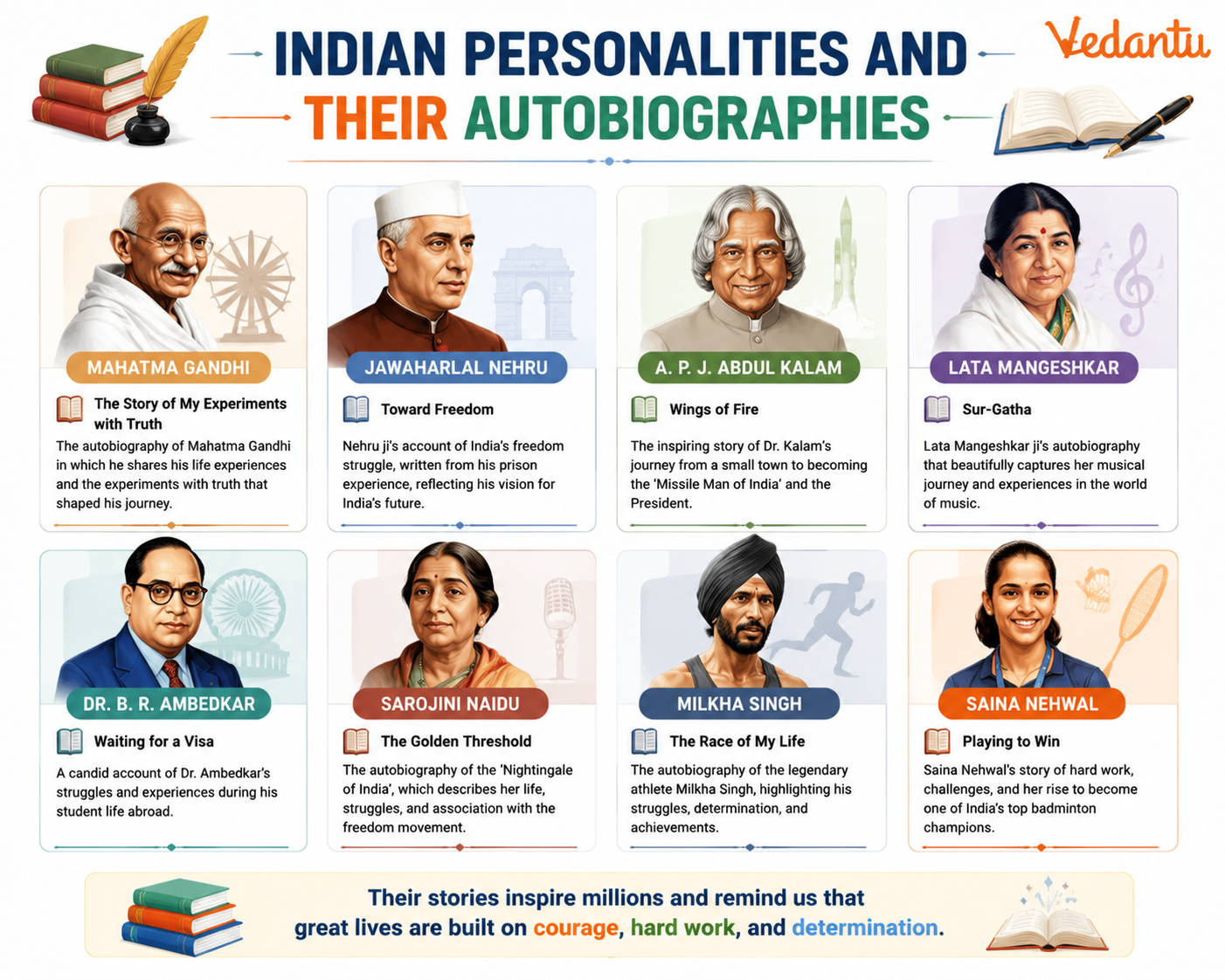
What is an Autobiography?
An autobiography is a self-written account of one’s own life. Unlike a biography, which is written by someone else, an autobiography reflects the personal experiences, emotions, and viewpoints of the author. Many Indian leaders, freedom fighters, scientists, sportspersons, and artists have written autobiographies that provide valuable insights into their journeys and contributions.
- Written by the person about their own life
- Based on real experiences and events
- Provides historical and social context
- Important source for understanding leadership and values
List of Indian Personalities and Their Autobiographies
| Personality | Autobiography | Field |
|---|---|---|
| Mahatma Gandhi | The Story of My Experiments with Truth | Freedom Fighter |
| Jawaharlal Nehru | An Autobiography | Politics |
| Dr. B. R. Ambedkar | Waiting for a Visa | Social Reformer |
| A. P. J. Abdul Kalam | Wings of Fire | Scientist |
| Sachin Tendulkar | Playing It My Way | Sports |
| Lata Mangeshkar | In Her Own Voice | Music |
| Milkha Singh | The Race of My Life | Athletics |
| Narendra Modi | Exam Warriors | Politics |
The above table includes well-known Indian personalities from various fields such as politics, science, sports, and arts. Their autobiographies not only narrate personal achievements but also reflect the socio-political conditions of their times.
Autobiographies of Indian Freedom Fighters
Many leaders of the Indian freedom movement documented their struggles and ideologies in autobiographical works. These books are significant for understanding India’s independence movement.
- Mahatma Gandhi - The Story of My Experiments with Truth
- Jawaharlal Nehru - An Autobiography
- Subhas Chandra Bose - An Indian Pilgrim
- Rajendra Prasad - Atmakatha
Autobiographies of Indian Scientists and Leaders
Indian scientists and national leaders have also shared their inspiring journeys through autobiographies. These works motivate students and provide insight into innovation, perseverance, and leadership.
- A. P. J. Abdul Kalam - Wings of Fire
- Verghese Kurien - I Too Had a Dream
- Homi J. Bhabha - Selected writings and speeches
Autobiographies of Indian Sportspersons
Sportspersons often share their personal and professional struggles, discipline, and achievements through autobiographies. These books highlight dedication, teamwork, and national pride.
- Sachin Tendulkar - Playing It My Way
- Milkha Singh - The Race of My Life
- P. V. Sindhu - Shuttler's Flick
- Saina Nehwal - Playing to Win
Why This Topic is Important for Competitive Exams
Questions about Indian personalities and their autobiographies are commonly asked in competitive exams such as UPSC, SSC, Banking, Railways, and state-level exams. They may appear in matching type questions, one word answers, or multiple choice questions.
- Direct questions about book titles
- Match the following type questions
- Questions related to freedom movement and reforms
- Current affairs based on newly released autobiographies
Preparation Tips
To prepare this topic effectively, students should focus on memorizing key personalities and their famous works. Creating short notes and revision tables can help in quick recall during exams.
- Make a list of important personalities from different fields
- Revise book titles regularly
- Practice previous year question papers
- Stay updated with recent autobiographical releases
Conclusion
Indian Personalities and Their Autobiographies is a significant General Knowledge topic that connects literature, history, politics, science, and sports. These autobiographies offer inspiration and a deeper understanding of India’s development through the lives of its remarkable individuals. For students and competitive exam aspirants, mastering this topic ensures better performance in objective exams and enriches overall knowledge.
FAQs on Indian Personalities & Their Autobiographies – Complete Guide for Students
1. What are some famous Indian personalities and their autobiographies?
Several Indian personalities have written influential autobiographies that reflect their life journeys and contributions to India.
• Mahatma Gandhi – The Story of My Experiments with Truth
• Jawaharlal Nehru – An Autobiography (also known as Toward Freedom)
• Dr. A.P.J. Abdul Kalam – Wings of Fire
• Nelson Mandela (Indian origin influence context often searched, but South African leader) – Long Walk to Freedom (People also search comparison)
• Milkha Singh – The Race of My Life
• L.K. Advani – My Country My Life
These books are important for General Knowledge (GK), competitive exams, and understanding Indian history.
2. Who wrote 'The Story of My Experiments with Truth'?
The Story of My Experiments with Truth was written by Mahatma Gandhi and is one of the most famous Indian autobiographies.
• Originally written in Gujarati
• Covers his childhood, education, and freedom struggle
• Explains his philosophy of Truth (Satya) and Non-violence (Ahimsa)
• Frequently asked in GK questions and UPSC exams
This book provides deep insights into India's freedom movement.
3. Which autobiography is written by Dr. A.P.J. Abdul Kalam?
Wings of Fire is the autobiography of Dr. A.P.J. Abdul Kalam, the “Missile Man of India.”
• Co-authored with Arun Tiwari
• Describes his journey from Rameswaram to Rashtrapati Bhavan
• Highlights India's space and missile programs
• Popular among students and competitive exam aspirants
This inspirational book motivates youth to pursue science, leadership, and national service.
4. What is the autobiography of Jawaharlal Nehru?
Jawaharlal Nehru wrote his autobiography titled An Autobiography in 1936.
• Also known as Toward Freedom
• Written during his imprisonment
• Describes the Indian National Congress and freedom struggle
• Important for understanding modern Indian political history
This book is frequently included in Indian GK and history exams.
5. Why are autobiographies of Indian leaders important for GK exams?
Autobiographies of Indian leaders are important because they provide authentic historical insights and are commonly asked in competitive exams.
• Frequently asked in UPSC, SSC, Railways, and State PSC
• Help understand India's freedom movement and political history
• Improve knowledge of famous books and authors
• Strengthen static GK preparation
These books connect literature with Indian history and personality-based questions.
6. Who wrote 'The Race of My Life'?
The Race of My Life is the autobiography of legendary athlete Milkha Singh.
• Co-written with his daughter Sonia Sanwalka
• Narrates his journey from Partition survivor to Olympic athlete
• Inspired the Bollywood film Bhaag Milkha Bhaag
• Important sports-related GK question
This autobiography highlights resilience, determination, and India's sports history.
7. What is the autobiography of L.K. Advani?
Lal Krishna Advani wrote his autobiography titled My Country My Life.
• Published in 2008
• Covers his political career and role in BJP
• Discusses key events in Indian politics
• Relevant for modern political GK
This book provides insight into post-independence Indian political developments.
8. What is the autobiography of Indira Gandhi?
Indira Gandhi did not write a full traditional autobiography, but her life is documented in several biographical works and speeches.
• Known for letters compiled in Letters to an American Friend
• Her life events are recorded in biographies by various authors
• Important figure in Indian political history
Students often confuse biographies with autobiographies in GK exams, so clarity is important.
9. What is the difference between an autobiography and a biography?
The main difference is that an autobiography is written by the person themselves, while a biography is written by someone else.
• Autobiography: Self-written life story (e.g., Wings of Fire)
• Biography: Written by another author (e.g., books on Subhas Chandra Bose)
• Common confusion in GK and English exams
Understanding this difference helps in literature and competitive exam preparation.
10. Which Indian freedom fighters wrote autobiographies?
Several Indian freedom fighters wrote autobiographies that document the struggle for independence.
• Mahatma Gandhi – The Story of My Experiments with Truth
• Jawaharlal Nehru – An Autobiography
• Subhas Chandra Bose – The Indian Struggle (semi-autobiographical)
• Rajendra Prasad – Autobiography
These works are valuable for understanding the Indian freedom movement and are frequently asked in GK quizzes.
