






What Were the Main Provisions of the Indian Councils Act of 1861?
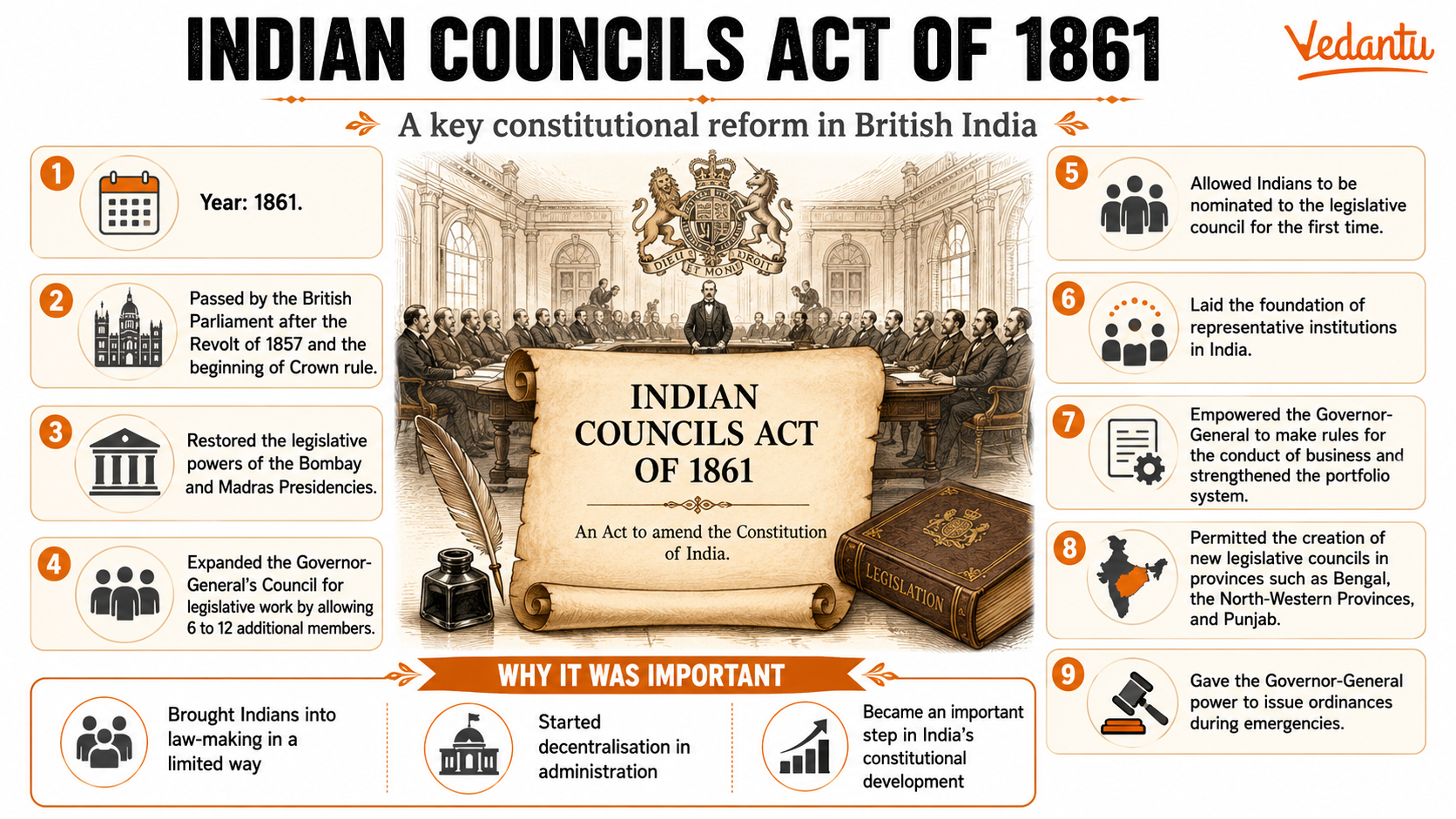
The Indian Council Act of 1861 was an important constitutional development in British India. Enacted after the Revolt of 1857, this Act marked the beginning of representative institutions in India. It aimed to strengthen British administration and include Indians in the legislative process on a limited scale. The Act restored the legislative powers of provinces and introduced the portfolio system, laying the foundation for future constitutional reforms in India. It is an important topic for students preparing for competitive exams and studying Modern Indian History.
Background of the Indian Council Act of 1861
The Revolt of 1857 exposed serious weaknesses in the British administrative system in India. In response, the British Parliament passed the Government of India Act of 1858, transferring power from the East India Company to the British Crown. However, further reforms were needed to involve Indians in governance and improve administrative efficiency. This led to the passing of the Indian Council Act of 1861.
- To associate Indians with the legislative process.
- To decentralize administrative powers.
- To strengthen the executive council of the Governor General.
- To prevent future rebellions by involving Indian elites in governance.
Main Features of the Indian Council Act of 1861
1. Expansion of the Governor General’s Executive Council
The Act increased the number of members in the Executive Council. It also introduced the portfolio system, under which each member was assigned a specific department such as finance, law, or home affairs.
2. Introduction of Legislative Councils
The Act provided for the inclusion of additional members for legislative purposes. These members could be Indians, but they had no real power and were mostly nominated.
3. Beginning of Representative Institutions
For the first time, Indians were nominated to the legislative councils. Notable Indians like Raja of Benaras, Maharaja of Patiala, and Sir Dinkar Rao were appointed.
4. Restoration of Legislative Powers to Provinces
The Act restored legislative powers to the Bombay and Madras Presidencies. This marked the beginning of decentralization in British India.
5. Ordinance Making Power
The Governor General was given the power to issue ordinances during emergencies. These ordinances were valid for six months.
Key Provisions of the Indian Council Act of 1861
| Provision | Description | Significance |
|---|---|---|
| Portfolio System | Departments assigned to council members | Improved administrative efficiency |
| Indian Representation | Indians nominated to legislative council | Beginning of representative governance |
| Provincial Powers | Legislative powers restored to provinces | Start of decentralization |
The table above summarizes the most important provisions of the Act and their impact on British Indian administration.
Significance of the Indian Council Act of 1861
The Indian Council Act of 1861 was a turning point in the constitutional history of India. Although it did not grant real power to Indians, it marked the beginning of their participation in governance.
- Laid the foundation of legislative institutions in India.
- Introduced decentralization in administration.
- Established the portfolio system which continues in modern governance.
- Opened the door for future reforms such as the Indian Council Acts of 1892 and 1909.
Limitations of the Indian Council Act of 1861
Despite its importance, the Act had several limitations. It mainly aimed to strengthen British control rather than empower Indians.
- Indians were nominated, not elected.
- Legislative councils had limited powers.
- Governor General could override council decisions.
- No financial control was given to Indian members.
Comparison with Previous System
Before 1861
- Centralized administration under the Governor General.
- No Indian representation in legislative process.
- Limited provincial powers.
After 1861
- Indians included in legislative councils.
- Legislative powers restored to provinces.
- Portfolio system introduced.
Conclusion
The Indian Council Act of 1861 was an important milestone in the constitutional development of India. It marked the beginning of limited Indian participation in governance and introduced decentralization and administrative reforms. Although it did not provide real democratic rights, it laid the groundwork for future constitutional changes. Understanding this Act is essential for grasping the evolution of legislative institutions in India and the gradual growth of representative government under British rule.
FAQs on Indian Councils Act 1861: Background, Features and Impact
1. What was the Indian Council Act of 1861?
The Indian Council Act of 1861 was a British parliamentary law that restructured the Governor-General’s Council and introduced limited legislative powers in India. • Enacted in 1861 during the rule of Lord Canning • Marked the beginning of legislative decentralization in British India • Allowed Indians to be nominated to the legislative council • Considered a key step in the evolution of constitutional development in India and colonial governance reforms.
2. What were the main features of the Indian Council Act 1861?
The main features of the Indian Council Act 1861 included expansion of councils and decentralization of powers. • Introduced a Legislative Council with nominated members • Allowed the Governor-General to nominate Indians as non-official members • Restored legislative powers to Bombay and Madras Presidencies • Introduced the portfolio system • Empowered the Governor-General to issue ordinances in emergencies.
3. Why was the Indian Council Act of 1861 passed?
The Indian Council Act of 1861 was passed to improve administration after the Revolt of 1857 and to include Indians in governance. • Aimed to gain support of Indian elites after the 1857 Revolt • Strengthened British control through limited participation • Introduced administrative reforms under the British Crown rule • Marked a shift from company rule to structured colonial administration.
4. Who introduced the Indian Council Act of 1861?
The Indian Council Act 1861 was introduced by the British Parliament during the tenure of Lord Canning, the first Viceroy of India. • Enacted under the authority of the British Crown • Followed the Government of India Act 1858 • Reflected British policy of cautious political inclusion • Designed to stabilize colonial rule in India.
5. What is the significance of the Indian Council Act 1861 in Indian history?
The Indian Council Act 1861 is significant as it marked the beginning of representative institutions in India. • First time Indians were associated with law-making processes • Laid foundation for future acts like Indian Council Act 1892 and Morley-Minto Reforms 1909 • Introduced decentralization in administration • Important milestone in the growth of Indian constitutional history and legislative reforms.
6. What was the portfolio system introduced under the Indian Council Act 1861?
The portfolio system under the Indian Council Act 1861 allocated specific departments to council members for efficient governance. • Introduced by Lord Canning • Each member handled a specific department like finance, military, or law • Improved administrative efficiency • Became the basis of the modern cabinet system in India.
7. How did the Indian Council Act 1861 promote decentralization?
The Indian Council Act 1861 promoted decentralization by restoring legislative powers to provinces. • Reinstated powers to Bombay and Madras • Allowed creation of new legislative councils in provinces • Reduced excessive centralization under the Governor-General • Encouraged local governance within the framework of British Indian administration.
8. Did the Indian Council Act 1861 allow Indian representation?
Yes, the Indian Council Act 1861 allowed limited Indian representation through nomination. • Indians could be nominated as non-official members • Example: Raja of Benaras and Maharaja of Patiala were nominated • Members had limited powers and could not control the executive • Marked the early stage of Indian participation in governance.
9. What were the limitations of the Indian Council Act 1861?
The Indian Council Act 1861 had several limitations despite introducing reforms. • No real power to Indian members • No system of elections (only nominations) • Governor-General retained veto and ordinance powers • Legislative councils had advisory roles only • Did not establish responsible government in British India.
10. How is the Indian Council Act 1861 different from the Indian Council Act 1892?
The Indian Council Act 1861 introduced nominated representation, while the Indian Council Act 1892 expanded participation. • 1861 Act allowed only nominated members • 1892 Act introduced indirect elections • 1892 increased discussion on budget matters • 1861 focused on decentralization; 1892 focused on broader legislative participation • Both acts were stages in India’s constitutional and political reforms.
