






Types of Amendments to the Indian Constitution and Article 368 Explained
The Indian Constitution Amendments form a vital part of Indian Polity and are frequently asked in competitive examinations. The Constitution of India is neither completely rigid nor completely flexible. It provides a well-defined procedure for making changes in order to meet the changing needs of society, governance, and democracy. Since its adoption in 1950, the Constitution has been amended several times to address political, social, economic, and administrative developments. Understanding Constitutional Amendments is essential for students, civil services aspirants, and anyone interested in Indian governance.
Meaning of Constitutional Amendment
A Constitutional Amendment refers to a formal change or modification made to the provisions of the Constitution of India. The procedure for amendment is laid down in Article 368 under Part XX of the Constitution. Amendments may involve addition, variation, or repeal of any provision of the Constitution.
- Ensures flexibility in governance.
- Allows adaptation to socio-economic changes.
- Protects democratic values while maintaining constitutional stability.
Procedure for Amendment of the Indian Constitution
Article 368 provides the procedure for amending the Constitution. However, different provisions require different types of majorities. The amendment process can be broadly classified into three categories.
1. Amendment by Simple Majority
Some provisions can be amended by a simple majority of Parliament. These are not considered amendments under Article 368. They relate to matters such as:
- Formation of new states and alteration of boundaries.
- Citizenship provisions.
- Quorum in Parliament.
2. Amendment by Special Majority
Most constitutional provisions can be amended by a special majority of Parliament. This requires:
- Majority of the total membership of each House.
- Two-thirds majority of members present and voting.
3. Amendment by Special Majority and State Ratification
Certain federal provisions require ratification by at least half of the State Legislatures in addition to special majority in Parliament. These include:
- Election of the President.
- Distribution of legislative powers between Union and States.
- Judiciary provisions related to Supreme Court and High Courts.
- Representation of States in Parliament.
Important Constitutional Amendments
Major Indian Constitution Amendments
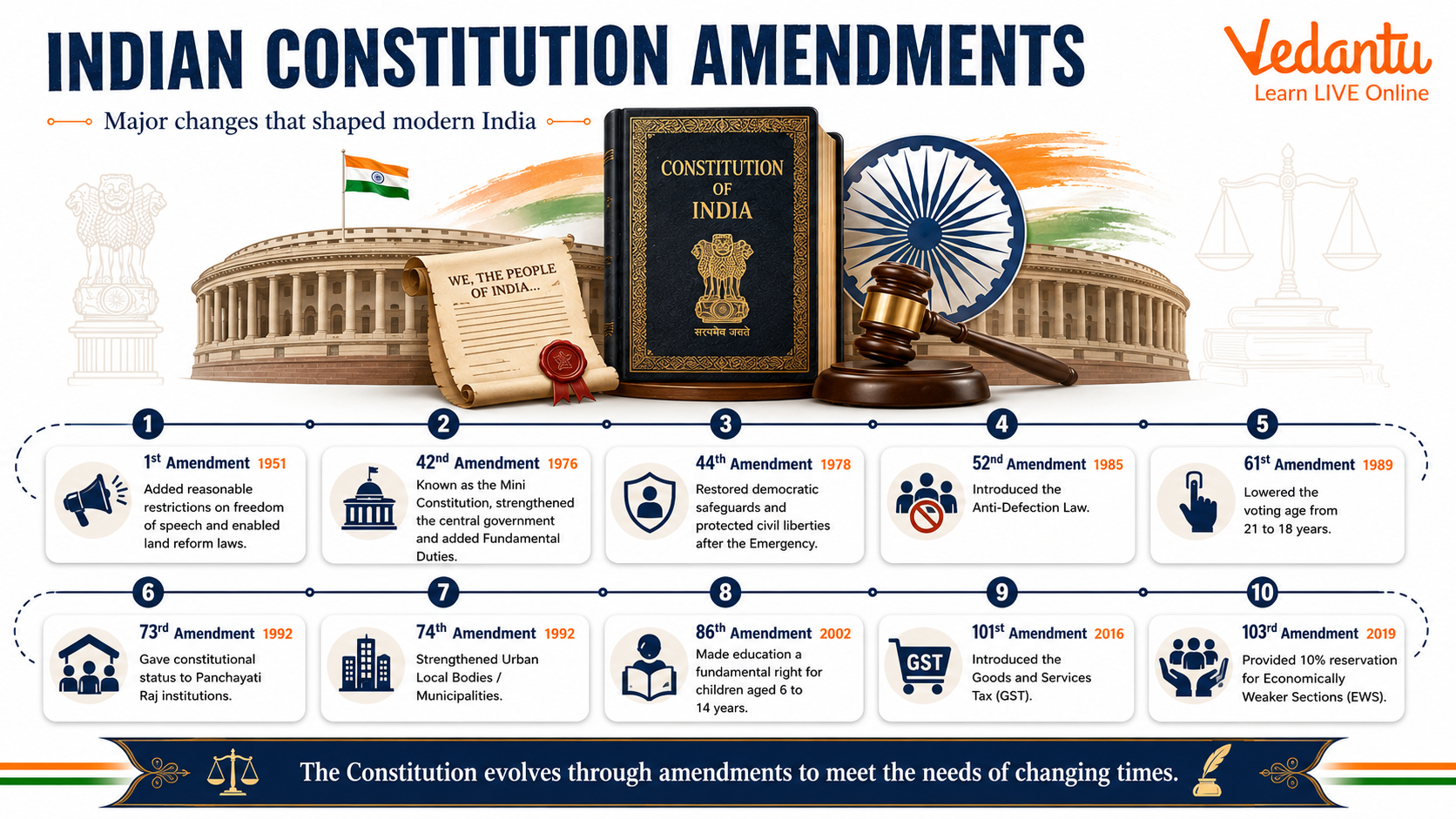
| Amendment | Year | Key Features |
|---|---|---|
| 1st Amendment | 1951 | Added Ninth Schedule and restricted Right to Property |
| 42nd Amendment | 1976 | Added words Socialist, Secular and Integrity to Preamble |
| 44th Amendment | 1978 | Removed Right to Property from Fundamental Rights |
| 73rd Amendment | 1992 | Provided Constitutional status to Panchayati Raj |
| 74th Amendment | 1992 | Provided Constitutional status to Urban Local Bodies |
| 86th Amendment | 2002 | Made education a Fundamental Right for 6 to 14 years |
| 101st Amendment | 2016 | Introduced Goods and Services Tax - GST |
These amendments significantly shaped the political and administrative structure of India. The 42nd Amendment is often called the Mini Constitution due to the extensive changes it introduced.
Basic Structure Doctrine
The Supreme Court introduced the Basic Structure Doctrine in the Kesavananda Bharati case of 1973. According to this doctrine, Parliament can amend any part of the Constitution but cannot alter its basic structure or essential features.
Elements of Basic Structure
- Supremacy of the Constitution.
- Republican and Democratic form of government.
- Secular character of the Constitution.
- Separation of powers.
- Judicial review.
- Federal character of the Constitution.
Significance of Constitutional Amendments
Constitutional Amendments play a crucial role in balancing continuity and change. They allow reforms while preserving core constitutional values.
- Help in socio-economic transformation.
- Strengthen democratic institutions.
- Reflect evolving public aspirations.
- Maintain balance between rigidity and flexibility.
Key Facts for Competitive Exams
- Article 368 deals with Constitutional Amendments.
- The Constitution has been amended more than 100 times.
- The 42nd Amendment is known as the Mini Constitution.
- The Basic Structure Doctrine limits Parliament’s amending power.
- Amendment bills can be introduced in either House of Parliament.
Conclusion
Indian Constitution Amendments ensure that the Constitution remains a living document capable of responding to new challenges and aspirations. While Parliament holds the power to amend, the Basic Structure Doctrine ensures that fundamental values remain protected. A clear understanding of Constitutional Amendments is essential for mastering Indian Polity and excelling in competitive examinations.
FAQs on Indian Constitution: How Amendments Are Made and Why They Matter
1. What are Constitutional Amendments in India?
Constitutional Amendments are formal changes made to the Indian Constitution under Article 368 to update laws and governance.
- They modify, add, or remove provisions of the Constitution.
- Ensure the Constitution remains flexible yet stable.
- Can affect Fundamental Rights, Directive Principles, federal structure, or other provisions.
- Commonly searched as: amendment procedure, change in Constitution, Article 368 process.
These amendments help India adapt to political, social, and economic changes.
2. How can the Indian Constitution be amended?
The Indian Constitution can be amended through three different procedures depending on the provision being changed.
- Simple Majority in Parliament (e.g., creation of new states).
- Special Majority under Article 368 (majority of total membership + two-thirds present and voting).
- Special Majority + Ratification by Half of State Legislatures (for federal matters like President’s election, Supreme Court powers).
This amendment procedure balances flexibility and rigidity in the Indian political system.
3. What is Article 368 of the Indian Constitution?
Article 368 defines the power and procedure of Parliament to amend the Constitution.
- Grants constituent power to Parliament.
- Specifies the special majority requirement.
- Allows amendment of most constitutional provisions.
- Subject to the Basic Structure Doctrine (as per Kesavananda Bharati case).
It is the key article governing Constitutional amendments in India.
4. What is the Basic Structure Doctrine?
The Basic Structure Doctrine limits Parliament’s power by protecting the core features of the Constitution.
- Established in Kesavananda Bharati v. State of Kerala (1973).
- Parliament cannot alter the basic structure.
- Includes features like Judicial Review, Federalism, Secularism, Democracy, Rule of Law.
This doctrine ensures that constitutional amendments do not destroy the fundamental identity of the Indian Constitution.
5. Which was the first Constitutional Amendment of India?
The First Constitutional Amendment Act, 1951 was the earliest amendment to the Indian Constitution.
- Added Article 15(4) for reservation policies.
- Introduced Ninth Schedule to protect land reform laws.
- Imposed reasonable restrictions on Freedom of Speech (Article 19).
It addressed early legal challenges related to Fundamental Rights and land reforms.
6. What is the 42nd Amendment Act, 1976?
The 42nd Amendment Act, 1976 is known as the Mini-Constitution due to its wide-ranging changes.
- Added words Socialist, Secular, Integrity to the Preamble.
- Strengthened Directive Principles of State Policy (DPSP).
- Curtailed powers of the judiciary.
- Extended the tenure of Lok Sabha from 5 to 6 years (later reversed).
It was enacted during the Emergency (1975-77) period.
7. What changes were made by the 44th Constitutional Amendment?
The 44th Amendment Act, 1978 restored democratic features after the Emergency.
- Replaced Right to Property as a Fundamental Right with a legal right (Article 300A).
- Restored Lok Sabha tenure to 5 years.
- Strengthened safeguards against misuse of National Emergency (Article 352).
It aimed to correct controversial provisions of the 42nd Amendment.
8. How many Constitutional Amendments have been made in India?
As of recent updates, more than 100 Constitutional Amendment Acts have been passed in India.
- The Constitution was adopted in 1950.
- Amendments reflect evolving governance needs.
- Frequently asked in competitive exams like UPSC, SSC, State PSC.
The large number highlights the flexible nature of the Indian Constitution.
9. Can Fundamental Rights be amended?
Yes, Fundamental Rights can be amended, but not beyond the Basic Structure limit.
- Parliament has amended Part III (Fundamental Rights) multiple times.
- Subject to Judicial Review by the Supreme Court.
- Cannot violate the Basic Structure Doctrine.
This balance protects citizens’ rights while allowing constitutional evolution.
10. What is the difference between Amendment and Revision of the Constitution?
An amendment modifies specific provisions, while a revision implies a complete overhaul of the Constitution.
- Amendment: Partial change under Article 368.
- Revision: Total rewriting (not practiced in India).
- India follows a system of incremental amendments instead of complete revision.
This approach maintains constitutional continuity and democratic stability.
