






How the Indian Collegium System Works in Appointing Supreme Court and High Court Judges
The Indian Collegium System is a mechanism used for the appointment and transfer of judges in the Supreme Court and High Courts of India. It plays a crucial role in maintaining the independence of the judiciary, which is a basic feature of the Indian Constitution. Although the Constitution does not explicitly mention the term "Collegium," the system evolved through a series of Supreme Court judgments known as the Judges Cases. Understanding how the Collegium System works is essential for students, competitive exam aspirants, and anyone interested in Indian polity and constitutional law.
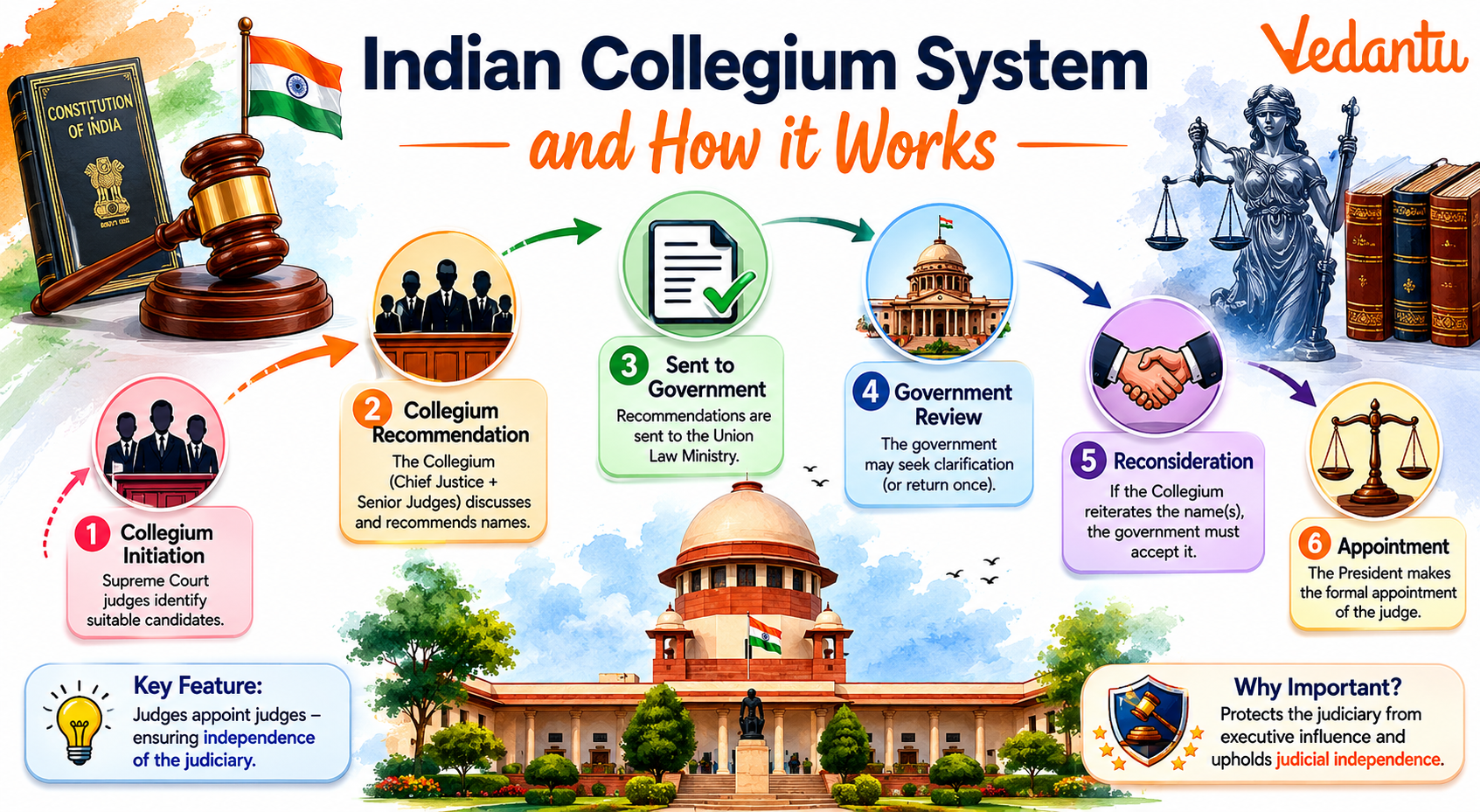
What is the Indian Collegium System?
The Collegium System is a group of senior judges of the Supreme Court that decides on the appointment and transfer of judges in higher courts. It was created through judicial interpretation and is not mentioned directly in the Constitution of India.
The system aims to ensure judicial independence by minimizing executive interference in the appointment process.
Constitutional Provisions Related to Judicial Appointments
The Constitution provides the framework for appointing judges, but it does not mention the Collegium System. The relevant Articles include:
- Article 124 - Appointment of Supreme Court judges
- Article 217 - Appointment of High Court judges
- Article 222 - Transfer of High Court judges
These Articles state that judges are appointed by the President of India after consultation with judges of the Supreme Court and High Courts. The interpretation of the word consultation led to the creation of the Collegium System.
Evolution of the Collegium System - The Three Judges Cases
First Judges Case (1981)
In S.P. Gupta vs Union of India, the Supreme Court held that the President had the final say in judicial appointments and consultation did not mean concurrence. This gave more power to the executive.
Second Judges Case (1993)
In Supreme Court Advocates on Record Association vs Union of India, the Court overruled the First Judges Case. It ruled that the Chief Justice of India, along with two senior-most judges, would have primacy in judicial appointments. This judgment created the Collegium System.
Third Judges Case (1998)
In a Presidential Reference, the Supreme Court expanded the Collegium to include the Chief Justice of India and four senior-most judges of the Supreme Court. This strengthened the system and clarified its functioning.
Composition of the Collegium
For Supreme Court Appointments
- Chief Justice of India (CJI)
- Four senior-most judges of the Supreme Court
For High Court Appointments
- Chief Justice of India
- Two senior-most judges of the Supreme Court
Additionally, the concerned High Court Collegium, consisting of the Chief Justice of the High Court and two senior-most judges of that court, also plays a role in recommending names.
How the Collegium System Works
The functioning of the Collegium involves multiple steps to ensure scrutiny and consultation.
- The High Court Collegium recommends names for appointment.
- The recommendation is sent to the state government and then to the Union Law Ministry.
- The Supreme Court Collegium reviews the names.
- If approved, the recommendation is sent to the President of India.
- The President appoints the judge officially.
If the government returns a recommendation for reconsideration and the Collegium reiterates it, the President is bound to appoint the recommended candidate.
Comparison Between Executive System and Collegium System
| Feature | Executive Dominance (Pre 1993) | Collegium System (Post 1993) |
|---|---|---|
| Final Authority | President and Council of Ministers | Chief Justice and Senior Judges |
| Judicial Independence | Relatively Limited | Strengthened |
| Transparency | Moderate | Often Criticized as Opaque |
The shift from executive dominance to the Collegium System was aimed at protecting the judiciary from political pressure and ensuring independence in appointments.
Advantages of the Collegium System
- Ensures judicial independence
- Reduces political interference
- Maintains separation of powers
- Encourages peer evaluation by senior judges
Criticisms of the Collegium System
- Lack of transparency in decision-making
- No formal criteria for selection
- Allegations of favoritism and nepotism
- Delays in judicial appointments
National Judicial Appointments Commission - NJAC
In 2014, Parliament passed the 99th Constitutional Amendment Act to replace the Collegium System with the National Judicial Appointments Commission. The NJAC included members from the judiciary, executive, and civil society.
However, in 2015, the Supreme Court struck down the NJAC as unconstitutional, stating that it violated the basic structure of the Constitution by affecting judicial independence. As a result, the Collegium System continues to function.
Importance of the Collegium System in Indian Democracy
The Collegium System is significant because it safeguards the independence of the judiciary, which is essential for protecting fundamental rights and maintaining the rule of law. An independent judiciary acts as a check on the legislature and executive.
Despite criticism, the system remains a key feature of India’s constitutional framework and continues to evolve through reforms and increased transparency measures.
Conclusion
The Indian Collegium System is a judicially created mechanism for appointing and transferring judges in higher courts. Developed through landmark judgments, it ensures judicial primacy in appointments to protect independence from executive influence. While it faces criticism for lack of transparency, it remains central to India’s democratic structure. For students and competitive exam aspirants, understanding its constitutional basis, evolution, functioning, advantages, and criticisms is essential for mastering Indian Polity.
FAQs on Indian Collegium System and Its Role in Judicial Appointments
1. What is the Indian Collegium System?
The Indian Collegium System is a method of appointing and transferring judges in the higher judiciary through judicial consultation rather than executive control.
• It governs appointments to the Supreme Court of India and High Courts.
• It is led by the Chief Justice of India (CJI) and senior-most judges.
• It evolved through the Three Judges Cases (1982, 1993, 1998).
• It ensures judicial independence, separation of powers, and constitutional balance.
People also ask: Is Collegium mentioned in the Constitution? How are judges appointed in India?
2. How does the Collegium System work in India?
The Collegium System works through internal judicial recommendations for appointing and transferring judges.
• The CJI and four senior-most Supreme Court judges form the Supreme Court Collegium.
• They recommend names for appointment and transfer.
• The recommendation is sent to the President of India via the Law Ministry.
• The government can return a name once for reconsideration, but if reiterated, it must accept it.
Semantic keywords: judicial appointment process, Supreme Court judge selection, High Court transfers.
3. Is the Collegium System mentioned in the Indian Constitution?
The Collegium System is not explicitly mentioned in the Indian Constitution.
• Articles 124 and 217 discuss judicial appointments.
• The system developed through Supreme Court judgments, especially the Second Judges Case (1993).
• It replaced the earlier system where the executive had greater influence.
People also search: Constitutional provisions for judges, evolution of judicial appointments in India.
4. Who are the members of the Supreme Court Collegium?
The Supreme Court Collegium consists of the top five senior-most judges of the Supreme Court.
• The Chief Justice of India (CJI) – Head of the Collegium.
• Four senior-most Supreme Court judges.
• For High Court appointments, the respective High Court Collegium includes the Chief Justice of that High Court and two senior-most judges.
Key terms: judicial hierarchy, seniority principle, higher judiciary.
5. What are the Three Judges Cases related to the Collegium System?
The Three Judges Cases shaped the structure of the Indian Collegium System.
• First Judges Case (1982): Executive had primacy in appointments.
• Second Judges Case (1993): Judiciary gained primacy; Collegium created.
• Third Judges Case (1998): Expanded Collegium to five members.
These cases strengthened judicial independence and limited executive interference.
6. What are the advantages of the Collegium System?
The Collegium System ensures judicial independence and protects the judiciary from political pressure.
• Maintains separation of powers.
• Reduces executive dominance.
• Protects constitutional values and rule of law.
• Promotes merit-based judicial appointments (in principle).
People also ask: Why is judicial independence important in India?
7. What are the criticisms of the Collegium System?
The Collegium System is criticized for lack of transparency and accountability.
• Decisions are often made behind closed doors.
• No formal selection criteria publicly defined.
• Allegations of favoritism and lack of diversity.
• Delays in judicial appointments.
Semantic keywords: judicial reforms, transparency in judiciary, appointment controversy.
8. What was the NJAC and why was it struck down?
The National Judicial Appointments Commission (NJAC) was a proposed body to replace the Collegium System.
• Established through the 99th Constitutional Amendment Act, 2014.
• Included members from judiciary, executive, and civil society.
• In 2015, the Supreme Court struck it down as unconstitutional.
• The Court ruled it violated judicial independence, a part of the Basic Structure Doctrine.
People also search: NJAC vs Collegium, Basic Structure of Constitution.
9. How are High Court judges appointed under the Collegium System?
The appointment of High Court judges follows a multi-level Collegium process.
• Initiated by the High Court Collegium.
• Reviewed by the Supreme Court Collegium.
• Sent to the President of India for final approval.
• Transfers are also decided by the Supreme Court Collegium.
Key concepts: Article 217, judicial transfer policy, constitutional appointment procedure.
10. Why is the Collegium System important for the Indian judiciary?
The Collegium System is important because it safeguards the independence and integrity of the Indian judiciary.
• Prevents political interference in judge appointments.
• Upholds the rule of law.
• Protects the Basic Structure of the Constitution.
• Ensures checks and balances between judiciary and executive.
People also ask: Importance of judicial independence, role of Supreme Court in democracy.
