






Famous Leaders and Reformers in Indian History
Important Personalities in Indian History play a crucial role in shaping the political, social, cultural, and economic foundations of India. From ancient rulers and spiritual leaders to freedom fighters and modern reformers, these individuals have influenced the course of the nation through their vision, leadership, and sacrifices. This topic is highly significant for students, competitive exam aspirants, and general readers as it frequently appears in examinations and enhances overall General Knowledge. Understanding their contributions helps in connecting historical events with present-day India.
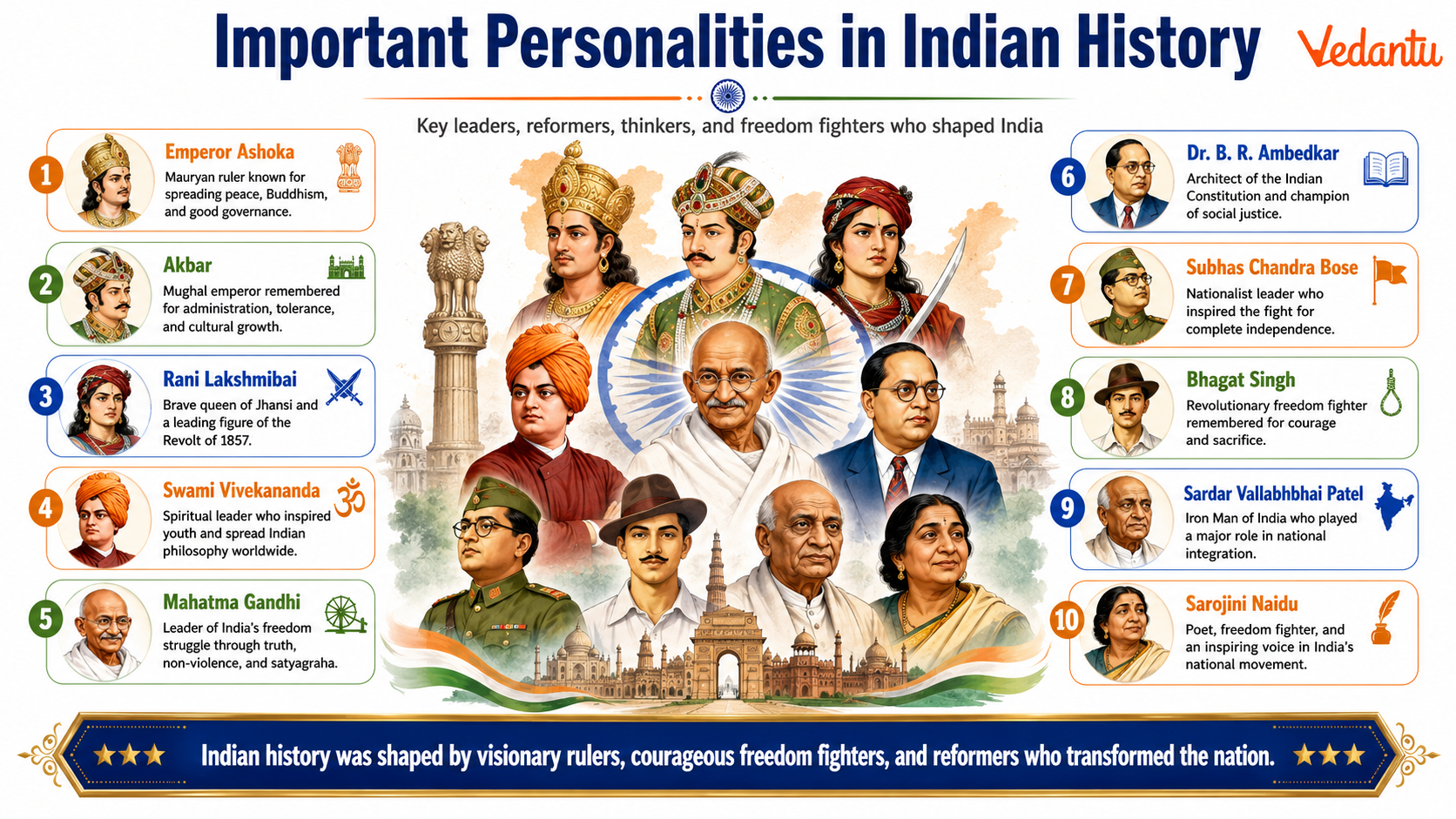
Ancient Indian Personalities
Ancient India witnessed the rise of powerful rulers, philosophers, and spiritual leaders who laid the foundation of Indian civilization. Their teachings and governance models continue to influence society.
- Chandragupta Maurya - Founder of the Maurya Empire, established one of the largest empires in ancient India.
- Ashoka the Great - Promoted Buddhism and the policy of Dhamma after the Kalinga War.
- Gautama Buddha - Founder of Buddhism, preached the Middle Path and Four Noble Truths.
- Mahavira - 24th Tirthankara of Jainism, emphasized non-violence and truth.
- Aryabhata - Renowned mathematician and astronomer, contributed to the concept of zero and astronomy.
Medieval Indian Personalities
The medieval period saw the emergence of influential rulers, saints, and reformers who shaped India’s political and cultural landscape.
- Akbar - Mughal emperor known for religious tolerance and administrative reforms.
- Shivaji Maharaj - Founder of the Maratha Empire, known for his guerrilla warfare tactics.
- Guru Nanak Dev Ji - Founder of Sikhism, preached equality and devotion to one God.
- Rani Durgavati - Brave Gond queen who resisted Mughal expansion.
- Krishnadevaraya - Prominent ruler of the Vijayanagara Empire, patron of art and literature.
Modern Indian Personalities and Freedom Fighters
Modern Indian history is marked by social reformers and freedom fighters who fought against British colonial rule and worked for social transformation.
- Mahatma Gandhi - Leader of the Indian freedom movement, followed the principles of non-violence and Satyagraha.
- Jawaharlal Nehru - First Prime Minister of India, played a key role in shaping modern India.
- Subhas Chandra Bose - Founded the Indian National Army to fight British rule.
- Bhagat Singh - Revolutionary freedom fighter who inspired youth with his courage.
- Dr. B.R. Ambedkar - Architect of the Indian Constitution and social reformer.
- Rani Lakshmibai - Queen of Jhansi, key leader in the Revolt of 1857.
Important Personalities in Social and Cultural Reform
Social reformers played a significant role in eradicating social evils and promoting education, equality, and women’s rights in India.
- Raja Ram Mohan Roy - Founder of the Brahmo Samaj, campaigned against Sati and social evils.
- Ishwar Chandra Vidyasagar - Promoted widow remarriage and women’s education.
- Swami Vivekananda - Spread Indian philosophy and Vedanta in the West.
- Jyotirao Phule - Worked for the upliftment of lower castes and women.
- Savitribai Phule - Pioneer of women’s education in India.
Summary of Important Personalities in Indian History
| Personality | Period | Major Contribution |
|---|---|---|
| Ashoka | Ancient | Spread of Buddhism and Dhamma |
| Akbar | Medieval | Religious tolerance and administration |
| Mahatma Gandhi | Modern | Non-violent freedom struggle |
| Dr. B.R. Ambedkar | Modern | Drafting of Indian Constitution |
The table above provides a quick overview of some of the most influential personalities across different historical periods. Each of these individuals contributed significantly to India’s political structure, cultural heritage, or social reform movements.
Why This Topic is Important for GK and Competitive Exams
Questions about important personalities in Indian history are frequently asked in competitive exams such as UPSC, SSC, State PSC, Railways, and various school-level examinations. Candidates are often required to match personalities with their contributions, identify chronological order, or answer fact-based questions about their achievements.
- Focus on timelines and major events associated with each personality.
- Remember key reforms, movements, and achievements.
- Understand the historical context in which they worked.
- Revise through summary tables and short notes for quick recall.
Conclusion
Important Personalities in Indian History have left a lasting legacy that continues to shape the nation. From ancient emperors and spiritual leaders to freedom fighters and reformers, their contributions have built the foundation of modern India. A clear understanding of their roles and achievements not only strengthens General Knowledge but also deepens appreciation for India’s rich historical heritage. Regular revision and structured study of these personalities will help students perform well in academic and competitive examinations.
FAQs on Important Personalities of Indian History: Complete Overview for Students
1. Who are the most important personalities in Indian history?
The most important personalities in Indian history are leaders, reformers, and revolutionaries who shaped India’s political, social, and cultural development.
• Mahatma Gandhi – Leader of the Indian National Movement and advocate of non-violence
• Jawaharlal Nehru – First Prime Minister of independent India
• Subhas Chandra Bose – Founder of the Indian National Army (INA)
• Dr. B.R. Ambedkar – Architect of the Indian Constitution
• Sardar Vallabhbhai Patel – Iron Man of India and unifier of princely states
These historical figures are frequently asked about in competitive exams, GK quizzes, and UPSC preparation.
2. Why is Mahatma Gandhi called the Father of the Nation?
Mahatma Gandhi is called the Father of the Nation because he led India’s freedom struggle through non-violent resistance.
• Introduced Satyagraha (truth-force) and Ahimsa (non-violence)
• Led major movements like the Non-Cooperation Movement, Dandi March, and Quit India Movement
• United people across caste, religion, and region
His leadership in the Indian Independence Movement made him one of the most respected global leaders.
3. What was the contribution of Dr. B.R. Ambedkar to Indian history?
Dr. B.R. Ambedkar played a crucial role in drafting the Indian Constitution and promoting social justice.
• Chairman of the Drafting Committee of the Constitution
• Championed the rights of Dalits and marginalized communities
• Advocated for equality, education, and fundamental rights
He is known as the Architect of the Indian Constitution and remains a key personality in modern Indian history.
4. Who was Subhas Chandra Bose and why is he important?
Subhas Chandra Bose was a revolutionary nationalist leader who sought independence through armed struggle.
• Founded the Indian National Army (Azad Hind Fauj)
• Gave the slogan “Give me blood, and I will give you freedom”
• Formed the Provisional Government of Free India
Popularly known as Netaji, he remains a significant figure in India’s freedom struggle and modern GK topics.
5. What role did Jawaharlal Nehru play in independent India?
Jawaharlal Nehru was the first Prime Minister of independent India and shaped its early governance and foreign policy.
• Promoted democracy, secularism, and socialism
• Initiated Five-Year Plans for economic development
• Advocated the Non-Aligned Movement (NAM)
His policies laid the foundation of modern India, making him a key figure in post-independence Indian history.
6. Why is Sardar Vallabhbhai Patel known as the Iron Man of India?
Sardar Vallabhbhai Patel is called the Iron Man of India for integrating over 560 princely states into the Indian Union.
• Led the political integration after 1947 Independence
• Served as India’s first Deputy Prime Minister and Home Minister
• Strengthened national unity and internal security
His firm leadership ensured the territorial consolidation of modern India.
7. Who was Rani Lakshmibai and what was her role in 1857?
Rani Lakshmibai was a brave queen who played a major role in the Revolt of 1857 against British rule.
• Queen of Jhansi
• Fought against the Doctrine of Lapse policy
• Became a symbol of courage and patriotism
She is remembered as one of the greatest female warriors in Indian history and a hero of the First War of Independence.
8. What were the achievements of Emperor Ashoka?
Emperor Ashoka was a Mauryan ruler known for spreading Buddhism and promoting peace.
• Ruled during the Mauryan Empire (3rd century BCE)
• Converted to Buddhism after the Kalinga War
• Promoted Dhamma (moral law) and built stupas and pillars
His reign marks a significant period in ancient Indian history and cultural development.
9. Why is Akbar considered a great Mughal ruler?
Akbar is considered one of the greatest Mughal emperors due to his administrative reforms and religious tolerance.
• Introduced the policy of Sulh-i-Kul (universal tolerance)
• Strengthened the Mansabdari system
• Expanded and consolidated the Mughal Empire
His governance and inclusive policies made him a significant personality in medieval Indian history.
10. How do important personalities influence Indian history and society?
Important personalities in Indian history shaped the nation’s political structure, social reforms, and cultural identity.
• Led the freedom struggle and independence movement
• Drafted the Indian Constitution and democratic framework
• Promoted social reforms like equality, education, and women’s empowerment
• Influenced global peace, diplomacy, and human rights movements
These historical leaders continue to impact GK studies, competitive exams, and national development discussions.
